New to Rust? Grab our free Rust for Beginners eBook Get it free →
What is Ethereum (ETH)?

Ethereum is a public blockchain that keeps a shared record of accounts and can run programs called smart contracts. ETH, also called ether, is the network’s native asset. It pays the fee for transactions and contract calls, but Ethereum describes the network around it.
Ethereum and ether are different things
Ethereum is the network. It defines how accounts send signed transactions, how nodes process them, and how the network agrees on the resulting state.
| Term | What it refers to | Why it matters |
|---|---|---|
| Ethereum | The blockchain network and its rules | It records transactions and supports smart contracts. |
| Ether or ETH | The native asset of Ethereum | It is used to pay transaction fees and can be transferred between accounts. |
| Gas | A measure of computational work | It lets the network price transfers and contract execution. |
The Ethereum Foundation overview describes Ethereum as a blockchain for applications and infrastructure. Its ether documentation separates the network from the asset that pays fees.
How an Ethereum transaction changes state
A transaction is a signed instruction from an account. It can transfer ETH to another account or request that a smart contract change its stored data.
Accounts sign transactions
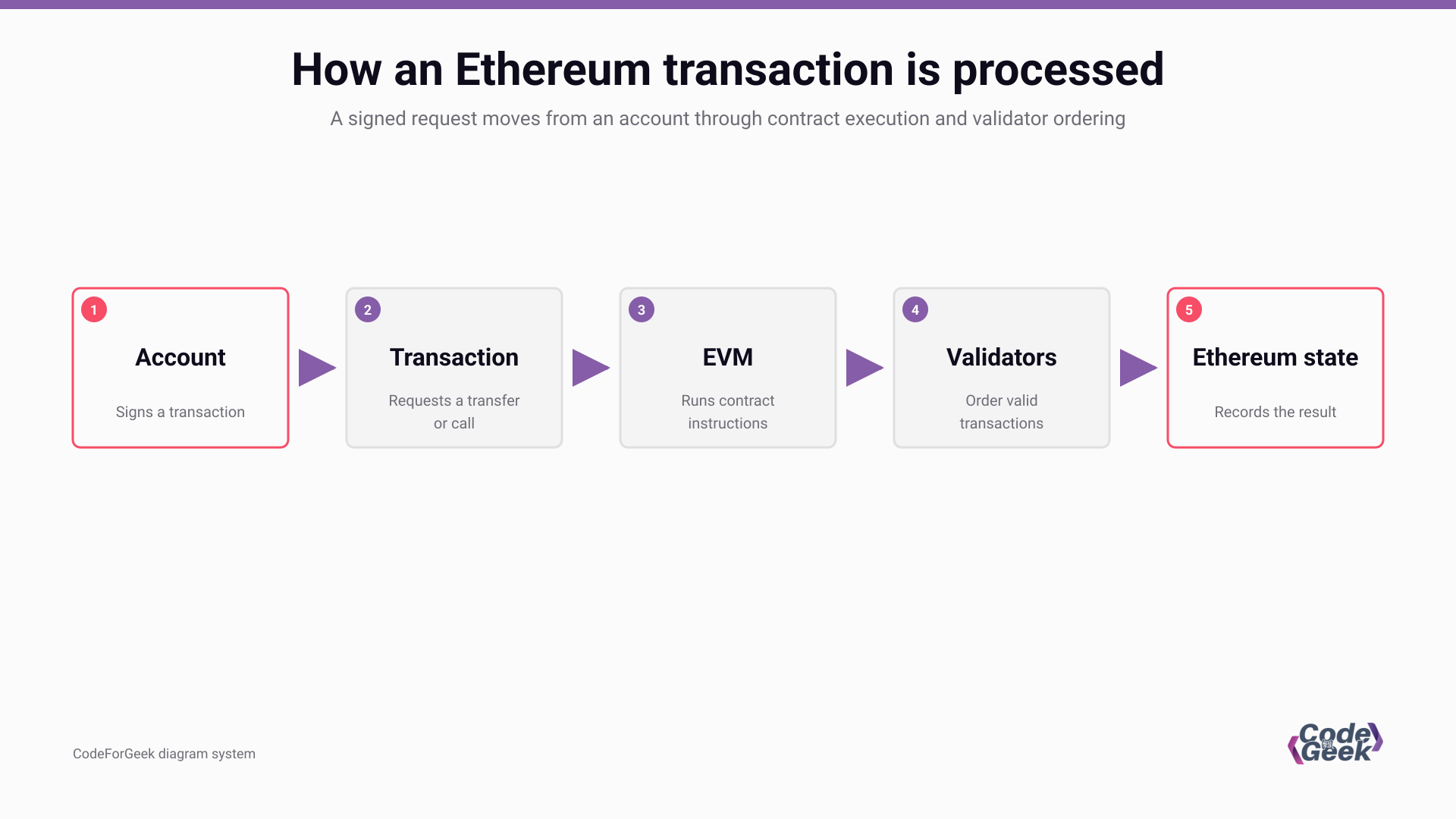
Ethereum has user-controlled accounts and contract accounts. A user-controlled account signs a transaction with its private key, then broadcasts that transaction to the network. A contract account has code and stored state, and it runs only when a transaction calls it.
Private keys control access to a user-controlled account. Do not share a private key or recovery phrase, and check the network and recipient before approving a transfer. The Ethereum accounts reference explains the account types and key-pair model in more detail.
Smart contracts run on the Ethereum Virtual Machine
A smart contract is code stored at an Ethereum address. When a transaction calls that contract, Ethereum nodes execute its instructions in the Ethereum Virtual Machine, or EVM, and calculate the resulting state change.
A contract call can update a token balance, record a vote, or apply another rule that the contract defines, and it can fail after consuming some gas because the network performed work before it stopped.
Validators order transactions into blocks
Ethereum Mainnet uses proof of stake, where validators check and propose blocks and the network follows the ordered chain of valid blocks when it updates account balances and contract storage.
The diagram simplifies a larger distributed process into the handoffs that matter for a first read, and each block has an ordered transaction history that records an accepted transaction.
What gas pays for
Gas measures the computational work a transaction asks the network to perform. A plain ETH transfer uses less work than a contract call that reads or changes several pieces of storage.
The fee is paid in ETH. Ethereum documents base fees, priority fees, and gas limits, so the amount you pay depends on the transaction and its fee settings rather than on a fixed network price.
Ethereum and Bitcoin solve different jobs
Bitcoin and Ethereum are both public blockchains, but their main software models differ. Bitcoin focuses on a digital asset and its transfer rules. Ethereum adds a general-purpose contract environment that applications can call through transactions.
That difference does not make one network a substitute for the other. It tells you what to inspect next. If you need the shared-ledger foundation first, read Introduction to Blockchain before digging into Ethereum transactions.
A safe way to start learning Ethereum
Start by reading a transaction in a block explorer without connecting a wallet. Identify the sender, recipient or contract address, network, transferred value, and fee before treating the page as evidence of what happened.
When you later use a wallet, confirm the network before sending funds or signing a contract request. Similar-looking addresses and the wrong network can create an irreversible mistake, and this overview does not replace custody or investment advice.
Frequently asked questions
These answers keep the network, the ETH asset, and transaction fees separate.
Is Ethereum the same as ETH?
Ethereum is the network. ETH, also called ether, is its native asset and the unit used to pay transaction fees.
Does Ethereum still use mining?
Ethereum Mainnet uses proof of stake. Validators that stake ETH participate in proposing and checking blocks.
What does gas mean on Ethereum?
Gas measures the computational work for a transaction or contract call. The fee paid depends on the gas used and the fee settings attached to that transaction.