New to Rust? Grab our free Rust for Beginners eBook Get it free →
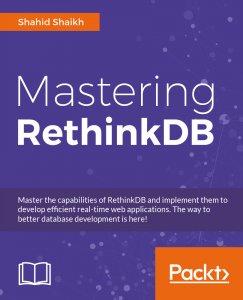
Mastering RethinkDB Book: Coverage, Prerequisites, and Buying Guide


Mastering RethinkDB is a Packt title by Shahid Shaikh for developers who want a deeper treatment of RethinkDB than a quick setup walkthrough provides. Use this page to decide whether its focus matches your work, then verify active implementation details in the RethinkDB documentation.

What Mastering RethinkDB is
Mastering RethinkDB is a technical book about working with RethinkDB as a document database for applications that need live updates, with print ISBN 9781786461070 and a digital-edition ISBN of 9781786468628 listed by book sellers.
The book is a structured learning resource rather than a replacement for project documentation, because a database project depends on the server version, driver behavior, deployment environment, and operational requirements you use today.
The publisher describes the material as covering RethinkDB architecture, data modeling, ReQL queries, Node.js application work, deployment, and live application examples. Those topics make the book most useful when you already know why you are considering RethinkDB and want a longer explanation of its design choices.
What the book covers
The original chapter list moves from the database model and query language into application development, administration, deployment, and integrations, following the way a data model shapes queries and query behavior shapes application and operations decisions.
The book describes ten chapters across 314 pages, which is an overview of its published scope rather than a substitute for checking the contents page from the seller you choose.
Data modeling and ReQL
RethinkDB stores JSON documents, so data modeling begins with the documents your application needs to read and change, and a structured treatment of models, relationships, indexes, and query design helps when you need more than a list of API calls.
ReQL is the query language used by RethinkDB drivers. The book’s ReQL coverage can help you understand how table operations, filters, joins, aggregations, and transformations relate to the data model, while the JavaScript ReQL command reference remains the right place to confirm a command’s current signature and behavior.
Read the longer explanation when you need design reasoning, then check the command reference before placing code in a project.
Changefeeds and application design
Changefeeds let an application subscribe to changes from a table, a document, or a query result, which makes them useful for dashboards, polling systems, collaboration features, and other workflows that must react when stored data changes.
Your service still needs connection handling, authorization, backpressure decisions, reconnection behavior, and a way to turn database events into messages your interface can use.
The book’s coverage of changefeeds and full-stack development can give you the conceptual bridge between a ReQL query and an application feature, while the official documentation confirms a driver API, cursor behavior, or an error boundary in the version you run.
Operations, deployment, and scale
The later chapters cover administration, performance tuning, clustering, replication, sharding, failover, backup, deployment, and extensions, because database design does not end when the first query works.
Operational guidance ages faster than data-model explanations, so use the book to frame the questions you need to answer and current project documentation to choose commands, services, security controls, and maintenance procedures.
The same boundary applies to integrations such as search engines, queues, and application frameworks. An integration chapter can explain the role a component plays, but package compatibility and deployment configuration must come from the active documentation for that component.
Who should choose this book
This RethinkDB book suits you if you already understand basic database concepts and want a connected explanation of RethinkDB rather than isolated examples. You should be comfortable reading JavaScript and JSON, because the book’s application material uses Node.js and its database examples assume you can follow queries and data structures.
It is a stronger fit when you are evaluating an existing RethinkDB codebase, building a feature around changefeeds, or studying how its document model affects application design. The book gives you a path through the subject instead of making you assemble architecture, query language, administration, and application topics from unrelated pages.
Start elsewhere if you need only a current installation command, a current driver compatibility answer, or a narrow fix for an error. The official documentation index can route you to focused material faster for those tasks.
What to check before buying
Confirm the edition before you pay. The print ISBN is 9781786461070, while digital listings may use 9781786468628. ISBNs help you compare the same title across sellers without relying on a shortened product name or an old cover image.
Check the format, regional availability, price, and refund terms on the seller page you intend to use. Publisher and marketplace pages can differ by country and format, and a listing can change without changing the book’s title.
Read the contents page if the seller provides one. Look for the technical theme you need, such as data modeling, ReQL, changefeeds, operations, or Node.js application design, rather than buying on the assumption that every database topic appears in equal depth.
Set the book beside your project requirement. If you are choosing a database for a new system, write down the questions that affect your decision: data shape, query requirements, update delivery, operations, backups, security, and the drivers your application needs. A book can help you reason through those questions, but it cannot choose them for you.
Use current documentation beside the book
Mastering RethinkDB was published in 2016, so it should not be your only source for implementation work. The underlying concepts can still help, but commands, package support, deployment options, and operational advice must be checked against the project’s current sources.
Keep the book for the explanation of a concept and use the official documentation for the behavior you are about to depend on. For JavaScript work, start with the ReQL command reference before you copy a query into an application.
That approach also gives you a better debugging path. Use the book to identify the layer involved, such as the data model, query, changefeed, or deployment design, then use current documentation and your project logs to verify the behavior you see.
How to use the book with a project
Start with a small question from your project instead of reading for completion alone, such as how a document shape affects a query or how a changefeed reaches an interface.
Read the chapter that gives that question its wider context, then write down the assumptions it makes about the server, driver, deployment, and application boundary.
Next, compare each assumption with your running environment, because a current driver may expose a different connection method, a package may have different support expectations, and a managed service may limit network access or backups.
Build a small proof in an isolated development environment before moving the idea into a larger service, using a data model, one query, or an event flow that shows how a write becomes an update your application can handle.
Keep the proof narrow enough that a failure identifies the layer that needs attention, and inspect the data model and command arguments before assuming application transport is at fault when a query does not return the expected document.
Changefeeds need an extra check because they remain open while your application runs, so decide what happens when a connection closes, a consumer falls behind, an event is duplicated, or a user loses permission to receive an update.
Translate broad operations topics such as replication, failover, backup, and monitoring into a specific service owner, recovery target, access control, and test before deployment.
Do not use a historical code example as evidence that a package will work in your environment, and verify its dependencies and API calls against documentation for the versions you use.
This reading method helps you understand why a design exists while current sources and a small proof decide whether the design fits the system you are building.
Keep notes that connect the explanation to a decision you must make by naming the document fields you will store, the query result you need, the event that should trigger an update, and the condition that should stop or retry processing.
Review those notes with the people who own application and operations work, because they can expose an assumption that a book chapter cannot know, such as connection duration, backup storage, or the service that handles access checks.
When the project changes, revisit the current documentation before extending the design so a useful technical reference does not become a source of unverified deployment instructions.
Use each completed proof to update the project record. A short record of the chosen query, expected event, observed result, recovery behavior, and specific source receipt gives the next engineer a testable starting point.
Where to get the book
The publisher product page is the most direct starting point. View Mastering RethinkDB on Packt.
Check the ISBN, format, seller terms, and contents before purchasing. If the book matches the questions your RethinkDB project raises, use it for the connected explanation and keep the official documentation open for the implementation details that must match your environment.