New to Rust? Grab our free Rust for Beginners eBook Get it free →
How Crypto Scammers use Fake Websites

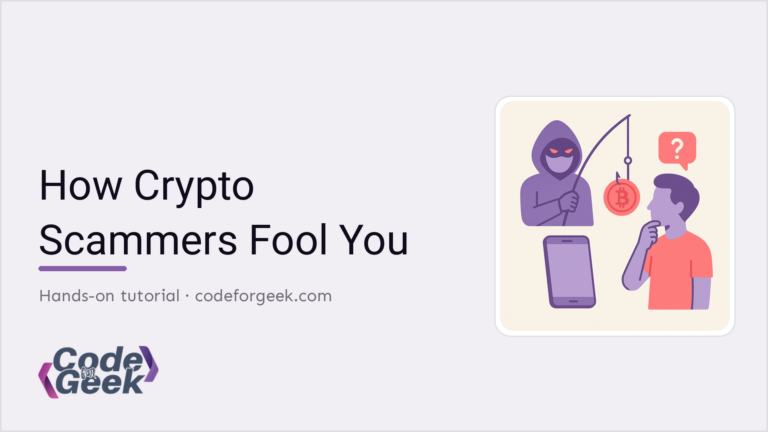
Crypto scammers use fake websites that look exactly like Coinbase, MetaMask, or Kraken to steal wallets and credentials. The clones rank in Google search results, run convincing live-chat “support,” and trick even careful users into handing over seed phrases or approving malicious transactions. Below is how the fake-website scam works today, plus the checks that keep your crypto safe.
How the fake-website scam works
The attack follows a predictable sequence. A scammer copies the design, logo, and layout of an established exchange or wallet, hosts it on a domain one character away from the original, then pushes it in front of you through search ads, sponsored links, or messages on Telegram, Discord, and X. You land on the clone, type your password or seed phrase, and the funds are gone within minutes.
Blockchain transactions cannot be reversed. When a bank drains your account, you can dispute the transfer, but a crypto transaction confirmed on-chain has no support desk to call. That asymmetry is why scammers invest so much effort in the moment of deception rather than the theft itself.
Modern versions add wallet drainers: scripts that ask you to connect your wallet and sign a permission. Nothing looks stolen at first. Later, the drainer moves out every token the approval covers.
Swap approvals are a common drain vector, so it helps to understand what you are approving. Read how token swaps work before signing anything, or start with what tokens represent in ChatGPT as an analogy.
How scammers get fake sites to the top of search
In the 2022 wave of attacks documented by Chainalysis, scammers built clones of Coinbase, Kraken, MetaMask, and Gemini on Google Sites, then used keyword-stuffed pages and cross-linked content to outrank legitimate domains. A fake Kraken page ranked above Kraken’s own Twitter account for the search term “Kraken wallet.” Google removed many of the sites, but new ones appeared as fast as takedowns landed.
The tactic persists because paid search ads still let anyone bid on brand names. Check any sponsored result carefully before clicking: the display URL can show “coinbase.com” while the actual destination is a different domain entirely.
Live chat phishing
Fake sites often include a chat widget staffed by a scammer posing as customer support. The conversation builds trust, then pivots to a request for your phone number, a verification code, or remote access to your device.
No legitimate platform asks for any of these. The request is the tell itself.
Red flags of a fake crypto website
- The domain differs from the official one by a letter, hyphen, or extension (coinbase.support instead of coinbase.com).
- The site came from a sponsored search result, a Telegram group, a Discord DM, or a QR code rather than your bookmark.
- The page demands urgency: “verify your wallet now,” “claim rewards before expiry,” “account suspension pending.”
- A chat agent asks for your seed phrase, passwords, 2FA codes, phone number, or remote access.
- Connecting your wallet triggers approval requests you did not expect.
How to protect yourself
Type the official URL yourself or use a saved bookmark instead of clicking search results. No legitimate exchange, wallet, or support team will ever ask for your seed phrase, 2FA code, or a transfer to an external address. Treat every such request as a confirmed scam.
Before signing any transaction, read what permissions you grant. A swap should ask only for the swap, and unlimited token access with no clear reason deserves an instant rejection.
Hardware wallets add a second gate because the device displays and confirms each transaction independently of the browser.
Keep large holdings off hot wallets entirely. If you are newer to the space, our introduction to blockchain covers how on-chain transfers settle without intermediaries, which is precisely why recovery is impossible after a scam transfer confirms.
Final words
Fake crypto websites work because they imitate trust faster than most people verify it. Bookmark official domains, refuse credential requests, and review every wallet signature before confirming.
Those habits defeat most of these scams on their own. To go deeper on the underlying technology, see how crypto mining secures networks or how Node.js implements cryptographic primitives in its built-in crypto module.