New to Rust? Grab our free Rust for Beginners eBook Get it free →
Crypto Mining: How Proof of Work, Pools, and Profitability Work

Crypto mining is the proof-of-work process that gives a network a costly way to choose a valid next block. I ran the small SHA-256 search in this post to show the repeated hash attempts behind that rule, then separated that mechanism from the hardware and operating costs that determine whether mining makes sense for you.
What crypto mining does
On a proof-of-work blockchain, miners assemble pending transactions into a candidate block and search for a block-header hash that satisfies the network target. A valid candidate can be broadcast for other nodes to validate and add to the chain.
Mining is not a button that creates money. It is a competition to propose a valid block under rules that every node can check, which is why it connects transaction processing with network security.
Proof of work selects a block producer
Bitcoin’s developer documentation describes mining software building a block template, creating a block header, and sending that header with a target threshold to specialized mining hardware. The hardware tries many candidate values because each hash attempt has only a small chance of landing below the target.
The first valid block does not bypass transaction rules. Nodes still verify the transactions, the block structure, and the proof of work before accepting it. Read Introduction to Blockchain first if block links, hashes, and distributed validation are unfamiliar.
Not every cryptocurrency uses mining
Mining applies to proof-of-work networks, while other networks use different consensus methods. You cannot assume that holding a coin lets you mine it or that a mining rig supports every cryptocurrency.
Start with the network’s own documentation before choosing equipment because its consensus method, algorithm, reward rules, and software requirements decide what work a device can perform.
From transaction to accepted block
A miner begins with candidate transactions and builds a block header that commits to the block. It then changes fields such as a nonce and hashes again until the output meets the target.
A shorter target means fewer hashes qualify, so the expected amount of work rises. Bitcoin adjusts difficulty as part of keeping block production near its intended schedule.
The target makes successful hashes rare
A hash function returns an output that looks unrelated to its input. Miners cannot calculate a winning nonce directly, so they test candidates until one produces an output below the target threshold.
Finding a qualifying hash takes repeated work, while a node can verify the submitted header with a hash calculation.
Pools reduce payout variance
Solo mining can leave a small operator waiting a long time for a block. A mining pool coordinates work from many participants and pays according to its published payout method and accepted shares, which are easier targets used to measure contributed work.
Before connecting a machine, read the pool’s payout formula, minimum withdrawal amount, fee, supported algorithm, account security options, and withdrawal rules.
Hardware and a practical starting point
Bitcoin mining uses specialized application-specific integrated circuit hardware, often shortened to ASIC. A desktop CPU or gaming GPU can demonstrate hashing, but it is not a competitive substitute for purpose-built Bitcoin hardware.
The operating setup also needs a compatible wallet, pool endpoint if you use one, stable networking, ventilation, electrical capacity, and a plan for monitoring failures.
Choose hardware by efficiency, not a legacy model list
Compare a device’s algorithm support, hash rate, electrical draw, efficiency, purchase price, warranty, noise, and cooling needs against your local constraints. Hardware rankings and daily revenue move with difficulty, fees, market prices, and operating conditions, so a fixed list of winners would mislead you.
Check that the device fits the electrical circuit and the room because a high draw can require work by a qualified electrician, while heat and fan noise can rule out an indoor location.
A pool, wallet, and operating plan come before a purchase
Create a wallet address that supports the network you plan to mine, secure its recovery material offline, and confirm the pool’s address format from its documentation. Do not reuse exchange deposit details where a pool asks for a self-custodied payout address without first checking the exchange policy.
Record your electricity price per kilowatt-hour, device draw in watts, pool fee, and expected downtime to turn a product page into an operating decision.
Check profitability before buying hardware
Profitability is a calculation, not a promise, because an estimate must account for expected mining revenue, electricity cost, pool fees, hardware cost, cooling, repairs, taxes, and changing network conditions.
Use a calculator that lets you enter the exact model, hash rate, device draw, electricity price, and pool fee, then run a pessimistic case with lower revenue or higher difficulty before committing money.
Security, electricity, and heat are part of the decision
Download mining software only from a project or vendor’s verified distribution channel, enable multifactor authentication where a service offers it, and treat any request for a wallet recovery phrase as a compromise attempt.
Fake mining dashboards and lookalike pool sites are common enough to deserve a deliberate check. How Crypto Scammers Use Fake Websites explains the URL, login, and payment signals worth checking before you share credentials or send funds.
Because electricity becomes heat, make cooling, airflow, circuit capacity, noise, and local rules part of the initial feasibility test.
Run a small proof-of-work search in Python
This example searches for a SHA-256 digest beginning with four zeroes. It is a teaching artifact, not a Bitcoin miner, because it has no peer-to-peer network, transaction validation, block template, difficulty adjustment, or specialized hardware.
from hashlib import sha256

prefix = "0000"
nonce = 0

while True:
    candidate = f"CodeForGeek block|{nonce}".encode()
    digest = sha256(candidate).hexdigest()
    if digest.startswith(prefix):
        print(f"nonce={nonce}")
        print(f"hash={digest}")
        break
    nonce += 1
Save the code as pow_demo.py and run the following command from the same directory. The nonce can differ if you change the input string or target prefix.
python3 pow_demo.py
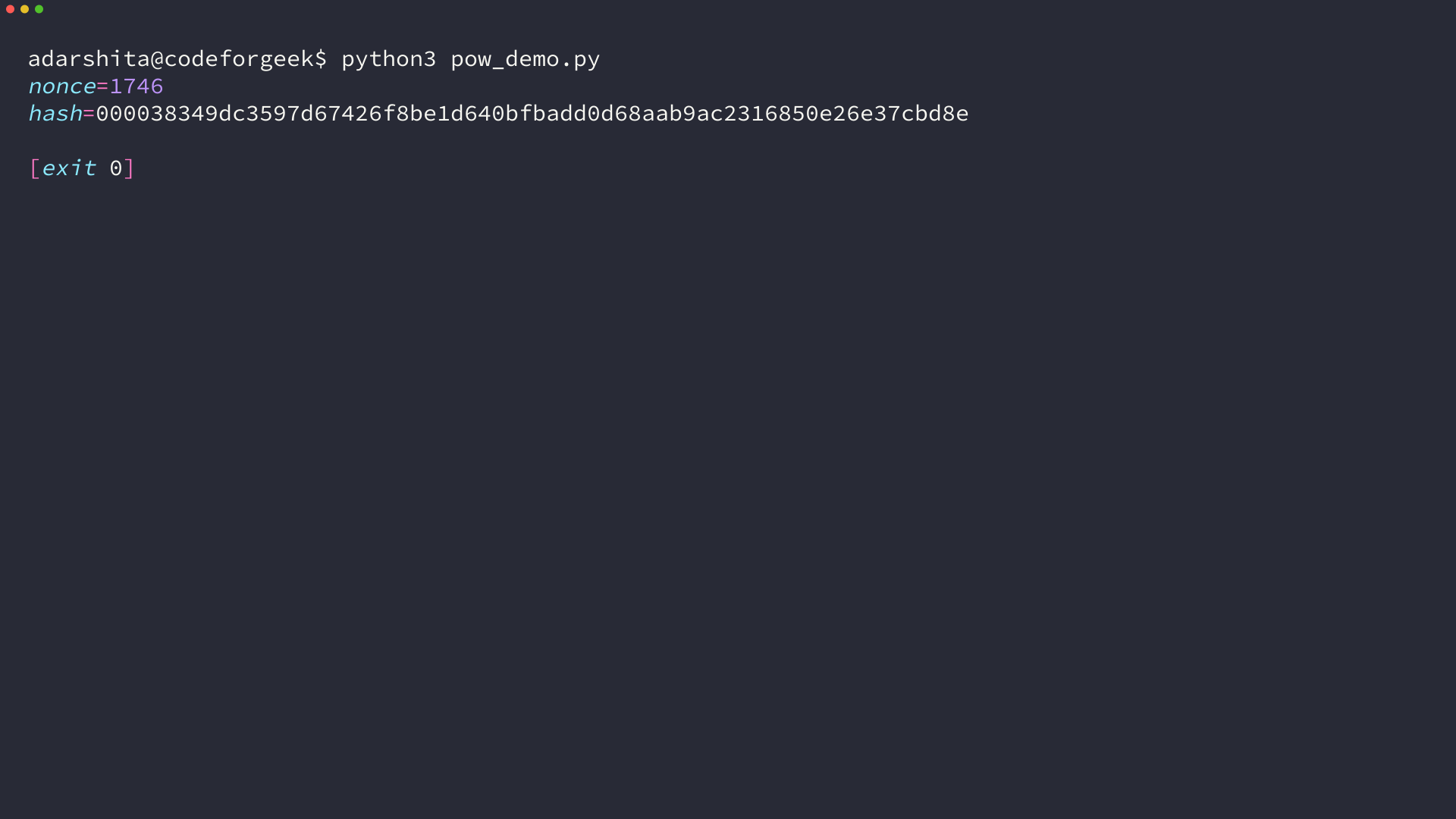
My executed run found nonce 1746 and produced a digest beginning with 0000. Raising the prefix length makes qualifying outputs less frequent, which gives you a compact way to observe the cost behind a stricter target.
What to do next
Use the Python example to understand the hash-search mechanism, then move to the network documentation and a device-specific profitability calculation. Buy hardware only after the electricity, cooling, pool, wallet, and security checks all fit your environment.
Is crypto mining the same as buying cryptocurrency?
No. Buying cryptocurrency acquires an asset. Mining performs work for a proof-of-work network with hardware, electricity, software, and operating risk.
Can a normal computer mine Bitcoin profitably?
A normal computer can run a hash demonstration, but Bitcoin mining uses specialized hardware. Evaluate a device with its power draw, efficiency, electricity price, pool terms, cooling, and operating costs before spending money.
Why do crypto miners join pools?
Pools combine work from many miners and distribute payouts using their published rules. This can reduce the long waiting time and payout variance that a small solo miner faces.