New to Rust? Grab our free Rust for Beginners eBook Get it free →
What Is Cardano and How Does It Work

Seeing ADA mentioned alongside Cardano can leave you wondering what the network does. Cardano is a public blockchain where network computers maintain a shared record of transactions.
I’ll explain how Cardano processes transactions and how ADA lets holders delegate stake and participate in governance.
TL;DR
Cardano is a blockchain network where ADA transfers, tokens, applications and governance actions follow rules enforced by independent computers.
- Ouroboros proof of stake selects stake pools to produce blocks.
- The extended UTXO model records transactions as spent outputs and newly created outputs.
- ADA is used for fees, delegation and participation in network governance.
What is Cardano?
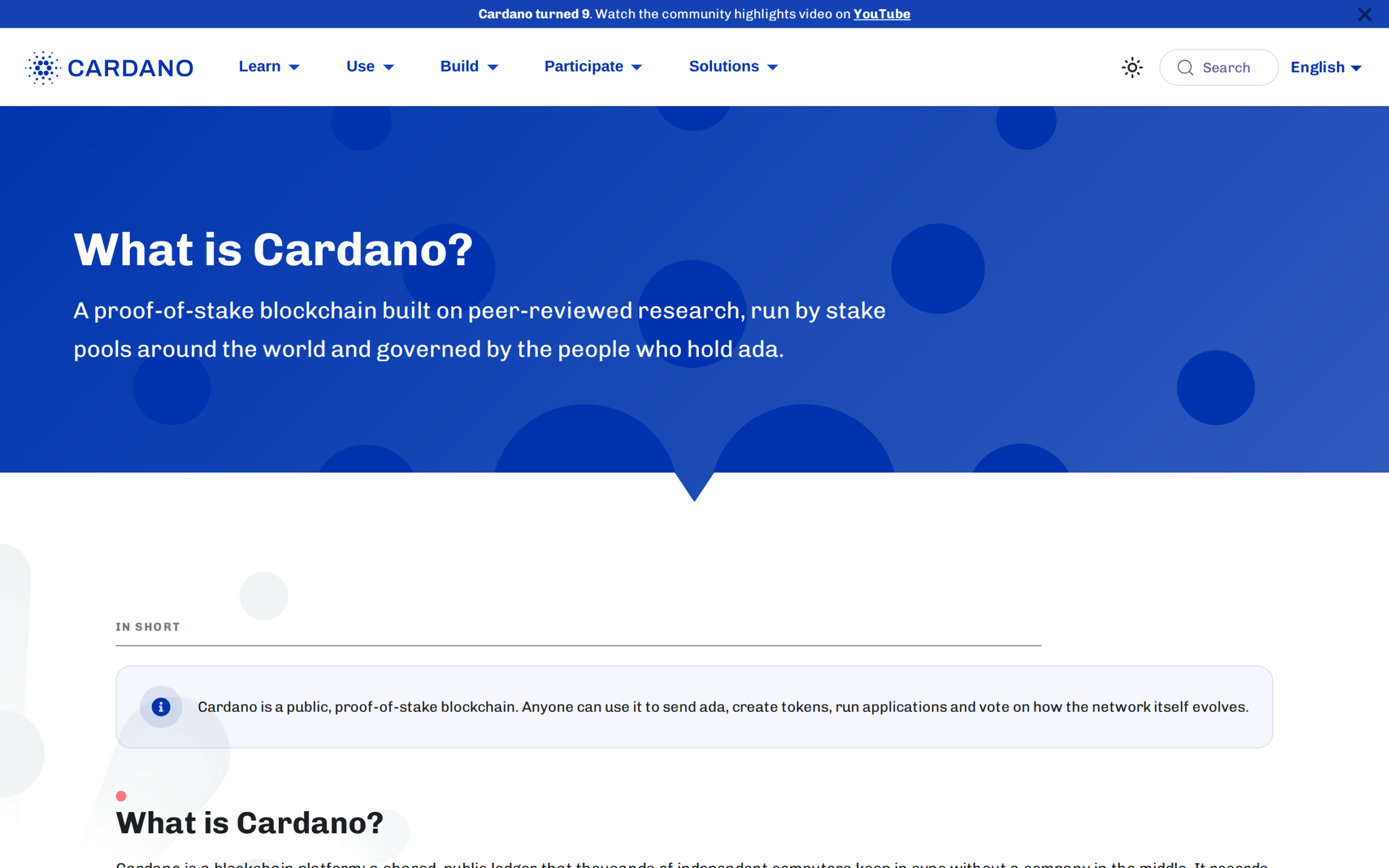
Cardano is a public, decentralized blockchain platform launched in 2017. A blockchain is a shared record of transactions maintained by network nodes, computers that check and relay transactions rather than relying on one company to keep the ledger.
ADA, usually written as ada by the project, is Cardano’s native currency. The network was founded by Charles Hoskinson and built by teams working across an open ecosystem. The chain supports transfers, user-created tokens, smart contracts and community decisions about protocol changes.
ADA pays transaction fees and can be delegated to a stake pool, which helps secure block production. Holders can also take part in governance directly or delegate voting power to a representative. These are protocol uses, not evidence that ADA will rise in price or that every application will succeed.
Cardano uses proof of stake rather than proof of work. Instead of miners competing with computing power, stake pools participate in producing blocks according to the network’s protocol and the stake delegated to them.
The network’s accounting model is called extended unspent transaction output, or eUTXO. Understanding it explains why Cardano transactions are assembled before the network checks them, and why an application can fail when an input has already been spent.
How does Cardano work step by step?
A Cardano transaction starts with existing ledger outputs, is assembled by a wallet or application, and is checked by network nodes before it becomes part of a block. The same ledger rules govern ADA and native tokens, while scripts add conditions for smart contracts.
Step 1: Ouroboros selects a stake pool to produce a block
Ouroboros is Cardano’s proof-of-stake consensus protocol. Time is divided into slots, and stake pools are eligible to produce blocks according to stake delegation and protocol rules.
A pool operator runs the infrastructure. ADA holders can delegate stake to a pool without handing the operator control of their wallet.
When a pool produces a valid block, other nodes check its transactions and protocol rules. Consensus lets separate nodes converge on a common ledger without a central transaction processor. It does not make every transaction free, instant, or immune to network congestion.
The practical distinction from proof of work is how block production is selected. Cardano does not require participants to race by solving energy-intensive mining puzzles. Stake pool participation is tied to ADA delegation and the protocol’s lottery.
Step 2: A wallet builds a transaction from unspent outputs
Cardano tracks value as unspent transaction outputs, or UTXOs. Each output is a record of value at an address, and each can be spent once as an input to a later transaction. The new transaction consumes selected inputs and creates outputs for the recipient and any remaining change.
For example, a wallet sending ADA first selects one or more outputs it controls. It builds a transaction that assigns ADA to the recipient, returns leftover value to a change address and includes a network fee. Once accepted, the old inputs are marked spent and the new outputs become available for later transactions.
The extended UTXO model adds scripts and data to this structure. A smart-contract output can hold a datum, information describing its state, and be locked by a validator script. To spend it, the transaction must supply the data and conditions that satisfy that script.
Because the wallet builds the transaction before submission, it can evaluate the contract against the inputs and outputs before asking for a signature. A transaction can still be rejected if an input was spent after the wallet built it, so the application may need to rebuild and submit a fresh transaction.
Step 3: Tokens and applications use the same ledger
Cardano supports native tokens, which the ledger tracks alongside ADA. A token transfer uses built-in ledger rules, so simply creating or sending a token does not require a smart contract to represent that token.
Smart contracts serve a different purpose. They add programmable conditions, such as requiring a transaction to meet a rule before locked funds can move. A decentralized application, or dApp, combines on-chain contracts with a user interface and often other software.
The contract cannot independently verify an outside fact such as a sports result or currency price. An oracle or another trusted data source must bring that information onto the chain.
ADA pays for transactions and can be included with other assets in a transaction. Fees are determined by protocol parameters and transaction details. A contract’s script also has execution limits, so an application must fit its work within the available transaction resources.
That distinction helps when assessing a token project. A token being visible on Cardano means the ledger can track its units and transfers. It does not verify the issuer’s claims or guarantee that the token can be redeemed.
Nor does a token prove that a related company or product is legitimate. Check the asset identifier and the project’s own terms before treating a token name or logo as proof of identity.
A smart contract does not run continuously like a server program. Someone must build and submit a transaction that invokes its rules. The validator checks that transaction against the contract’s conditions.
The ledger then accepts or rejects the resulting state change. An application may use off-chain services to show data or prepare a transaction, but those services do not replace on-chain checks.
For users, this means there are two different questions: what does the Cardano ledger guarantee about a transaction, and what does a particular application promise to do? Read the wallet’s transaction summary and the application’s documentation separately.
A correct ledger execution cannot make a misleading interface or an unsupported business claim trustworthy.
Step 4: ADA holders delegate stake and vote
Delegating ADA assigns its stake to a pool for block production. In Cardano’s native delegation model, the ADA stays in the delegator’s wallet and remains spendable. A new stake key requires a refundable deposit, and rewards depend on protocol conditions and the pool’s performance, so they are not guaranteed.
Pool operators run nodes and help produce blocks. When choosing a pool, compare its fees, pledge, saturation and performance rather than treating a displayed reward estimate as a promise. Official Cardano guidance says delegation becomes active after an epoch delay and rewards arrive later, so staking is not an instant payment.
Cardano also has on-chain governance. ADA holders can register as a delegated representative, or DRep, or delegate voting power to one. Governance actions can cover protocol changes and treasury decisions.
Other governance roles provide checks on those decisions. Voting gives participants a way to influence the network. It does not remove disagreement or guarantee a particular outcome.
What should you know before using Cardano?
The ledger enforces protocol rules, but it cannot promise that an application will meet a business or investment expectation. Check what your wallet is asking you to sign. Distinguish network rules from an app’s own behavior.
- A failed transaction can need a rebuild. If another transaction spends one of the selected UTXOs first, the old transaction no longer uses valid inputs. Refresh the wallet or application state and review the replacement transaction before signing.
- Contract rules can reject a transaction. The script checks the transaction supplied to it. A missing datum, invalid condition or insufficient execution budget can prevent the contract call from succeeding.
- Staking rewards vary. Delegation keeps ADA spendable, but rewards depend on pool operation and protocol conditions. A wallet or exchange may also offer a custodial product with different terms, so read its rules separately.
- Governance is participation, not a return guarantee. Proposals and votes can change network parameters or treasury decisions, but a vote does not promise that a project will be funded or an application adopted.
- ADA is a volatile asset. Network utility and token price are different questions. A technically functioning blockchain does not guarantee demand, future value, security of a third-party app or recovery from a lost private key.
Use a wallet you control for a first transaction, then confirm the recipient address and network and review the fee and outputs before signing.
For development, start with the official Cardano documentation. Do not copy a contract without understanding its validator rules.
Common Cardano transaction and staking errors
Cardano transactions can fail when their inputs or script conditions no longer match the ledger state. Before signing again, check the wallet’s current transaction details and confirm the pool or application terms from its official documentation.
- If a transaction reports a spent input, refresh the wallet or application so it can build a transaction from current unspent outputs.
- If a contract call is rejected, check the datum and validator conditions, then review the transaction’s execution budget with the application’s documentation.
- If delegated ADA or rewards appear unavailable, distinguish native delegation from a custodial product and check the wallet’s epoch and reward information.
Conclusion
Cardano is a proof-of-stake blockchain whose eUTXO ledger, native assets and validator scripts define how transactions and applications work. ADA pays fees and supports delegation and governance, while rewards, app outcomes and market value remain uncertain.
For the protocol details, read the Cardano introduction, the eUTXO explanation and the Cardano Developer Portal. The stake pool delegation guide explains the wallet and pool steps.
FAQ
These answers cover common Cardano questions that go beyond the basic network definition.
What is ADA in Cardano?
ADA is Cardano’s native currency. It pays network transaction fees and can be delegated for stake pool participation or used in governance processes.
Does Cardano support smart contracts?
Yes. Cardano smart contracts use validator scripts that check whether a transaction meets specified conditions before locked outputs can be spent.
Can you spend ADA while it is delegated?
In Cardano’s native stake delegation model, delegated ADA stays in the wallet and remains spendable. Custodial exchange products may have separate terms.
Are Cardano tokens smart contracts?
Cardano native tokens are tracked by the ledger and can be transferred without a smart contract just to represent or move the token. Contracts add programmable rules for other actions.