New to Rust? Grab our free Rust for Beginners eBook Get it free →
What is LoRA Fine-Tuning for Code LLM | From Zero to AI Hero

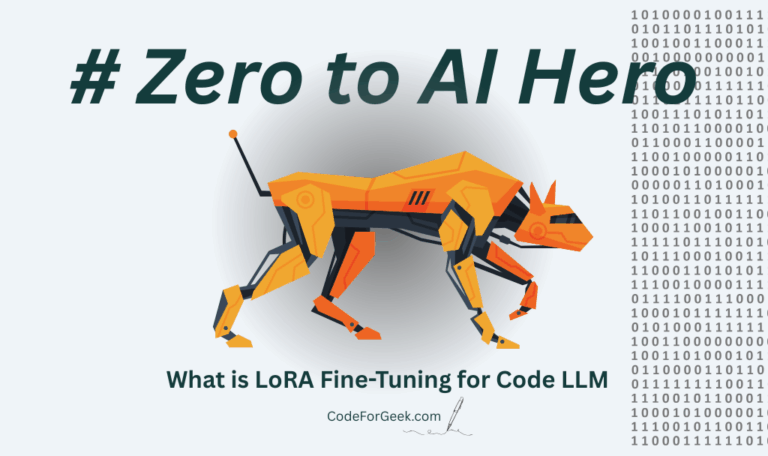
If you want to customize an open-source Large Language Model (LLM) to truly understand your company’s unique coding style, project structure, or internal terminology, standard fine-tuning is often too expensive and resource-heavy. This is where LoRA comes in.
LoRA fine-tuning for code LLMs is a revolutionary technique that allows developers to efficiently adapt powerful models to match organizational needs without requiring massive computing power, turning model customization into an accessible task.
The Problem with Traditional Fine-Tuning
A modern LLM, like one based on the Transformer architecture (Article #10), can have billions of parameters or “weights.” These weights hold all the knowledge the model learned from its massive public training dataset.
Traditional Fine-Tuning (Full Fine-Tuning) means taking all those billions of weights and slightly adjusting them using your new, custom data (your private codebase).
- Costly: It requires high-end, dedicated hardware (GPUs) for days or weeks.
- Time-Consuming: The training process is very slow.
- Storage Intensive: You must save a full copy of the entire model for every small update.
For a developer wanting to customize a model quickly for a specific project, traditional fine-tuning is often impractical.
LoRA Fine-Tuning for Code LLMs: The Efficient Solution
LoRA (Low-Rank Adaptation) is a method of Parameter-Efficient Fine-Tuning (PEFT). Instead of modifying all the billions of original weights, LoRA freezes the original, pre-trained weights entirely.
LoRA then introduces small, trainable, low-rank matrices (think of them as tiny adapter layers) right next to the original weights.
Here is how LoRA works:
- Freeze the Base Model: The original LLM’s vast knowledge base is locked in place. You preserve the general coding knowledge it already has.
- Add Tiny Adapters: You attach small, new weight matrices (called A and B) into the key layers of the Transformer architecture.
- Train Only the Adapters: When you fine-tune the model on your custom data, for instance, 10,000 examples of your company’s unique Python error handling style, only the small A and B matrices are trained and updated.
The Benefits for Developers
The total number of trainable parameters in the LoRA adapters is often less than one percent of the original model’s size.
- Speed and Hardware: You can run LoRA fine-tuning for code LLMs on consumer-grade GPUs or less powerful cloud machines, significantly speeding up the training process.
- Small Output: Instead of saving a 100 gigabyte model copy, you only save the tiny LoRA adapter weights (often just a few megabytes). You can swap these small adapters in and out for different projects instantly.
- No Catastrophic Forgetting: Since the original weights are frozen, LoRA prevents the model from forgetting its general knowledge (like how to write basic Python or JavaScript), a problem that can happen with traditional fine-tuning.
When to Use LoRA
LoRA is the ideal choice for developers when the goal is specialization, not fundamental change.
Use LoRA When:
- Matching Coding Style: You want the LLM to follow your organization’s specific formatting, variable naming conventions, or documentation standards.
- Understanding Proprietary APIs: You need the LLM to learn the names and usages of your internal utility functions or APIs that are not public.
- Improving Agentic Workflows: You want to customize a code generation model to make better Thoughts and Actions for complex tasks, which is key to the ReAct framework for developer agents we explored in Article #4.
- Improving Debugging Prompts: You can fine-tune a model to better understand and respond to the outputs of Chain-of-Thought prompting for code debugging (Article #3).
LoRA vs. RAG
It is important to remember that LoRA (specialization) is different from RAG for codebases explained (Article #1). RAG gives the model context (the actual code snippets) at runtime, while LoRA gives the model skill (the style and convention for generating code). Ideally, you use both: you use RAG to find the correct files (using code embeddings from Article #2) and you use a LoRA-tuned model to write the new code in the perfect house style.
LoRA vs Instruction Tuning
LoRA is a method of how you tune the model. You can use LoRA to perform either full fine-tuning (to teach new knowledge) or instruction tuning (to teach new behavior). The critical distinction between these two primary tuning goals is so important for developers that it is the entire focus of Article #6.
The efficiency of LoRA also plays a role in system performance. Faster training means faster iterations, which contributes to the overall speed and efficiency of your AI tools—a concept we dive into with LLM latency optimization for developers in Article #8.
Frequently Asked Questions (FAQs)
What does “Low-Rank” mean in LoRA?
In linear algebra, the “rank” of a matrix relates to how much information it contains. LoRA uses low-rank matrices (A and B) because they are very small and sparse, meaning they capture only the essential, new information needed for the specialization task, making them highly efficient.
Can I use LoRA on any open-source code model?
LoRA can be applied to almost any modern Transformer-based LLM. Many popular open-source models, especially those designed for code like Code Llama or StarCoder, are excellent candidates for LoRA fine-tuning for code LLMs.
Does LoRA impact the security of the model?
LoRA itself is a training method and does not directly change security. However, if the fine-tuning data contains insecure coding patterns, the LoRA-tuned model might replicate those. This highlights the need for implementing guardrails in AI code generation regardless of the tuning method.
Is LoRA the only Parameter-Efficient Fine-Tuning method?
No. Other PEFT methods exist, such as QLoRA (a memory-efficient version of LoRA) and Prompt Tuning. LoRA and its variations are currently the most popular and effective for code models.
How does LoRA help with multi-modal AI?
LoRA is not limited to text. In multi-modal AI for developer workflows, you could use LoRA to fine-tune a multi-modal model to better recognize and interpret your company’s unique UI components or graph formats from screenshots.
Is LoRA more complex than RAG?
Conceptually, LoRA is more complex because it involves changing the model’s internal structure. RAG is an architectural setup that focuses on data retrieval. RAG is typically easier to implement quickly, but LoRA provides a deeper, more permanent specialization.
Conclusion
LoRA is a game-changer for developers who need to bridge the gap between powerful general AI and specific organizational needs. By making LoRA fine-tuning for code LLMs accessible, you can efficiently customize models to match your coding standards, significantly improving the quality of the AI-generated code. This efficiency is driving innovation from major cloud providers and open-source communities alike, making powerful, specialized AI tools available to teams of all sizes.