New to Rust? Grab our free Rust for Beginners eBook Get it free →
Cognigy Alternatives for Enterprise Voice + Chat Automation (2026)

This guide gives you a clear, no-fluff explanation of Cognigy alternatives with direct comparisons, real use cases, and top features so you can find the most reliable option faster.
Quick Notes for Founders
If voice automation at scale is mission-critical, Cognigy and a few peers (Boost.ai, Avaamo) are the serious options.
If voice is “nice to have” and your real pain is ticket backlogs or first-response SLAs, then honestly, Cognigy is not your first move. Intercom + Zendesk/Freshworks + a bot layer will get you 80% there with less pain.
What Cognigy Is Actually Built For
Cognigy is built for high-volume enterprises that want automation across both chat and voice, with full workflow control. Think airline call centres, telco service desks, banks with IVR queues – not a 5-person SaaS startup.
It gives you low-code flow design, omnichannel, multilingual NLU, and deep integration into backend systems.
When Teams Go Looking for Cognigy Alternatives
- Complexity: You need technical people to build and maintain flows. This is not “let marketing own the bot.”
- Rollout effort: You are basically designing an internal product, not “adding a widget.”
- Cost: It’s an enterprise platform priced like an enterprise platform.
Who You Should Compare
- Boost.ai → focus on virtual agents for customer-facing Q&A and containment
- Aisera → strong for internal IT / HR support automation, agent assist, ticket resolution
- Avaamo → industry-compliant, multilingual, regulated sectors
- Zendesk / Freshworks → if you realise you actually just needed decent chat + ticketing and not full voice automation, stop overbuying
Top Cognigy Alternatives in 2026
Boost.ai
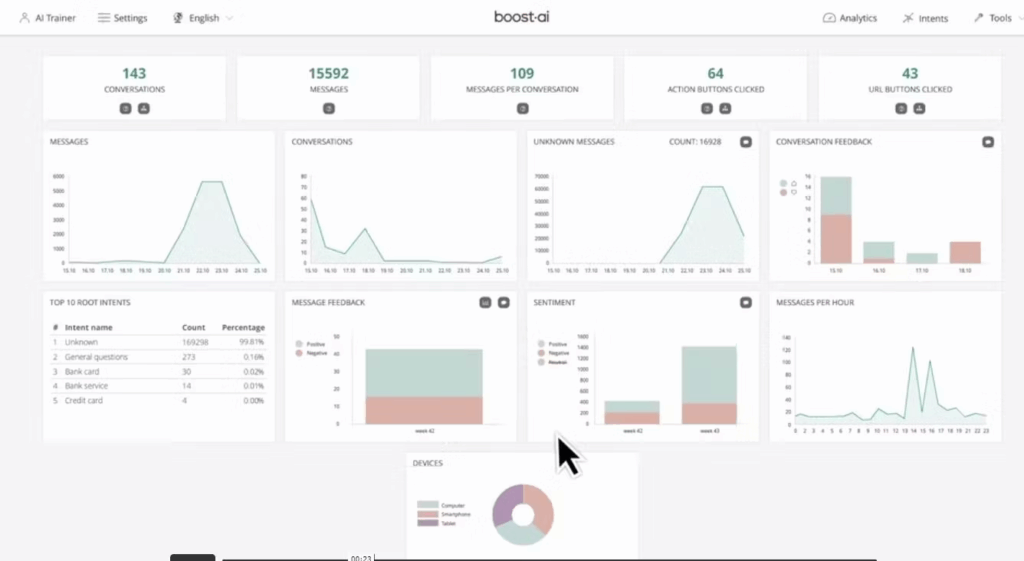
Boost.ai is the closest one-to-one alternative to Cognigy. It combines rule-based precision with generative AI flexibility, letting enterprises automate voice and chat interactions without losing control.
Key Features:
- Hybrid AI: Combines rules with NLU and large language models for precise control.
- No-Code Builder: Slack-style interface for training intents and flows.
- Self-Learning AI: Improves continuously from agent interactions.
- Omnichannel Support: 35+ channels and 100+ languages supported.
- Compliance: ISO27001, GDPR, SSO, and on-premise options.
- Agent Assist: Suggests replies and context for human agents in real time.
Pros:
- High Accuracy: Delivers reliable responses in regulated industries.
- User-Friendly: Simple interface for non-technical staff.
- Fast ROI: Pre-trained content helps bots go live quickly.
- Scalable: Handles thousands of simultaneous conversations.
- Enterprise Focus: Strong support and co-creation with clients.
Cons:
- Premium Cost: Aimed at large enterprises with bigger budgets.
- Interface Gaps: Admin tools for large intent sets can feel clunky.
- Language Coverage Limits: Some niche languages require extra work.
- Mobile UI Issues: Minor glitches reported on certain iOS apps.
Pricing:
| Plan | Price | Core Features |
|---|---|---|
| Custom | Quote-based | Hybrid AI, no-code builder, compliance features, omnichannel support, etc. |
Best For:
Enterprises that need reliable, compliant virtual agents at large scale with human-like accuracy and low hallucination risk.
Aisera
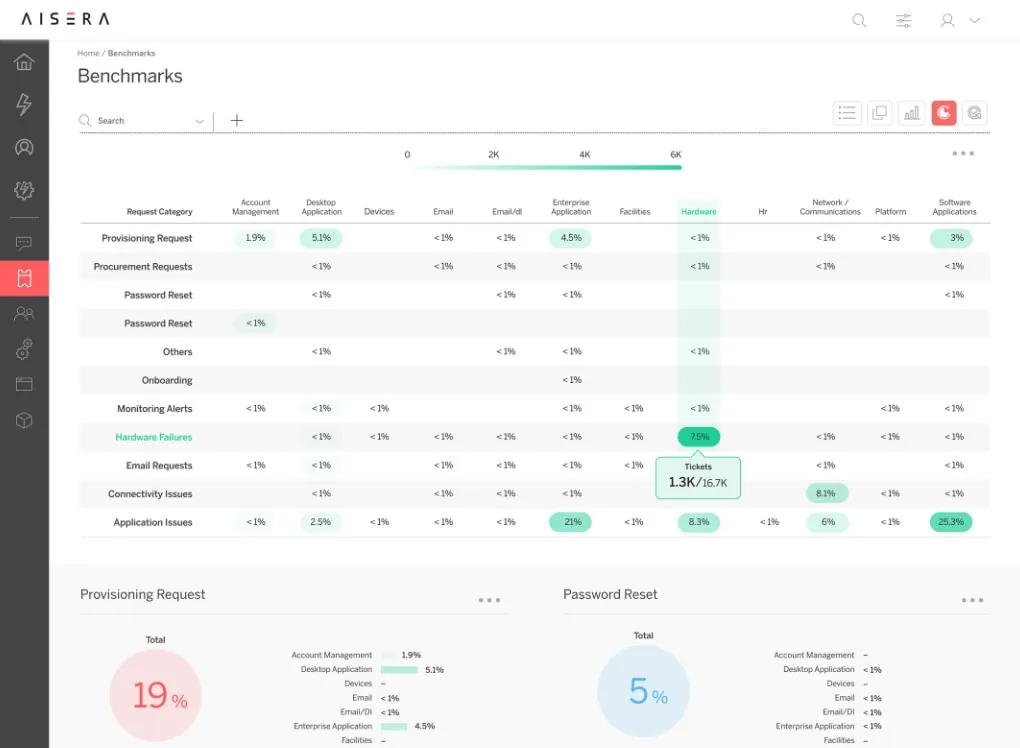
Aisera extends conversational AI into a complete service-desk automation platform. It handles voice and chat for IT, HR, and customer support – automating repetitive tasks and connecting to existing CRMs and ITSM systems.
Key Features:
- Unified AI Service Desk: One virtual agent for IT, HR, and support requests.
- Workflow Automation: Handles tasks like password resets and license provisioning.
- Multi-Channel Support: Works across chat, voice, email, and collaboration apps.
- Knowledge Search: AI-driven search across FAQs, tickets, and documents.
- Agent Assist: Suggests next-best actions and answers to live agents.
- Integrations: 75+ certified connectors with ITSM, CRM, and IAM systems.
Pros:
- High Auto-Resolution: Resolves up to 80% of routine queries.
- Cross-Department Use: Consolidates IT, HR, and support into one AI layer.
- Vendor-Agnostic: Works alongside existing platforms.
- Fast Deployment: Pre-trained intents allow quick setup.
- Scalable: Expands coverage with minimal retraining.
Cons:
- Enterprise Pricing: Suited only for large organisations.
- Implementation Effort: Requires setup and data preparation.
- Admin Learning Curve: Workflow and analytics need training.
- Monitoring Needed: AI-driven actions require oversight to build trust.
Pricing:
| Plan | Price | Core Features |
|---|---|---|
| Custom | Quote-based | Unified AI desk, workflow automation, multi-channel support, integrations, etc. |
Best For:
Enterprises that want end-to-end automation across departments, not just customer chatbots.
Avaamo
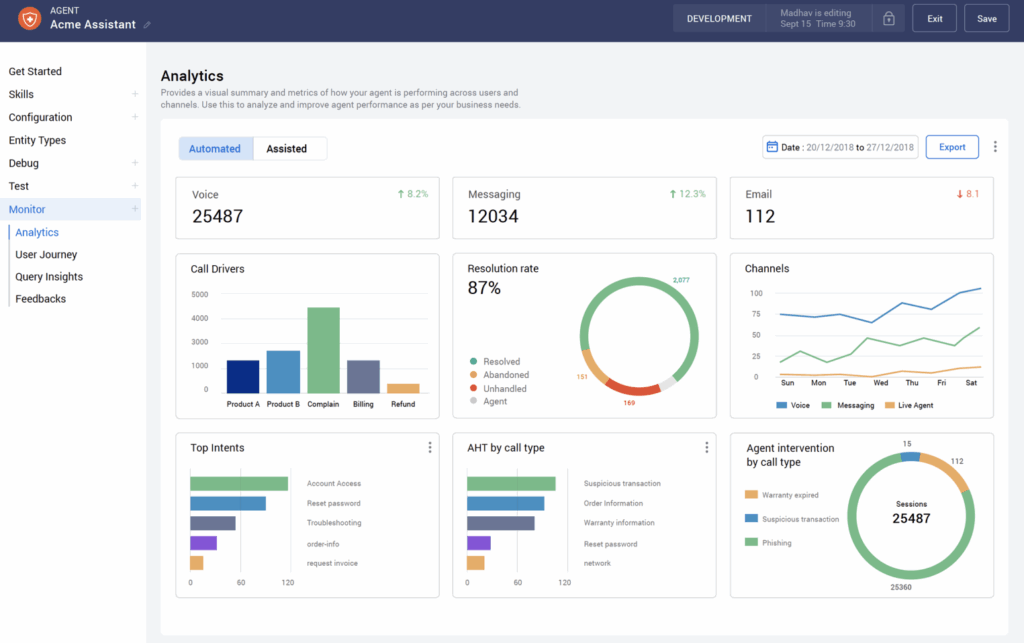
Avaamo is purpose-built for regulated industries where data privacy and compliance trump everything else. It offers pretrained AI models for finance, healthcare, and insurance, supporting both chat and voice in over 100 languages.
Key Features:
- Vertical AI Models: Pre-trained for finance, healthcare, insurance, and HR.
- No-Code Builder: Visual designer to create workflows without coding.
- Multilingual Support: 100+ languages and dialects for global deployments.
- Voice + Chat: Works across SMS, IVR, mobile, and web channels.
- Enterprise Integrations: 1,000+ connectors for CRM, ERP, ITSM, and more.
- Security & Compliance: SOC2, HIPAA, and GDPR ready with role-based access.
Pros:
- Industry-Specific Expertise: Comes ready with models for regulated sectors.
- Strong Automation: Handles complex queries with high accuracy.
- Flexible Deployment: Cloud or on-premise options.
- Comprehensive Analytics: Tracks containment, CSAT, and intent failures.
- Scalable: Supports large enterprises with high volumes.
Cons:
- Premium Pricing: Aimed at large enterprises only.
- Complex Setup: Deep integrations require technical expertise.
- Steep Learning Curve: Non-technical teams may need support.
- Cross-Channel Context: Conversations do not always carry over seamlessly.
Pricing:
| Plan | Price | Core Features |
|---|---|---|
| Custom | Quote-based | Enterprise deployment, vertical AI models, omnichannel support, etc. |
Best For:
Banks, insurers, and healthcare providers needing vertical AI with airtight compliance.
CoRover.ai
CoRover.ai shines in multilingual and multimodal deployments. It supports chat, voice, and even video bots – and powers national-scale systems like government helpdesks. Its BharatGPT engine makes it especially strong for regional use cases.
Key Features:
- Omni-Channel Assistants: Chat, voice, and video bots on web, apps, WhatsApp, IVR, and more.
- Multi-Language NLP: Supports 100+ global languages and 13+ Indian languages.
- BharatGPT: Generative AI tuned for regional accuracy and contextual responses.
- Fast Deployment: Chatbot-as-a-Service model enables quick rollout.
- Enterprise Integrations: Pre-built connectors for CRM, ERP, banking, and ticketing.
- Security & Compliance: ISO 27001, GDPR, and HIPAA-ready with encryption and audit logs.
Pros:
- Proven at Scale: Handles billions of interactions in government and enterprise use.
- Strong Language Coverage: Ideal for multilingual deployments in Asia.
- Fast Implementation: Up to 10x quicker deployment with CaaS model.
- High ROI: Deflects repetitive queries and reduces operational costs.
- Versatile Use Cases: Customer support, HR, grievance handling, and lead generation.
Cons:
- Enterprise-Level Pricing: Costs are not public and aimed at large organisations.
- Limited Global Reach: Strong in Asia but less presence in Western markets.
- Newer LLM Offering: BharatGPT adoption outside Asia is still limited.
Pricing:
| Plan | Price | Core Features |
|---|---|---|
| Custom | Quote-based | Multilingual bots, omni-channel support, enterprise integrations, security, etc. |
Best For:
Governments and large enterprises serving diverse, multilingual user bases.
Zendesk (Suite Enterprise)
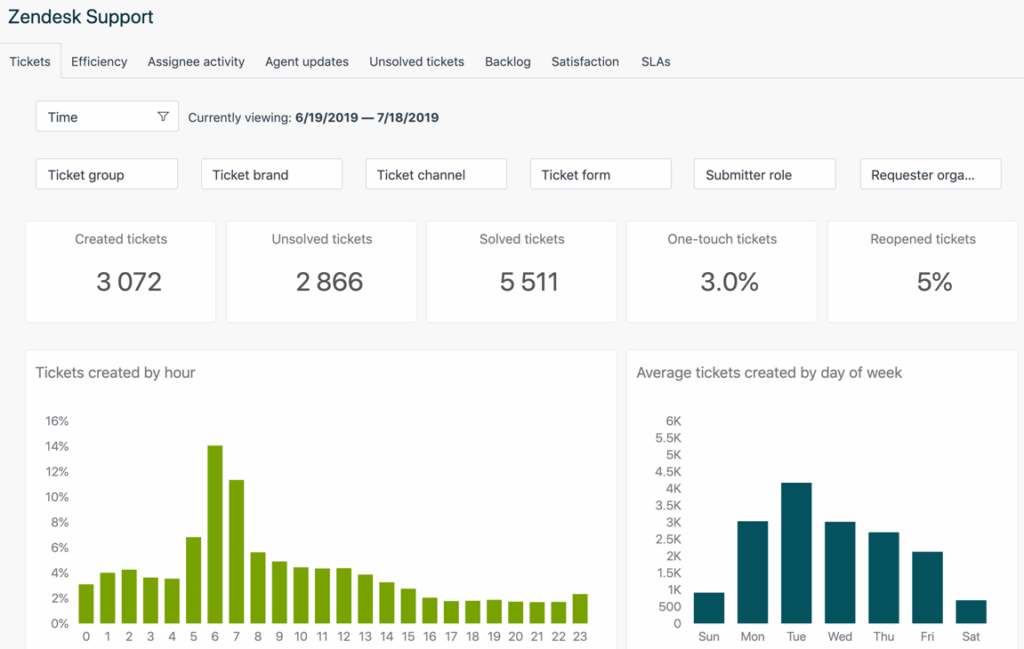
Zendesk isn’t a pure conversational AI, but it’s the backbone platform many enterprises integrate their voice and chat AI tools into. It unifies channels, ensures auditability, and provides the compliance framework needed for enterprise-grade automation.
Key Features:
- Omnichannel Ticketing: Centralises email, chat, phone, and social into one ticketing hub.
- AI and Automation: Bots, routing, and workflows to cut manual effort.
- Integrated Voice: Built-in call centre with IVR, call recording, and voicemail.
- Analytics & Reports: Dashboards and custom metrics for SLA, CSAT, and team performance.
- Marketplace: 1,000+ integrations with CRMs, ecommerce, and productivity apps.
Pros:
- Comprehensive Suite: Covers tickets, chat, phone, and self-service.
- Automation Strength: Improves productivity and resolution speed.
- Advanced Analytics: Tracks KPIs and service quality effectively.
- Flexible Setup: Wide configuration and integration options.
Cons:
- High Pricing: Advanced features require costly tiers.
- Steep Learning Curve: Complex UI needs proper training.
- Developer Dependence: Customisation often requires technical support.
- No Free Plan: Only a limited trial is available.
Pricing:
| Plan | Price (per agent/month) | Core Features |
|---|---|---|
| Support Team | $19 | Email, ticketing, Facebook/X support, analytics dashboards, etc. |
| Suite Team | $55 | AI agents, generative replies, knowledge base, chat, social messaging, etc. |
| Suite Professional | $115 | Multiple help centres, advanced reporting, CSAT surveys, SLA management, IVR, etc. |
| Suite Enterprise | $169 | 300 help centres, sandbox, custom roles, audit logs, advanced security, etc. |
Best For:
Large organisations that need a compliant, omnichannel hub before layering in AI tools like Boost.ai or Cognigy.
LiveChatAI
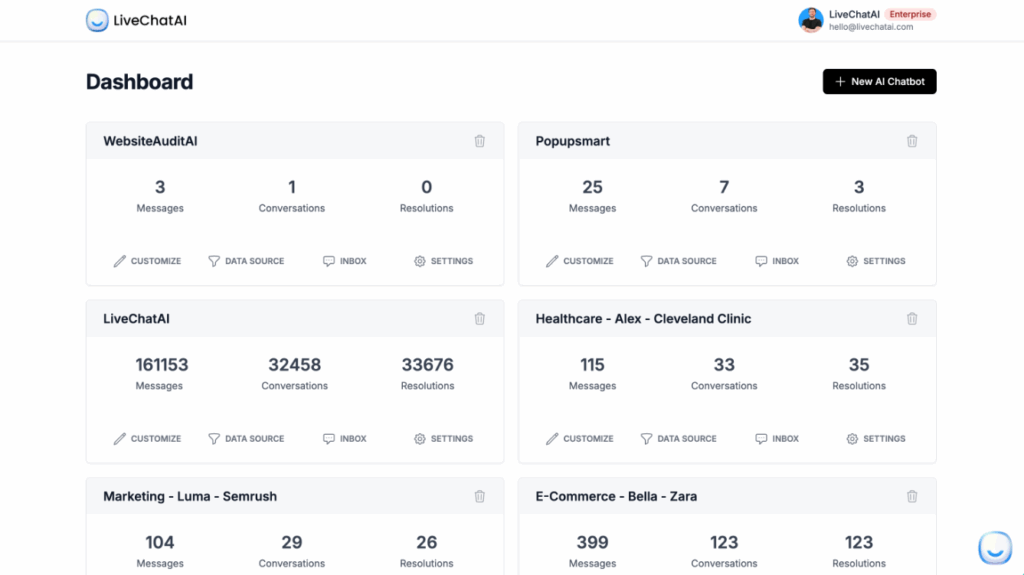
LiveChatAI offers a lighter, faster-deploying automation layer compared to Cognigy. It automates FAQs, supports human fallback, and works across web, WhatsApp, and e-commerce platforms – ideal for smaller teams that still want enterprise-style uptime.
Key Features:
- Dual Response: AI resolves FAQs and passes complex queries to humans.
- Seamless Handoff: Transfers to your team via Intercom, WhatsApp, SMS, or email.
- Knowledge Training: Learns from FAQs, documents, and website content.
- Multi-Channel Deployment: Works on websites, WhatsApp, Shopify, Slack, and WordPress.
- AI Actions & API: Can reset passwords, check orders, or book appointments.
- Analytics: Monitors resolution rates, response times, and satisfaction.
Pros:
- Balanced Support: Automation plus human backup keeps quality high.
- Cost Savings: Reduces repetitive queries so agents focus on complex cases.
- User Experience: Smooth transition between AI and human agents.
- Channel Reach: Covers web chat and popular messaging apps.
- Quick Setup: Templates and knowledge uploads make deployment faster.
Cons:
- Outsourced Handoff: Using external agents may raise quality or privacy concerns.
- Pricing Complexity: Costs vary by usage and added services.
- Integration Effort: Requires setup for CRM or workflow connections.
- Smaller Ecosystem: Newer platform with fewer third-party references.
Pricing:
| Plan | Price | Core Features |
|---|---|---|
| Free | Free | 250 messages, 1 chatbot, live chat, basic analytics, etc. |
| Basic | $39 | 4,000 messages, 1 chatbot, live chat, contacts, etc. |
| Pro | $89 | 10,000 messages, 2 chatbots, AI actions, API access, etc. |
| Advanced | $189 | 15,000 messages, 5 chatbots, WhatsApp integration, advanced models, etc. |
| Expert | $389 | 20,000 messages, 10 chatbots, more seats, advanced analytics, remove branding, etc. |
Best For:
SaaS and e-commerce companies that want round-the-clock AI chat without enterprise overhead.
When Cognigy Alternatives Make More Sense Than Cognigy
Cognigy is a strong platform but it is not always the right fit. If any of the following apply to your situation, you should look at alternatives seriously before committing.
Budget Constraints
Cognigy operates on a enterprise pricing model. For mid-market companies or startups, the cost of Cognigy licensing, implementation, and ongoing maintenance can consume a significant portion of your automation budget. LiveChatAI and Aisera offer pricing tiers that make sense for smaller teams. LiveChatAI has a free tier that covers 250 messages per month. Aisera’s model starts lower and scales more gradually.
Internal Team Capacity
Cognigy requires technical people to build and maintain the flow logic. If your team does not have Conversational AI specialists or bot developers, you will spend heavily on professional services to get value from the platform. Boost.ai and Aisera both have stronger no-code components that let non-technical staff contribute meaningfully after initial setup.
Regulatory Environment
Cognigy handles regulated industries well, but so does Avaamo. If your specific industry has niche compliance requirements, Avaamo’s pretrained vertical models might be faster to deploy and easier to audit. The same applies if you need HIPAA compliance specifically and Cognigy’s healthcare offering does not fit your architecture.
Time to Value
Enterprise platforms like Cognigy have longer implementation cycles. If you need results in weeks rather than months, platforms with stronger pre-trained content libraries get you there faster. Boost.ai and Aisera both offer pre-trained intents that can go live within days rather than requiring months of training data building.
How to Evaluate Cognigy Alternatives for Your Specific Use Case
Not every Cognigy alternative fits every use case. Here is a practical framework for evaluating which one fits your situation.
Step 1: Define Your Primary Channel
Start with whether you need voice, chat, or both. If voice automation is the core requirement, Cognigy and Boost.ai lead this category. If you primarily need chat and messaging, Intercom, Freshworks, and LiveChatAI are strong options. If you need both, look at Boost.ai, Avaamo, and CoRover which handle omnichannel natively.
Step 2: Map Your Compliance Requirements
List every compliance standard that applies to your use case. HIPAA for healthcare. PCI-DSS for payments. SOC2 for enterprise B2B. GDPR for EU users. Then check each platform against that checklist. Avaamo and Aisera have the most comprehensive compliance coverage for regulated verticals. Boost.ai and CoRover cover the major standards but verify your specific requirements with their sales teams.
Step 3: Estimate Total Cost of Ownership
Enterprise AI platform pricing is rarely simple. Beyond licensing fees, consider implementation services, ongoing training data maintenance, human agent oversight, and integration costs. Request detailed pricing proposals from at least three platforms and build a 3-year TCO model before deciding. A platform that looks cheaper on licensing might have higher implementation costs that reverse the equation.
Step 4: Test With Real Queries
Every platform vendor will show you polished demos. The real test is how well the platform handles your actual user queries. Before committing, run a pilot with 50-100 real conversation transcripts. Feed them to the platform and evaluate containment rate and accuracy. Most vendors will allow this kind of pilot. If they do not, treat that as a red flag.
Implementation Timeline: What to Expect
Setting realistic expectations for implementation timelines helps you plan resource allocation and avoid false promises to stakeholders.
For a basic chatbot-only deployment with a no-code builder, most platforms listed here can get to a working prototype within 2-3 weeks. Full voice automation with IVR and backend integrations typically takes 2-4 months for the initial deployment. Achieving high containment rates across a wide range of user intents usually requires 3-6 months of ongoing tuning after the initial launch.
Platforms with stronger pre-trained content libraries like Boost.ai and Aisera tend to have faster time-to-value. Platforms that require building conversation flows from scratch take longer but offer more control over the final experience.
Integration Considerations for Cognigy Alternatives
No conversational AI platform works in isolation. The value comes from integrating with your existing systems. Here is what to evaluate for each alternative.
CRM Integration
For customer-facing bots, CRM integration determines whether the bot can access customer context and update records. Most enterprise platforms support Salesforce, HubSpot, and Microsoft Dynamics out of the box. Verify that your specific CRM is supported and that the integration is native, not a third-party middleware layer.
ITSM Integration
For internal IT and HR support bots, ITSM integration with ServiceNow, Jira, Freshservice, or Zendesk Support is critical. Aisera has the strongest ITSM integration story here. Boost.ai and CoRover also support major ITSM platforms. Evaluate whether the integration handles bidirectional data flow or just one-way read access.
Analytics and Reporting
Your analytics stack determines how well you can measure bot performance and ROI. Check whether the platform exports conversation transcripts, sentiment data, escalation reasons, and containment metrics in formats you can ingest. Most platforms have built-in analytics. Verify that they cover the metrics that matter to your business before signing.
FAQ: Cognigy Alternatives
What is the best Cognigy alternative for a mid-market company?
For mid-market companies, Boost.ai and Aisera are the strongest alternatives. Both offer pre-trained content that reduces implementation time and have no-code builders that let your internal team manage the bot after initial setup. Boost.ai is stronger for customer-facing voice and chat automation. Aisera is stronger for internal IT and HR support automation.
Can I replace Cognigy with Zendesk?
Zendesk is not a direct Cognigy replacement. Zendesk is primarily a ticketing and customer service platform. Cognigy is a conversational AI automation platform. You can use Zendesk as the underlying ticketing and agent management layer and layer a conversational AI tool on top. Zendesk has its own AI features but they do not match Cognigy’s depth in voice automation and multilingual NLU.
Which Cognigy alternative has the best voice automation?
Boost.ai and Cognigy are the closest competitors in voice automation capability. Both handle IVR, voice routing, and speech-enabled conversations at enterprise scale. Avaamo is a strong alternative if you need compliance-first voice automation in regulated industries. CoRover handles voice at national scale but is stronger in Asian markets.
How long does it take to switch from Cognigy to an alternative?
A realistic migration timeline is 3-6 months from contract signing to full production deployment. This includes data export from the existing platform, conversation flow redesign or porting, backend integration, testing, and tuning. You do not need to migrate everything at once. A phased approach where you run both platforms in parallel is safer and lets you validate the alternative before full cutover.
Is there a free alternative to Cognigy?
No fully free enterprise-grade alternative exists. Cognigy and its alternatives are enterprise platforms with corresponding pricing. LiveChatAI has a free tier that covers basic chat automation for small teams, but it does not scale to enterprise voice automation requirements. For proof-of-concept work, most platforms offer limited free pilots.
Comparison Table
| Tool | Best For | Key Strength | Compliance & Scale | Pricing Starts At |
|---|---|---|---|---|
| Boost.ai | Enterprises needing reliable AI voice + chat automation | Hybrid AI with accuracy, control, and scale | ISO 27001, GDPR, on-premise | Custom |
| Aisera | IT, HR & support teams automating service ops | Unified AI service desk + workflow automation | SOC 2, GDPR, secure SSO | Custom |
| Avaamo | Regulated industries (finance, healthcare, insurance) | Vertical AI models + voice + chat + compliance | SOC 2, HIPAA, GDPR | Custom |
| CoRover.ai | Government & multilingual enterprises | Voice, chat, video bots + regional LLM (BharatGPT) | ISO 27001, GDPR, HIPAA | Custom |
| Zendesk (Suite Enterprise) | Large orgs needing omnichannel backbone | Ticketing + chat + analytics + integrations | SOC 2, GDPR, audit logs | $169 / agent / mo |
| LiveChatAI | SaaS + e-commerce teams | Hybrid chatbots + 24/7 automation | Data encryption, cloud security | Free / $39 / mo |
Hope this guide saved you a few hours of research and helped you spot the right Cognigy alternative faster. If you are exploring more options, check out our guide on Zendesk alternatives to find what fits your support stack best.