
New to Rust? Grab our free Rust for Beginners eBook Get it free →
How to add Modules in Breach browser

Adding a module to Breach means finding its GitHub repository and entering its owner and repository name in the module manager. A Breach module is a separate web application that adds part of the browser’s interface or behavior, and Breach installs it from a repository.
I’ll show how to enter a module’s GitHub identifier and check whether it loaded.
What is a Breach module?
A Breach module is a separate web application that adds part of the browser interface or behavior.
The original Breach project describes modules as web apps running in their own processes, so the manager installs one from a repository instead of treating it as a conventional browser extension.
This is a historical workflow for an old browser project. The project repositories document the module format, but they do not establish a supported Breach release for current systems.
| Module | Documented role |
|---|---|
| mod_strip | Default tab and URL-bar layout |
| mod_stats | Usage-statistics aggregation |
| mod_newtab | Example new-tab page |
What you need before adding a module
You need a working Breach installation and the exact GitHub owner and repository name for the module. If Breach is not installed yet, follow the separate Breach installation instructions first.
These are historical instructions, so read the repository source before installing code from a project with no supported release established here.
- Open the module’s GitHub page and read its README before installing it.
- Confirm the repository still exists. Check that its contents match the module you intend to add.
- Keep a copy of the module identifier, written as github:owner/repository.
Step 1: Open Configure Modules
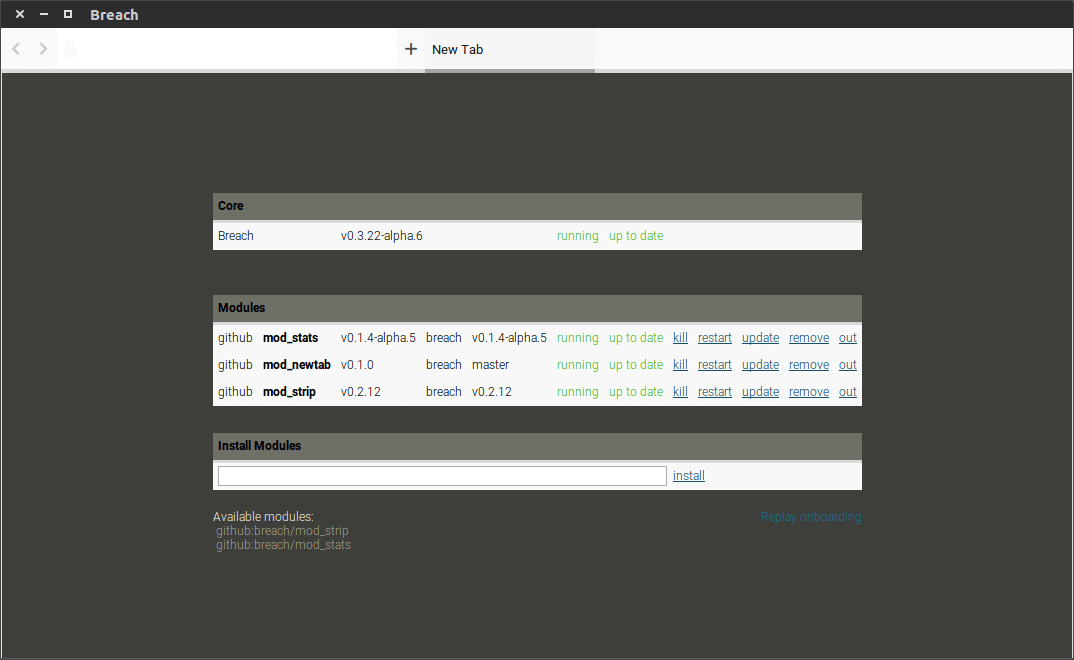
Right-click the Breach window and choose Configure Modules. This menu opens the screen where you enter a repository identifier in the documented interface.
The image below is an original screenshot from the article’s historical setup, not a current capture. If your installed build has a different menu, use its own module-management screen rather than assuming the old interface is present.
Step 2: Enter the GitHub module identifier
Enter a repository in the format github:owner/repository. The Breach module list identifies mod_strip as the default tab and URL-bar module. Its repository is github.com/breach/mod_strip.
github:breach/mod_strip
Choose the install action and wait for the manager to finish fetching the module.
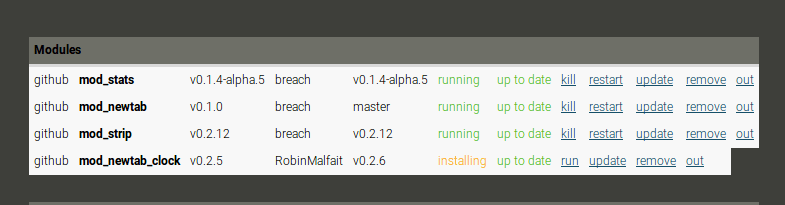
The archived screenshot shows an “Installing Module” state. That means the operation started, not that the module finished loading.
Step 3: Check that the module loaded
After installation finishes, check for the behavior the module provides.
The old module list describes mod_newtab_clock as a new-tab page module, so opening a new tab is the relevant check for that example.
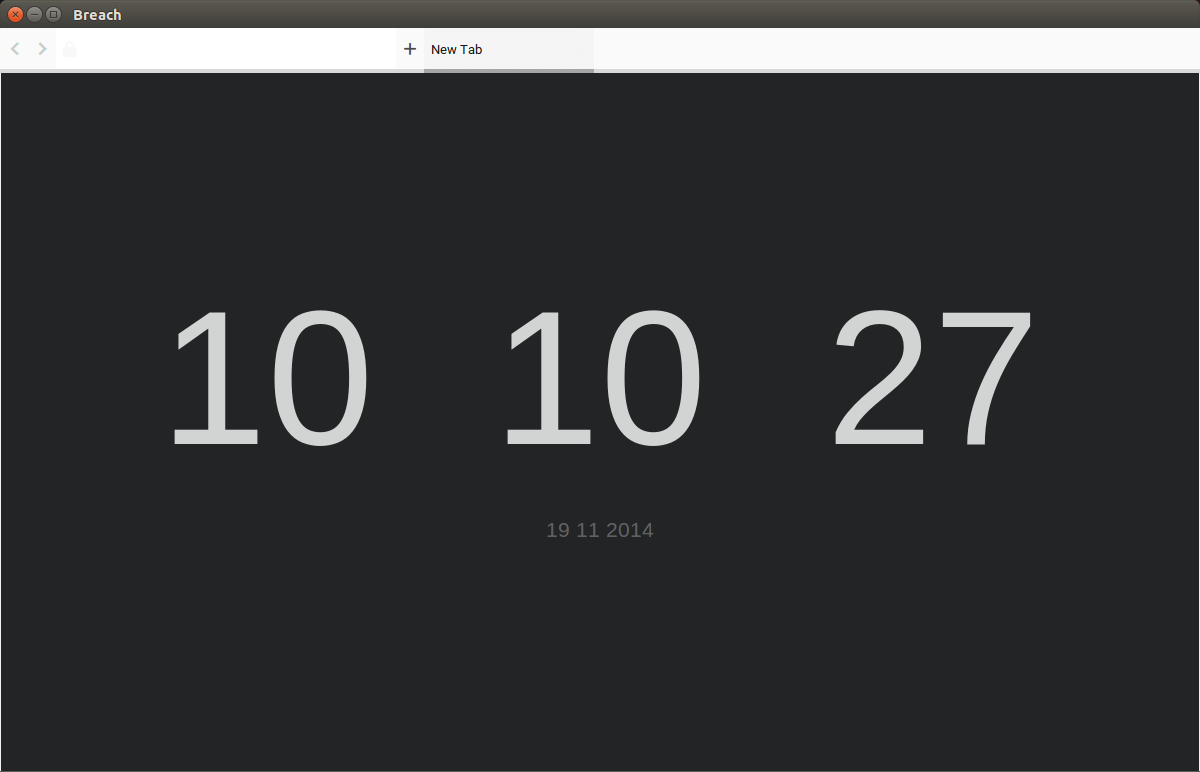
This screenshot records an older interface. It does not prove that the repository or module runs with a different Breach build.
If the feature does not appear, reopen the module manager and check its status before trying the identifier again.
When a Breach module does not install
A failed install can come from a mistyped owner or repository name, a missing repository, or an incompatible Breach build. The historic instructions do not distinguish those cases.
- Compare every character in the identifier with the repository URL.
- Open the repository directly and inspect its README and source before retrying.
- If the repository is missing or the interface differs, stop rather than substituting a similarly named module.
Breach’s Linux notes and module list are historical project pages. They do not establish maintained downloads, security fixes, or compatibility with current operating systems.
Check the repository before adding code
A module identifier points to code that will run as part of the browser. Read the repository’s source and README before installing it, rather than relying on a name in an old list.
https://github.com/breach/mod_strip
Frequently asked questions
The project documents a repository-based install route, with compatibility dependent on the old browser build.
What format does a Breach module identifier use?
The historical format is github:owner/repository, where owner and repository identify the module’s GitHub repository.
How do I know whether a Breach module installed?
Wait for the installation status to finish, then check for the feature the module provides. An Installing message only shows that the process started.
Are these Breach module instructions supported for current systems?
The project pages and screenshots are historical. They do not establish a supported current Breach release or module compatibility with current systems.