New to Rust? Grab our free Rust for Beginners eBook Get it free →
Federated Blockchains (Consortium Blockchains) Explained

A federated blockchain, also called a consortium blockchain, is a permissioned network governed by several organizations instead of one owner or an open public community. You use it when participants need a shared record but must agree on membership, approvals, and data visibility.
I checked the Hyperledger Fabric network documentation and its policy documentation for the mechanism in this explanation. Those sources show why consortium governance is more important than a label such as federated.
What is a federated blockchain?
A consortium blockchain gives a defined group of organizations the authority to operate the network, while each organization can run infrastructure, hold an identity, and take part in rules that decide which changes the shared ledger accepts.
The word federated describes shared control, not a required protocol. Hyperledger Fabric is a useful example because it separates member organizations, peers, channels, policies, and ordering services rather than treating every participant as one identical node.
How consortium blockchain governance works
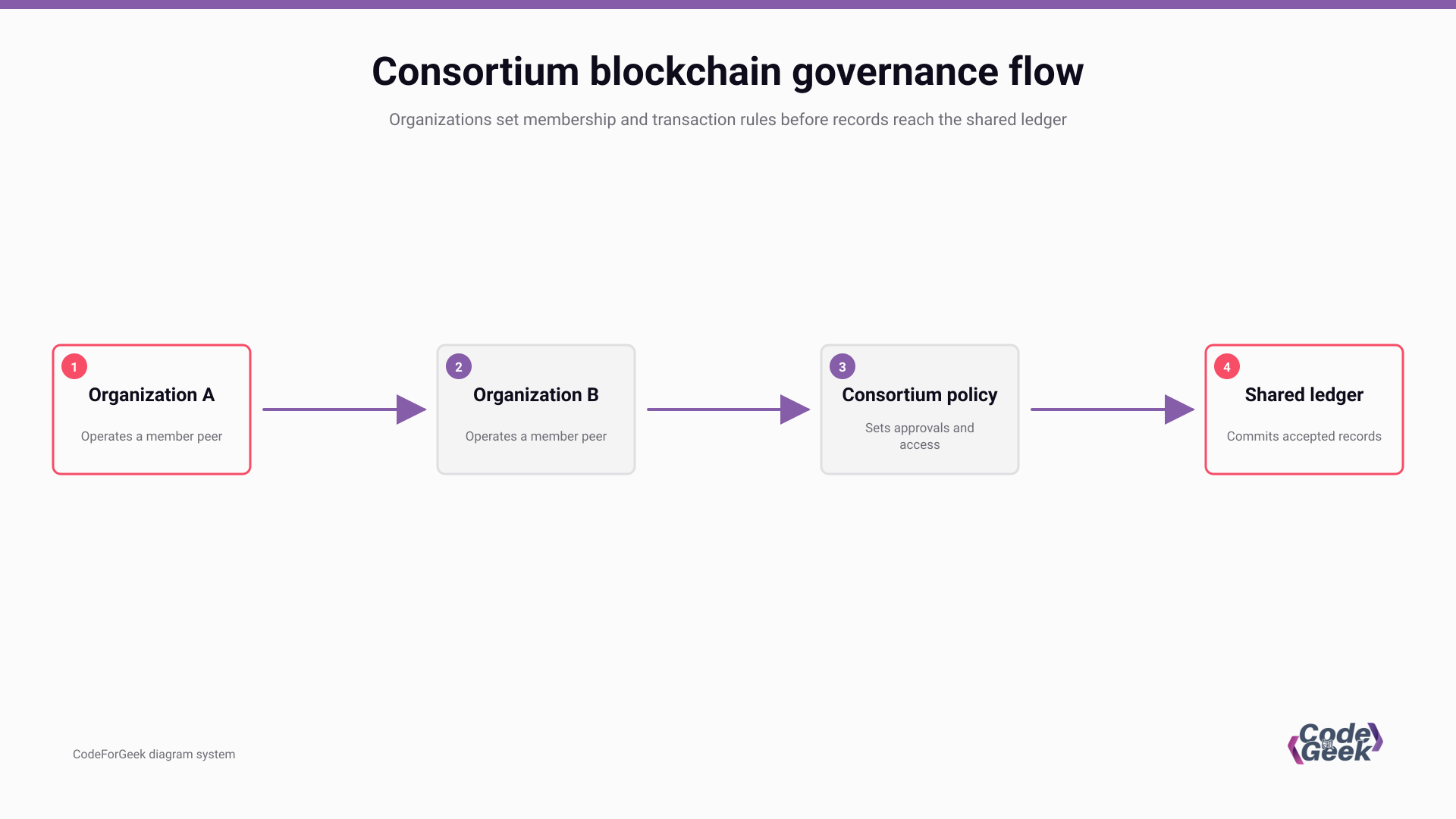
The consortium must decide who may join, who may submit a transaction, whose approval is required, and which members may read a given record.
Member organizations and identities
Amazon Managed Blockchain describes a Hyperledger Fabric member as a unique network identity and gives an organization in a banking consortium as an example.
Joining is an administrative and governance decision, so a consortium needs an owner for onboarding, removal, certificates, and incident response.
Transaction approval is a policy decision
In Hyperledger Fabric, an endorsement policy identifies the peer organizations whose signatures are needed before a transaction can be accepted on a committing peer’s ledger copy.
That rule can require one organization, several named organizations, or a threshold chosen by the consortium. The important question is not whether the network has a vote, but which parties must agree for this business action.
Privacy can vary by workflow
Fabric channels and private-data features can limit data sharing to the organizations involved in a workflow.
You still need to decide what goes on the shared ledger, what stays in a private collection, and what remains outside the network. A blockchain cannot repair an access policy that the consortium never defined.
Federated blockchain vs private blockchain
A private blockchain usually leaves membership and operational decisions with one organization, while a consortium blockchain distributes that authority across several organizations through a governance agreement.
| Question | Private blockchain | Consortium blockchain |
|---|---|---|
| Who governs the network? | One organization | Several member organizations |
| Who sets approval rules? | The network owner | The members through agreed policy |
| Where does it fit? | Internal workflows with one accountable operator | Shared workflows across organizations that need a common record |
| Main operational challenge | Owner control and access management | Governance, member coordination, and dispute handling |
Both designs can restrict access and use authenticated members. The choice turns on authority, not on whether the network is public or private in a marketing sense.
When a consortium blockchain fits
A consortium blockchain fits when independent organizations need a shared history of business events and none should own the system alone, such as supply-chain handoffs, trade documentation, shared compliance records, and settlement workflows.
It does not fit merely because several companies exchange data. If one organization is already the trusted operator, or if a database with signed messages meets the audit need, a blockchain adds coordination work without improving the decision.
Ask the governance questions first
Before choosing a platform, write rules that can govern the network through a disagreement, a member departure, and a security incident.
- Which organizations may join or leave the network?
- Which organizations must approve each transaction type?
- Which records are visible to every member, and which stay limited to a smaller group?
- Who pays for operations, rotates credentials, and responds to an unavailable member?
- How are policy changes and disputes approved?
A practical way to evaluate the design
Start with one shared business event, such as a custody transfer or a document approval, and identify the organizations that create it, validate it, consume it, and need to audit it later.
Then turn those roles into membership, endorsement, data-visibility, and dispute rules. If the group cannot agree on those rules, the platform choice is premature.
Conclusion
A federated or consortium blockchain shares network authority among a defined set of organizations. Its value comes from the governance model that makes a shared ledger acceptable to members with separate interests.
Read the introduction to blockchain if you need the underlying ledger and consensus vocabulary. Then write the membership and transaction-approval rules for one workflow before evaluating an implementation.