New to Rust? Grab our free Rust for Beginners eBook Get it free →
What is LoRA Fine-Tuning for Code LLM | From Zero to AI Hero

Low-Rank Adaptation (LoRA) lets you adapt a code large language model (LLM) without updating every weight in the base model, so the useful question is whether your task needs learned behavior, retrieved context, or both.
What LoRA changes during fine-tuning
A Transformer contains linear layers whose weight matrices shape how information moves through the model, while full fine-tuning updates selected weights throughout that model and can produce a checkpoint close to the base model’s storage size.
LoRA freezes the base weights and adds two smaller trainable matrices to selected linear layers. Their product represents the update that would otherwise be applied directly to a much larger weight matrix.
The adapter rank controls the inner dimension of those two matrices, with lower ranks reducing trainable parameters and higher ranks giving the adapter more capacity to represent changes.
Low rank does not mean sparse because the matrices can contain dense values, and adapter size still depends on the model, rank, target layers, and data type.
Why LoRA fits code models
Code adaptation often targets a narrow behavior such as response format, framework conventions, tool-call structure, or a recurring transformation. LoRA can learn that behavior while keeping the original checkpoint unchanged.
- Smaller training state. The optimizer tracks adapter parameters rather than every base-model parameter.
- Compact deployment choices. You can store adapters separately, load them with the base model, or merge a compatible adapter into the model for inference.
- Faster experiments. Fewer trainable parameters make it easier to compare datasets, ranks, and target modules within the same hardware budget.
- Stable base checkpoint. The original model stays available, which makes adapter rollback and comparison straightforward.
Freezing the base model does not stop a weak dataset from teaching insecure code, reducing performance outside the target task, or encouraging memorization of sensitive examples.
A current PEFT LoRA configuration
Hugging Face Parameter-Efficient Fine-Tuning (PEFT) represents the adapter setup with LoraConfig. I verified the configuration below with Python 3.13.5, PEFT 0.19.1, Transformers 5.13.1, and PyTorch 2.13.0 on July 15, 2026.
from peft import LoraConfig, TaskType

config = LoraConfig(
    task_type=TaskType.CAUSAL_LM,
    r=16,
    lora_alpha=32,
    lora_dropout=0.05,
    target_modules="all-linear",
)

print(f"task type: {config.task_type.value}")
print(f"rank: {config.r}")
print(f"alpha: {config.lora_alpha}")
print(f"dropout: {config.lora_dropout}")
print(f"targets: {config.target_modules}")
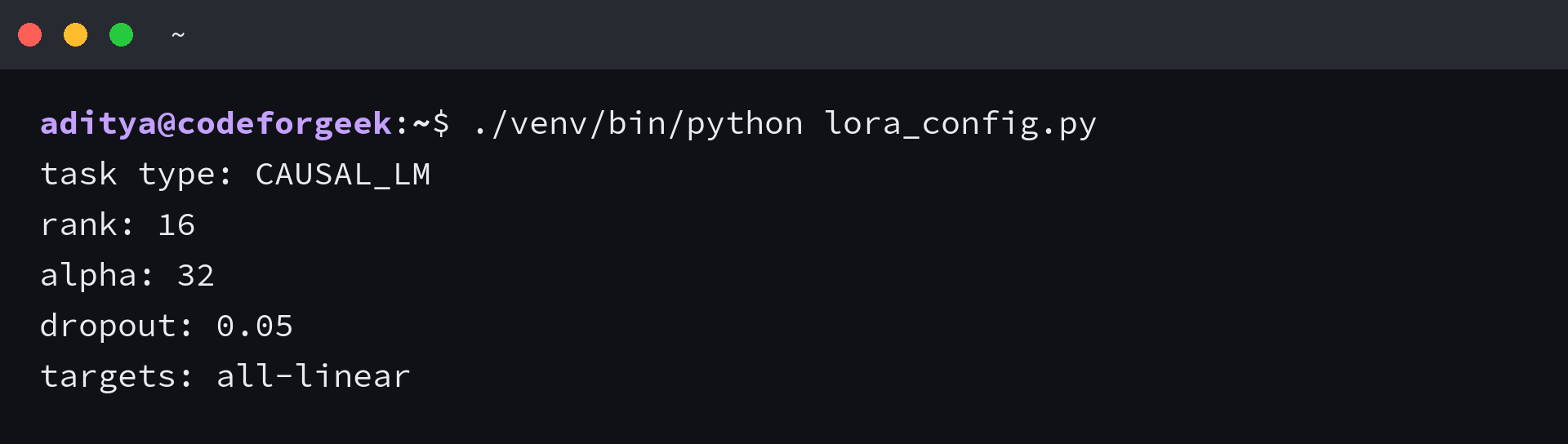
The causal-language-model task type suits autoregressive code generation. Rank 16 is a starting point for evaluation rather than a universal optimum, and the alpha value scales the adapter update.
The all-linear setting asks PEFT to target linear layers without hard-coding architecture-specific projection names, while explicit target modules give you tighter control when the model documentation identifies the correct layers.
LoraConfig only defines the adapter. A complete training run still needs a base model, tokenizer, prepared dataset, trainer, evaluation set, optimizer settings, and enough compute for the chosen sequence length and batch size.
Choose LoRA, retrieval, or prompting
LoRA is not the default answer to every code-model problem, so pick the mechanism that matches what must change.
| Need | Best starting point | Reason |
|---|---|---|
| Current repository files or internal API details | Retrieval-augmented generation | Fresh source text reaches the model at request time. |
| Consistent output format or coding behavior | LoRA fine-tuning | The adapter can learn the target behavior from examples. |
| A small set of clear instructions | Prompting | You avoid training and can revise the instructions immediately. |
| Repository context plus house style | Retrieval and LoRA | Retrieval supplies the code while the adapter shapes the response. |
If the model needs source files that change every week, use code embeddings to retrieve the relevant symbols and files rather than trying to encode them into an adapter.
Instruction tuning describes the training objective and dataset shape, while LoRA describes an efficient way to update the model. The instruction tuning and fine-tuning comparison explains that distinction in more detail.
What QLoRA adds
Quantized Low-Rank Adaptation (QLoRA) keeps the frozen base model in a quantized representation during training and learns LoRA adapters on top. That representation can reduce memory use enough to make a larger model fit on constrained hardware.
Lower memory use does not make every workload fast. Sequence length, activation memory, gradient accumulation, data loading, checkpointing, and hardware kernels still affect throughput, so measure end-to-end training and LLM latency separately.
A practical LoRA workflow for code
A good adapter starts with a measurable task, not a dump of an entire repository. Define the behavior and create held-out cases before training.
- Choose a base model whose license, context window, language support, and deployment requirements fit your project.
- Build instruction and response examples that demonstrate the exact coding behavior you want.
- Remove secrets, credentials, personal data, generated files, and low-quality duplicates before training.
- Reserve a test set that does not overlap with the training examples.
- Start with a modest rank, train the adapter, and compare it with the untouched base model on the same cases.
- Check correctness, security, compilation or test results, latency, and behavior outside the target task before deployment.
Evaluation should execute generated code when the task allows it. Text similarity alone cannot tell you whether a suggested patch compiles, passes tests, preserves an API contract, or introduces a vulnerability.
Frequently asked questions
These answers cover the decisions that matter before you commit compute and data to an adapter run.
Does LoRA add new knowledge to a code model?
LoRA can adapt a model to examples from a domain, but it is not a dependable database for changing repository facts. Use retrieval when the model needs current files, internal API definitions, or other source material at request time.
Can LoRA prevent catastrophic forgetting?
Freezing the base weights limits direct changes to the original checkpoint, but an adapter can still reduce output quality outside its target task. Compare the adapted and base models on both target and general evaluation sets.
How do I choose the LoRA rank?
Start with a modest rank and measure task quality, memory use, and training time. The best value depends on the base model, target layers, dataset, and complexity of the behavior you want to learn.
Should I merge the adapter before deployment?
Merging can simplify inference when you need one fixed adapter. Keeping it separate makes switching, rollback, and storage easier, so test both choices against your serving stack and latency target.
Use LoRA for learned behavior
LoRA gives you a compact, reversible way to adapt a code model, but the adapter still depends on careful data and evaluation. Use it for behavior that examples can teach, keep changing source facts in retrieval, and test generated code against the same standards you apply to human-written changes.