New to Rust? Grab our free Rust for Beginners eBook Get it free →
How Code Embeddings Work for Search and Help LLMs Understand Your Codebase | From Zero to AI Hero

Code embeddings turn functions, classes, comments, and natural-language questions into vectors that an artificial intelligence (AI) assistant can compare to retrieve code by meaning when filenames and exact keywords do not match the question.
Keyword search and semantic search solve different jobs
A text search looks for characters or tokens you supply, so a search for “validate credentials” can miss a function named authenticateUser() even when that function handles the request you care about.
Semantic search compares the meaning represented by vectors, letting a question such as “where do we check login access?” retrieve authentication code that contains none of those words.
Keep both methods because exact search is better for symbols, error strings, configuration keys, and known filenames, and semantic search helps when you know the behavior but not the identifier.
How code embeddings work for AI search
An embedding model maps an input to a fixed-length list of numbers called a vector. Inputs with related meaning should land near one another according to the similarity metric used by the index.
1. Split the repository into useful units
The indexer first divides the repository into chunks. A function, method, class, or short module usually preserves more useful context than an arbitrary slice that starts halfway through one function and ends inside another.
Each chunk should retain metadata such as its file path, symbol name, language, commit, and line range. Retrieval can then return a source location instead of an anonymous block of text.
2. Generate and store vectors
The embedding model converts every chunk into a vector and stores it beside the chunk text and metadata in an index such as Qdrant, Pinecone, or a PostgreSQL database with pgvector.
Vector dimensions depend on the selected model, so the index schema must match its output. Changing the embedding model usually requires rebuilding the index because vectors from different models do not share a comparable coordinate space.
3. Embed the question and find nearby chunks
The query passes through the same embedding model. A nearest-neighbor search ranks stored vectors with a metric such as cosine similarity, dot product, or Euclidean distance.
OpenAI’s embeddings guide demonstrates cosine similarity by embedding a query and candidate functions, then choosing the candidates with the highest scores. Pinecone calls the same operation semantic, similarity, vector, or nearest-neighbor search.
Cosine similarity in a small JavaScript example
The vectors below are compact demonstration values rather than output from an embedding model. They make the ranking step inspectable without an API key or external package.
const cosineSimilarity = (a, b) => {
  const dot = a.reduce((sum, value, i) => sum + value * b[i], 0);
  const magnitude = vector =>
    Math.sqrt(vector.reduce((sum, value) => sum + value ** 2, 0));
  return dot / (magnitude(a) * magnitude(b));
};

const query = [0.82, 0.11, 0.54];
const candidates = {
  "verify user permissions": [0.79, 0.15, 0.57],
  "calculate shipping price": [0.08, 0.91, 0.18],
};

for (const [label, vector] of Object.entries(candidates)) {
  console.log(`${label}: ${cosineSimilarity(query, vector).toFixed(3)}`);
}
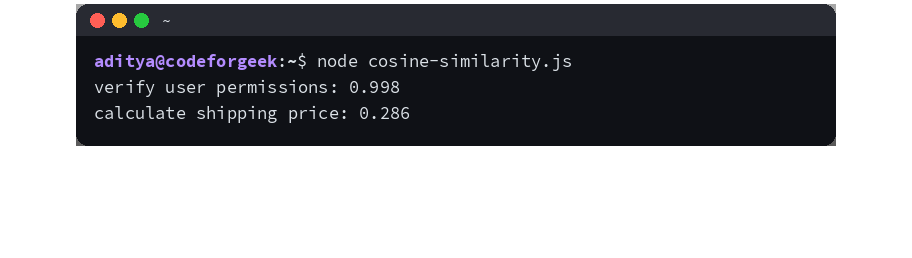
Node.js returns 0.998 for “verify user permissions” and 0.286 for “calculate shipping price.” A retrieval system ranks the permissions chunk first because its vector points in almost the same direction as the query vector.
Retrieval gives an LLM repository context
A large language model (LLM) cannot infer private repository details from its training data, so retrieval supplies selected chunks in the prompt for answers grounded in the current codebase. Our guide to retrieval-augmented generation for codebases explains that full flow.
The model sees only the retrieved context, not a perfect representation of the whole repository. A weak chunking strategy, stale index, missing metadata filter, or poor top-k setting can hide the file that contains the answer.
Tools can combine vector results with lexical search, symbol graphs, import relationships, and reranking. Hybrid retrieval is useful when a query contains an exact symbol such as PaymentService and a broad intent such as “where are failed charges retried?”
Where code embeddings help
Search quality matters whenever an AI tool must select a small amount of repository context before generating an answer or edit.
- Repository chat can retrieve implementations, tests, and nearby documentation for a natural-language question.
- Code review can locate related validation logic or earlier implementations before suggesting a change.
- Debugging systems can use an error message as a query and return functions associated with the failing behavior.
- Migration tools can group semantically related call sites even when teams used different names for the same operation.
If you want to see how repository context appears inside an editor workflow, the GitHub Copilot setup guide for Visual Studio Code shows the user-facing side. Embeddings can also cluster examples for dataset preparation, though changing model behavior itself belongs to methods such as low-rank adaptation for code models.
Limits to check before you trust the results
A high similarity score means the vectors are close under one model and metric. It does not prove that the chunk is correct, safe, reachable at runtime, or compatible with the current branch.
- Re-embed changed chunks and delete vectors for removed files so retrieval does not quote stale code.
- Exclude generated files, vendored dependencies, secrets, and binary artifacts before indexing.
- Evaluate retrieval with repository-specific questions and expected source files instead of judging fluent answers alone.
- Apply access controls before retrieval so a user cannot receive chunks from a repository or directory they cannot open.
Qdrant’s vector search documentation explains how embeddings and a chosen distance metric drive retrieval. Your evaluation should still measure whether the correct file reaches the prompt, because generation cannot repair missing evidence reliably.
Frequently asked questions
Are code embeddings the same as tokens?
No. Tokenization splits source text into units a model can process. An embedding model converts an input into a vector used for comparison or retrieval.
Does an embedding model understand an entire repository at once?
Usually no. An indexer splits the repository into chunks, embeds each chunk, and retrieves a small set for each query. Chunk boundaries and metadata therefore affect the result.
Do code changes require re-embedding?
Changed chunks need new vectors, and deleted chunks need removal from the index. Incremental indexing can limit that work to files or symbols affected by a commit.
Can code embeddings replace exact search?
No. Exact search remains better for known symbols, strings, and filenames. Hybrid systems combine lexical and vector retrieval when a query contains both identifiers and intent.
Start an evaluation with questions whose source files you already know, then inspect the retrieved chunks before reading the generated answer. Retrieval accuracy tells you whether the embedding pipeline is finding the evidence your LLM needs.