New to Rust? Grab our free Rust for Beginners eBook Get it free →
Online BCD Decimal Converter

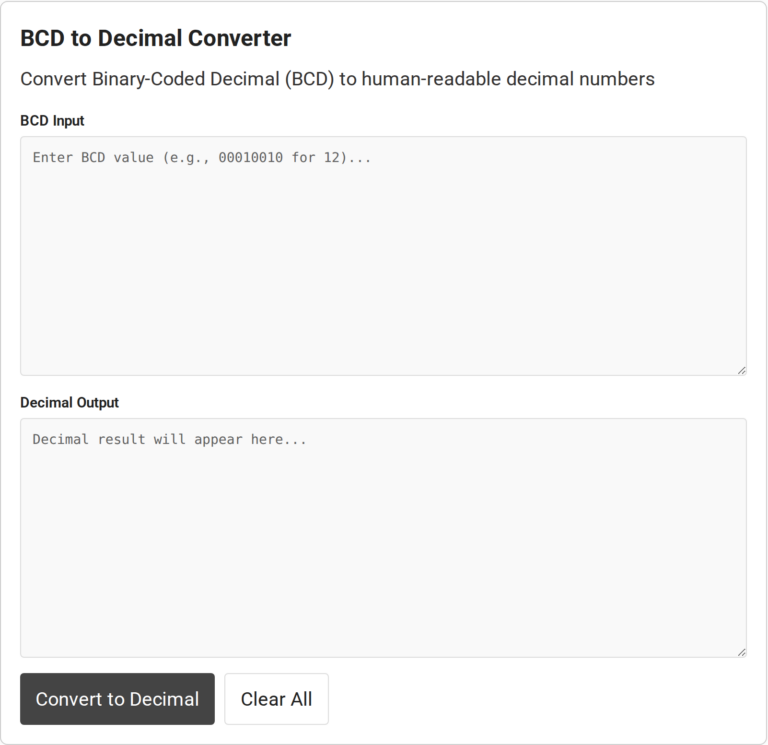
When a display or exercise gives you BCD bits, the groups can look like one binary number. The online converter reads each four-bit group as a decimal digit and shows the digits in order.
I’ll explain how BCD differs from ordinary binary, then show how to convert a value with the online tool.
TL;DR
Read each four-bit BCD group as one decimal digit, then join the digits from left to right. In standard 8421 BCD, a valid group represents 0 through 9.
- Split the input into groups of four bits.
- Check each group is between 0000 and 1001.
- Convert each group on its own. Do not read the whole string as one binary number.
What Is BCD and How Is It Different from Binary?
Binary-coded decimal, or BCD, stores every decimal digit in its own four-bit group. In the common 8421 form, bit positions carry weights of 8, 4, 2 and 1. The digit 6 is 0110 because 4 + 2 equals 6.
The string 0001 0010 gives decimal digits 12, whereas reading those bits continuously as a binary integer gives 18.
| Decimal digit | 8421 BCD | Calculation |
|---|---|---|
| 0 | 0000 | 0 |
| 5 | 0101 | 4 + 1 |
| 9 | 1001 | 8 + 1 |
The unused six four-bit combinations run from 1010 through 1111. Other circuit encodings may assign these combinations separate meanings.
How to Convert BCD to Decimal with the Online Tool
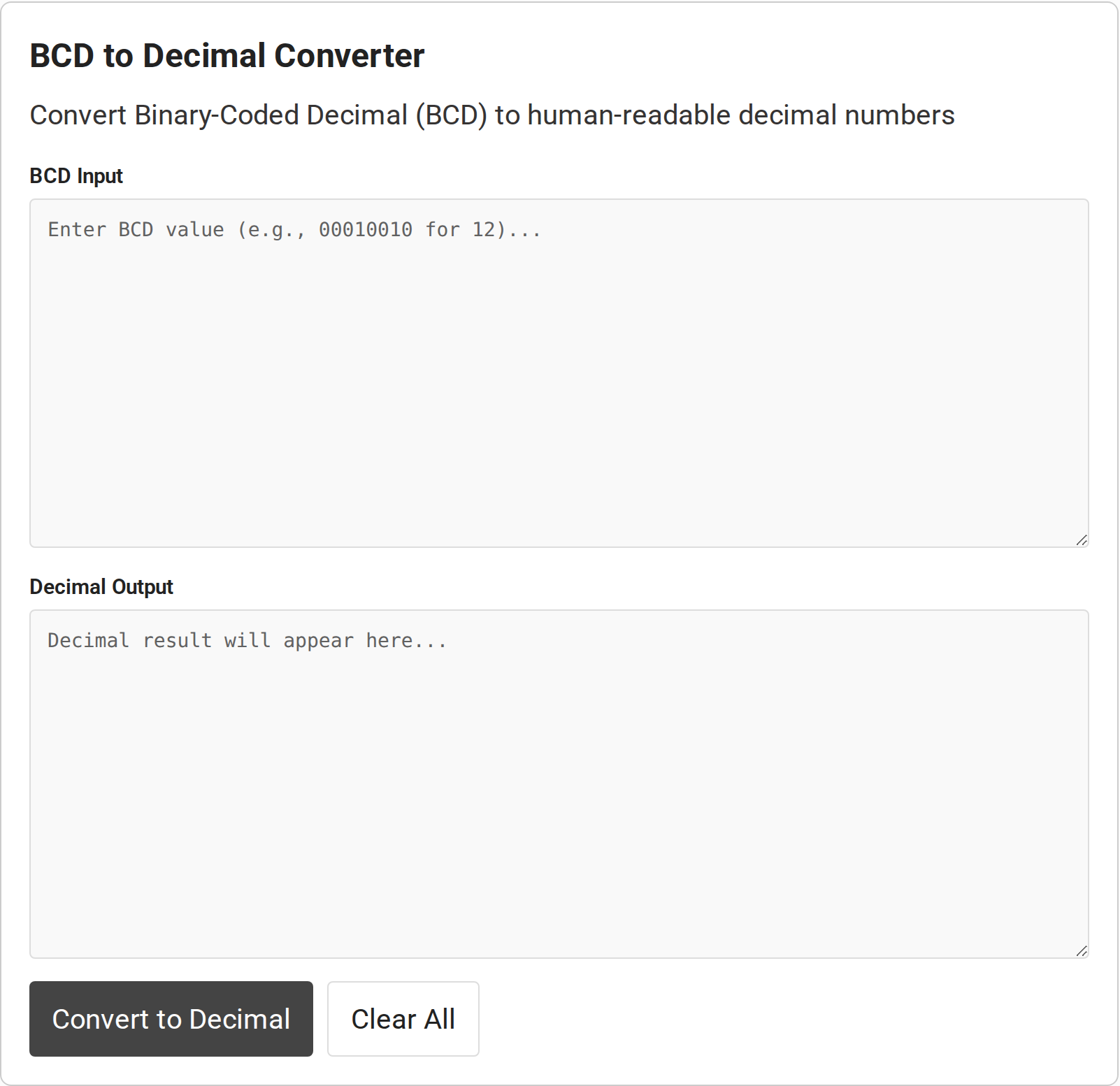
The page has a BCD Input area, a Convert to Decimal button, and an output area. Its input check verifies bit characters and group length, but it may return digits for an invalid BCD value.
Step 1: Split the BCD bits into groups of four
Mark a boundary after every four bits, starting at the left, and keep the original order.
Step 2: Identify valid BCD digit groups
For example, 0100 is 4 and 1001 is 9. Use the validity table below to assess groups outside those examples.
Step 3: Enter the bits and convert
Paste the groups into the BCD Input box and select Convert to Decimal. The decoded digits appear in the output box. Select Clear All before starting over with a blank form.
Step 4: Read the digits in their original order
For 0100 0101 0011, the result is 453. The order stays left to right, so the first group produces the first digit in the output.
The output has no spaces between groups, so compare each digit with its input nibble before copying it into a fixed-width field.
BCD Input Errors and Edge Cases
These cases separate malformed bit strings from four-bit values that fall outside the decimal digit set.
| Input | Check | Meaning |
|---|---|---|
| 0001 0010 | Valid | 1 and 2, so the result is 12 |
| 0000 0001 1001 | Valid | 0, 1 and 9, leading zero preserved |
| 1010 | Invalid BCD digit | Four bits, but value 10 is outside 0–9 |
| 010 0010 | Wrong group length | First group has only three bits |
| 01A0 | Invalid character | BCD input uses only 0 and 1 |
Whitespace is only a separator here, so 0001 0010 and 00010010 represent the same two groups. The page removes whitespace before grouping, and accepts a continuous string when its length divides evenly into four-bit groups.
For a manual conversion, write each nibble above its decimal digit. With 0010 1000 0001, the groups give 2, 8 and 1, so the result is 281. Use this to check a display reading or converter output.
To decode one group, add the weights under its set bits. For 0101, the 4 and 1 positions are set, so that nibble represents 5. This gives you a quick independent check without converting the complete string as binary.
A missing bit shifts the grouping and can change every digit after it. When the groups look wrong, count four bits from the left again and check the source for a dropped character.
The decimal quantity is 19, but a BCD digit string of 019 retains three displayed positions, which can matter for identifiers or fixed-width readouts.
If a reading includes a sign or decimal point, check the device format because sign and scale may be stored separately from the digit groups.
How to troubleshoot an unexpected result
Check the bit string before changing its interpretation. These checks separate a mistyped input from a BCD value that is valid as bits but invalid as a decimal digit.
| Case | What to check | Next step |
|---|---|---|
| Incomplete group | Remaining bit count is not divisible by four | Count from the left and check for a dropped bit |
| Invalid character | A group contains something other than 0 or 1 | Compare the source and correct the character |
| Invalid BCD digit | A four-bit value is 1010 through 1111 | Confirm the source encoding before changing the input |
| Digits appear shifted | Later groups no longer match the expected digits | Regroup from the left and check for an added or missing bit |
| Leading zero disappears | The value is displayed as a shorter number | Keep the digit string when width or identifier positions matter |
Conclusion
Retain leading zeroes when the output represents a fixed-width display or identifier. For the reverse direction, use the Decimal to BCD Converter. Hexadecimal input needs a different conversion, available with the HEX to Decimal Converter.
FAQ
These answers cover the input questions that come up when a BCD string does not look like an ordinary binary number.
Why does BCD 0001 0010 equal 12 instead of 18?
BCD treats each four-bit group as one decimal digit, so 0001 is 1 and 0010 is 2. Read as one ordinary binary number, the same bits equal 18.
Does BCD keep leading zeroes?
Yes. Each group becomes one digit, so a group of 0000 contributes a zero in that position. For example, 0000 0001 1001 becomes 019.
Is 1010 a valid BCD digit?
No. In standard 8421 BCD, valid digit groups range from 0000 to 1001. The group 1010 has value 10, which is outside the decimal digit range.