New to Rust? Grab our free Rust for Beginners eBook Get it free →
How Code Embeddings Work for Search and Help LLMs Understand Your Codebase | From Zero to AI Hero

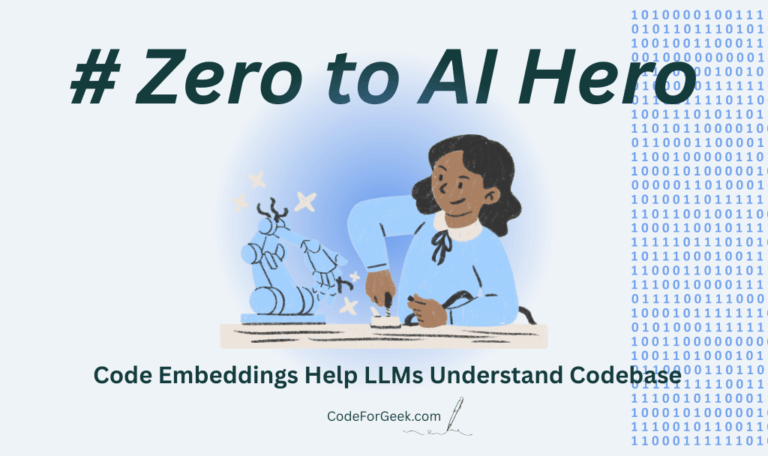
The foundation of modern AI developer tools, especially those that use RAG (Retrieval-Augmented Generation), is a seemingly magical concept: code embeddings.
If you want to understand how code embeddings work for search within your project, this article is essential. Embeddings are the key that allows an LLM to accurately find and understand the most relevant parts of your millions of lines of code.
The Problem with Standard Search
When you use the standard “Ctrl+F” or a simple keyword search in your IDE, the computer looks for an exact text match. If you search for “user authentication,” it will find exactly that phrase. However, it will miss code that says “validate credentials” or “verify user login,” even though those phrases mean the exact same thing.
This keyword-only limitation is why standard search is terrible for AI. An LLM needs to understand the meaning of the code, not just the words used.
How Code Embeddings Work for Search
An embedding is a numerical representation of an object, like a piece of code, a document, or a query. For code, the embedding is a long list of numbers (often hundreds or thousands of them) called a vector.
Here is the three-step process that explains how code embeddings work for search:
1. Vectorization: Turning Code into Coordinates
The process starts when a specialised embedding model takes a chunk of your code, say, a single function, and processes it. It converts the abstract meaning of that function into a specific vector.
This vector can be thought of as a set of coordinates in a high-dimensional space. The key principle is:
- Code that means similar things will have vectors that are numerically close together in this space.
- Code that means different things will have vectors that are far apart.
For example, the function def check_user_access(user_id): might be represented by a vector. A nearby vector could represent the documentation sentence “This method is used to verify permissions.” A vector for def calculate_shipping_cost(): would be very far away.
2. Storing in the Vector Database
Once all your code and documentation are converted into these vectors, they are stored in a vector database. A vector database is optimized for one task: lightning-fast searches based on numerical closeness.
When we discussed RAG for codebases explained in Article #1, we mentioned the “Retrieval” step. The vector database is the engine that powers that retrieval.
3. Semantic Search: Finding Similarity
When you ask the AI a question, such as, “How do I set up a new endpoint in the API?”, the system does not search for the keywords. Instead, it does this:
- The user’s question (“How do I set up a new endpoint?”) is immediately converted into its own query vector using the same embedding model.
- The system then compares this single query vector to the millions of stored code vectors in the database.
- It uses simple geometry, calculating the distance between vectors, to find the code snippets whose vectors are closest to the query vector.
The closest vectors represent the code and documentation that are most semantically similar to your question. This means the system retrieves code that is relevant in meaning, even if the exact keywords are not present. This is why LLM-powered tools like Copilot chat are so effective.
The Role in Advanced Workflows
Code embeddings are not just for answering questions. They are essential for almost every advanced developer AI task:
- Debugging: When an error is reported, the system can embed the error message and instantly retrieve the most semantically related functions and documentation, providing the LLM with the context it needs for efficient debugging. This is crucial for successful Chain-of-Thought prompting for code debugging (Article #3).
- Agentic Workflows: Autonomous agents, which we cover in Article #4 on agentic workflows, use embeddings to decide which tool or file to interact with next. An agent that needs to “fix a bug” first converts that task into an embedding to locate the relevant code sections to operate on.
- Model Specialization: When you are looking to specialize an open-source model using techniques like LoRA fine-tuning for code LLMs (Article #5), you often need to create high-quality, relevant training data. Embeddings help you quickly find and cluster similar code examples to build a focused training set.
Frequently Asked Questions (FAQs)
-
Are code embeddings the same as tokenization?
No. Tokenization breaks text into smaller pieces (tokens) for the LLM to process. Embeddings are numerical vectors that represent the meaning of those tokens. Tokenization is a prerequisite for both training LLMs and creating embeddings.
-
How big are code embeddings?
The size of a vector is the dimension of the embedding space. Common sizes range from 384 to 1536 dimensions. A vector is simply a list of that many numbers.
-
Does the embedding model need to be trained on my code?
No, the embedding model is typically trained on a vast and diverse dataset of public code to learn the general syntax, structure, and semantics of programming languages. You use this pre-trained model to generate embeddings for your private code. This is why RAG is cost-effective compared to full-scale training.
-
What is the most common mathematical technique used to calculate similarity?
The most common technique is called cosine similarity. This method measures the angle between two vectors in the high-dimensional space. A smaller angle (closer to 1) means higher similarity in meaning.
-
What happens if I update my code?
When you update your code, the system must re-embed the changed code chunks and update those corresponding vectors in the vector database. This ensures the RAG system is always retrieving the most current information.
-
How does this affect model performance?
The speed of the embedding look-up is critical. If the retrieval is slow, your entire AI experience is slow.
-
Are embeddings just for text and code?
No. The embedding concept applies to anything. You can create embeddings for images, videos, and even complex system logs.
Conclusion
Code embeddings are the unsung heroes of AI developer tools. They transform the textual, complex nature of code into a mathematically searchable format, making semantic search possible. This power unlocks the entire RAG paradigm and allows LLMs to interact with your specific project knowledge with incredible accuracy. The rapid advancements in embedding models by companies and open-source communities are making our AI coding assistants smarter and faster every day.