New to Rust? Grab our free Rust for Beginners eBook Get it free →
Conversational AI vs. Generative AI: What’s the Real Difference?

Conversational artificial intelligence (AI) manages an interaction across turns, while generative AI creates new text, images, audio, video, or code from an instruction.
Conversational AI vs. generative AI at a glance
The clearest distinction lies in the system’s job because a conversational system listens, identifies intent, keeps context, chooses an action, and returns an appropriate response.
A generative model predicts and produces new content.
| Aspect | Conversational AI | Generative AI |
|---|---|---|
| Primary job | Manage a useful exchange across one or more turns | Create new content from an instruction |
| Typical input | Text, speech, intent, and conversation context | A prompt plus optional files, images, or other context |
| Typical output | A response, clarification, lookup, or completed action | Text, images, audio, video, code, or structured data |
| Core components | Speech recognition, natural language understanding, dialogue management, integrations, and response delivery | Foundation models, prompt processing, generation, grounding, and safety controls |
| Best fit | Support bots, voice assistants, booking flows, and guided self-service | Drafting, summarization, design, coding, and content transformation |
| Main risk | Losing context, choosing the wrong intent, or failing a task flow | Producing unsupported, unsafe, or inaccurate output |
A product can belong to both categories. ChatGPT, for example, presents a conversational interface and uses generative models to compose its responses.
What is conversational AI?
Conversational AI lets you communicate with software through text or speech. Its goal is not merely to produce a fluent sentence, but to understand what you need and move the exchange toward an answer or action.
A customer-support assistant might identify a request to change an address, verify the account, collect the new details, call an application programming interface (API), and confirm the update. Dialogue management and business integrations matter as much as language quality in that workflow.
How conversational AI works
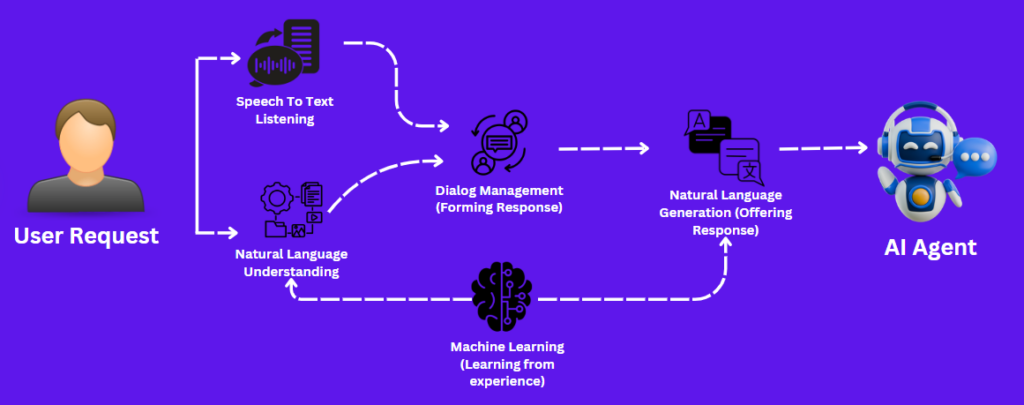
A conversational system usually combines several components rather than relying on one model.
- The interface accepts text or converts speech to text.
- Natural language understanding (NLU) identifies the intent and extracts details such as an order number, date, or product name.
- A dialogue manager uses the current request, earlier turns, and business rules to decide what happens next.
- The system retrieves information, calls another service, asks a clarifying question, or hands the conversation to a person.
- The response is returned as text or converted to speech.
Where conversational AI fits
- Customer support: Answer account questions, guide troubleshooting, and route exceptions to a human agent.
- Voice assistants: Interpret spoken requests, control devices, set reminders, and retrieve information.
- Commerce: Help you find products, check an order, arrange a return, or complete a booking.
- Internal help desks: Answer policy questions and trigger approved employee workflows.
Amazon Web Services describes conversational AI as systems designed to understand speech and conversational flow, with responses that can stay inside a configured scope. That boundary is useful when an incorrect answer could create support, compliance, or account risk.
Read the AWS overview of conversational AI for a component-level explanation.
What is generative AI?
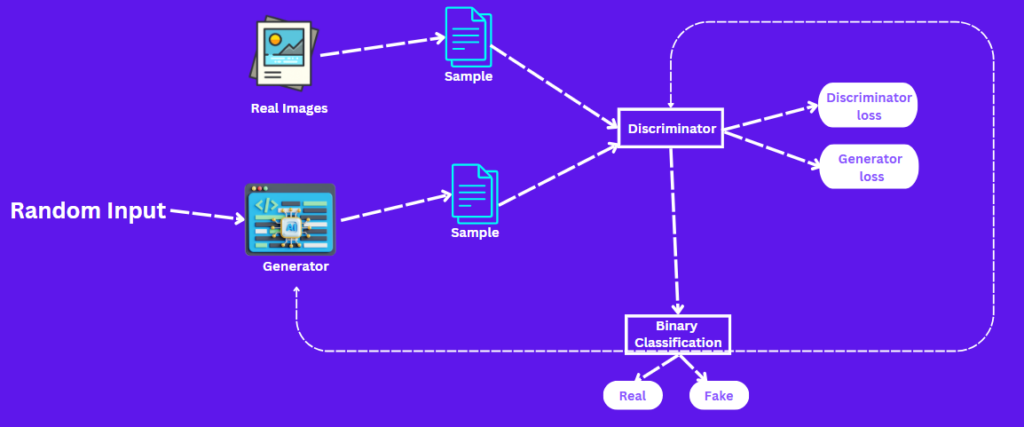
Generative AI creates new output by modeling the relationships learned from training data. A prompt steers the result, and additional context can ground the output in documents, databases, images, or tool results.
Large language models (LLMs) generate text and code by predicting tokens. Other model families generate images, speech, music, video, and three-dimensional assets.
How generative AI works
Training teaches a model statistical relationships across a large dataset. During inference, the model uses your prompt and supplied context to produce an output that follows those learned relationships.
Generation does not guarantee factual accuracy. Grounding, retrieval, tool calls, validation, moderation, and human review determine whether the output is dependable enough for its intended use.
Where generative AI fits
- Writing and summarization: Draft, rewrite, translate, classify, or condense text.
- Software development: Explain code, suggest implementations, generate tests, and transform code between languages.
- Design and media: Produce or edit images, audio, video, and presentation assets.
- Knowledge work: Extract information, compare documents, and produce structured drafts from source material.
If code assistance is your target, the Visual Studio Code and GitHub Copilot guide shows how generation fits into an editor workflow.
Why modern assistants use both
Modern assistants often place a generative model inside a conversational application where the conversation layer tracks turns, gathers missing details, applies permissions, calls tools, and decides when the task is complete.
The generative layer writes the response or transforms the supplied content.
Google Cloud’s guidance on building conversational experiences with generative AI describes this combination as a way to ground conversational answers in a provided knowledge base.
For a late-order complaint, the conversational layer identifies the order, checks its status, asks for the desired resolution, and keeps the exchange on task.
The generative layer drafts a message using those verified details, while production controls prevent the model from inventing a refund, delivery date, or policy that the connected service did not confirm.
Which one should you choose?
Choose based on the job, not the interface. A chat box does not prove that a product has robust dialogue management, and a fluent response does not prove that it can complete a business process.
- Choose conversational AI when you need multi-turn context, intent handling, controlled workflows, voice interaction, or escalation.
- Choose generative AI when you need to create, transform, summarize, or analyze content.
- Combine them when a conversation must gather context before creating content or taking an action.
Your evaluation should test task completion, grounding, latency, privacy, failure handling, and the handoff to a person. Model quality is only one part of the system.
The ChatGPT complete guide connects this distinction to practical prompting and assistant workflows. If you are comparing model behavior rather than system architecture, the DeepSeek and ChatGPT comparison is the more useful next step.
Frequently asked questions
Is ChatGPT conversational AI or generative AI?
ChatGPT uses generative models to create responses through a conversational interface, so it fits both descriptions. The model generates content, while the application manages messages, context, tools, and safety controls.
Can conversational AI work without generative AI?
Yes. A conversational system can use intent classification, rules, templates, retrieval, and fixed task flows without a generative model. That design can be preferable when responses must remain tightly controlled.
Does generative AI need a chatbot interface?
No. Generative AI can run inside an editor, image tool, search product, application programming interface, or automated workflow without a conversation.
Which technology is better for customer support?
Conversational AI provides the interaction structure that support needs. Generative AI can improve drafting and flexible answers, but grounding, permissions, workflow controls, and human escalation still determine whether the system is safe to deploy.