
New to Rust? Grab our free Rust for Beginners eBook Get it free →
Blockchain in Healthcare: Uses, Limits, and Practical Examples

How Blockchain Is Used in Healthcare
Blockchain in healthcare is most useful when several organizations need to verify the same event without giving one organization unchecked control of the record. It can support drug traceability, consent logs, clinical-trial provenance, and credential checks, but it does not replace electronic health records, privacy controls, or interoperability standards.
I checked current guidance from the US Food and Drug Administration, the Department of Health and Human Services, and the Office of the National Coordinator for Health Information Technology while rebuilding this explanation. Their material points to a narrower conclusion than “disruption”: a shared ledger can make selected handoffs easier to audit when governance and data handling are designed first.
The healthcare problems a ledger can address
Healthcare data crosses hospitals, laboratories, pharmacies, insurers, researchers, regulators, and patients, and each participant may keep its own database. A dispute can become a reconciliation exercise across copies, timestamps, and access logs.
A permissioned ledger gives approved participants a shared sequence of signed events. It is useful when the question is “who asserted this, when, and has the record changed?” rather than “where should a large clinical file live?”
How a permissioned healthcare blockchain works
A public blockchain lets unknown participants validate transactions. Healthcare workflows usually need a permissioned network instead, where known organizations receive defined roles and access rules.
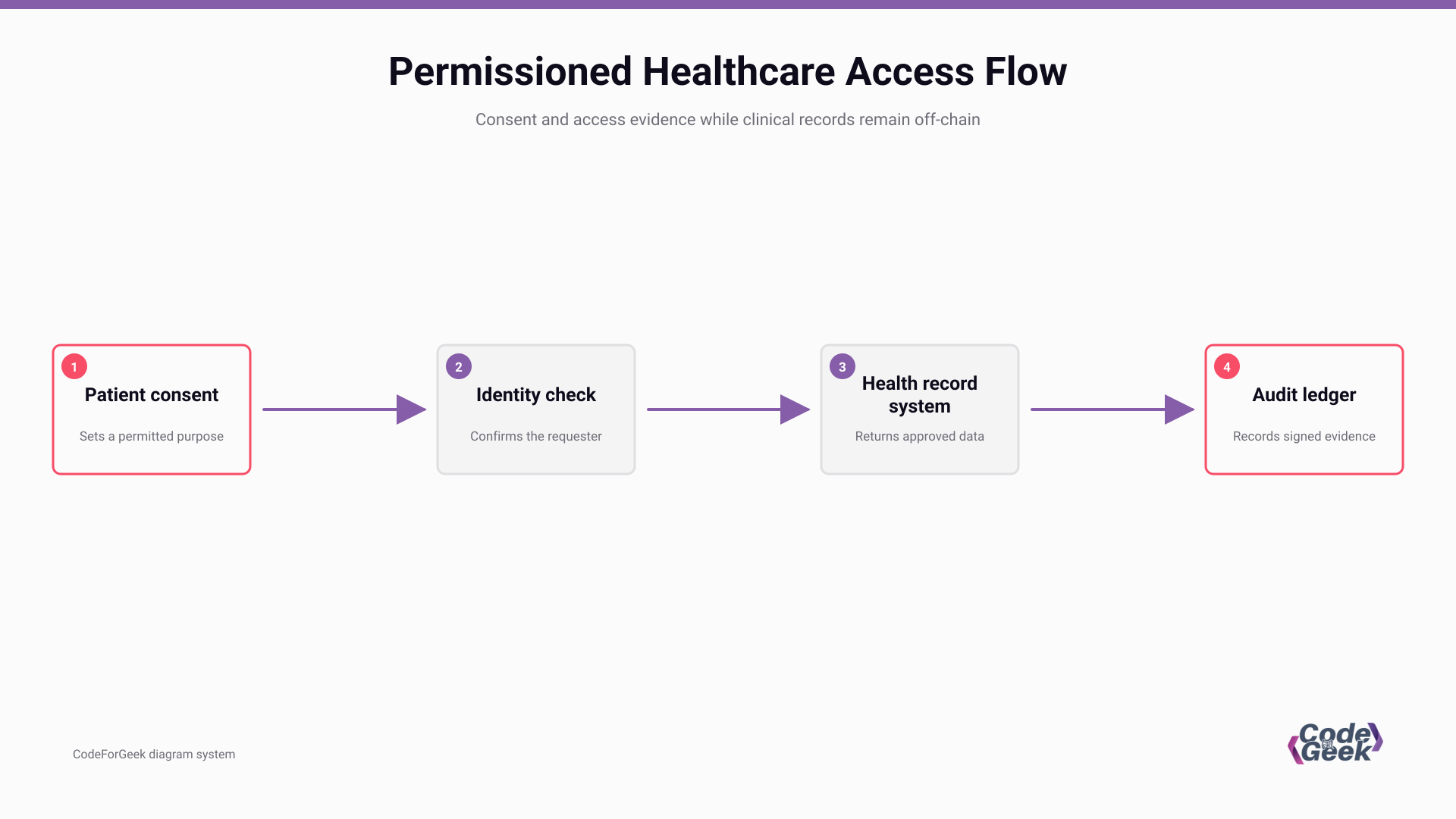
The ledger then records signed references to events, such as a consent change, a product handoff, or a trial-data submission. The clinical content stays in a system built to protect, update, and retrieve it.
Store proofs and permissions, not clinical files
Medical images, notes, and laboratory reports are large, sensitive, and sometimes need correction. Putting them directly on an immutable ledger creates retention, correction, and exposure problems.
A safer design stores a cryptographic fingerprint, a reference, and the policy decision on the ledger, allowing an authorized verifier to detect when an off-chain document no longer matches the recorded evidence.
Verify each access request
An access request should pass through identity, authorization, and audit checks. The application confirms who is asking, evaluates whether that person has a permitted purpose, retrieves only the allowed off-chain data, and records the resulting access event.
The ledger does not decide whether access is lawful. That decision still depends on the organization’s privacy policy, applicable law, patient consent, role assignments, and the surrounding health-record system.
Where blockchain can help
The strongest healthcare use cases have a shared handoff, multiple accountable parties, and a reason to preserve evidence. A ledger adds little value when one trusted system already owns the full workflow.
Drug traceability
Each medicine-package handoff can record the product identifier, sender, receiver, time, and supporting evidence as it moves through manufacturers, distributors, dispensers, and sometimes regulators.
The FDA’s Drug Supply Chain Security Act work focuses on interoperable electronic tracing across trading partners. A permissioned ledger can support that handoff history, but it must integrate with serialization, verification, exception handling, and each participant’s operational systems.
Consent and access logs
Recording signed, time-stamped consent changes can help an organization demonstrate which policy it evaluated at the moment of access, including when a patient grants, withdraws, or narrows permission.
That evidence is not a substitute for consent management. You still need a user-facing process for explanation, revocation, identity recovery, and handling the jurisdictions where consent is not the only legal basis for processing health information.
Clinical-trial provenance and credentials
Research teams can record when a protocol artifact, data submission, or approval was produced and by whom, while a verifier compares the retrieved artifact with its recorded fingerprint without exposing every underlying record to every participant.
The same approach can support professional credentials when issuers, employers, and regulators need to verify a signed claim. The ledger proves evidence flow, not whether the original claim was accurate when it entered the system.
What blockchain does not solve
Blockchain does not make a poor data model interoperable. Health systems still need agreed identifiers, terminology, application programming interfaces, data-quality rules, and workflows that let clinicians act on the information they receive.
The HIPAA Security Rule requires administrative, physical, and technical safeguards, so a ledger design must fit those safeguards rather than claim to replace them.
Participants must decide who may join, how keys are recovered, who resolves disputes, how software changes are approved, and what happens when an organization leaves the network.
A practical evaluation checklist
Start with the handoff, not the technology. Write down the event that must be shared, the organizations that must verify it, the data that must remain off-chain, and the system that remains responsible for clinical retrieval.
- Is there more than one accountable organization?
- Does each participant need an independently verifiable history?
- Can sensitive health data stay outside the ledger?
- Do identity, authorization, correction, retention, and incident processes exist?
- Would a shared database with clear ownership solve the same problem more simply?
If the answer points to a shared evidence trail across independent parties, a permissioned blockchain may be worth prototyping. If the issue is incomplete clinical data exchange inside one organization, improve the health IT workflow first.
Conclusion
Blockchain can support healthcare when it records a narrow, auditable handoff between parties that need shared evidence. Keep clinical data off-chain, treat privacy and interoperability as separate design work, and test the governance model before treating the ledger as an answer.
Can blockchain store medical records?
A healthcare system should usually keep medical records in approved off-chain storage. A permissioned ledger can record a fingerprint, reference, consent event, or access evidence so authorized participants can verify the history without placing clinical files on the ledger.
Does blockchain make healthcare data HIPAA compliant?
No. HIPAA compliance depends on administrative, physical, and technical safeguards, plus the organization’s policies and operations. A blockchain design must fit those controls and does not replace them.
Where is blockchain most useful in healthcare?
It is most useful for shared, auditable handoffs between accountable organizations, such as drug traceability, consent evidence, clinical-trial provenance, and credential verification.