New to Rust? Grab our free Rust for Beginners eBook Get it free →
Blockchain vs Database: Differences and When to Use Each

A database is the better default when one accountable organization controls the application and needs fast queries, private data, and ordinary updates. A blockchain earns its extra coordination cost when independent parties must agree on a shared transaction history without giving one participant sole control.
The direct verdict
Choose from the trust boundary, not from a feature checklist.
If your application already has a trusted operator, a conventional database gives you simpler writes, richer queries, mature access control, and easier correction of mistakes.
Choose a blockchain when several parties need to submit or verify transactions, do not want one party to rewrite history, and can accept consensus latency, replicated storage, and more complex governance. Many production systems combine both technologies because public verification and private application data have different jobs.
Blockchain vs database at a glance
Both technologies store data, but they answer different questions about who may change it and how everyone accepts a valid state.
The table compresses the architectural differences that affect a build decision.
| Decision axis | Conventional database | Blockchain |
|---|---|---|
| Control | A known operator or administrator defines permissions | Network rules and consensus determine accepted writes |
| Data changes | Create, read, update, and delete operations are normal | Confirmed history is append-oriented and changes require protocol-approved actions |
| Trust | Participants trust the operator and its controls | Participants verify a shared state under the protocol |
| Queries | Flexible indexes, joins, filters, and aggregates | Ledger reads are often narrower, with indexes or off-chain stores added for analysis |
| Performance | Optimized for low-latency application workloads | Consensus and replication add latency and resource cost |
| Privacy | Fine-grained access control can keep records private | Visibility depends on public, private, or permissioned network design |
| Failure recovery | Backups, replicas, logs, and administrator action | Replicated nodes and protocol rules maintain the accepted history |
| Best fit | Apps with one accountable data owner | Multi-party workflows without one trusted record keeper |
How the trust model changes the design
The word distributed does not settle the comparison. A database can run across many servers while one organization still controls schemas, permissions, backups, and write policy.
Database control and transactions
A database management system gives an operator a controlled place to validate, store, query, correct, and delete application data.
Relational systems commonly use atomicity, consistency, isolation, and durability (ACID) guarantees so concurrent transactions either complete under defined rules or roll back safely.
Replication can remove a single-machine dependency, and an audit log can preserve change history. Those capabilities strengthen availability and accountability, but they do not remove the trusted administrator who sets policy.
Blockchain consensus and shared history
A blockchain distributes a ledger among network participants.
Transactions are grouped into records linked with cryptographic hashes, while a consensus mechanism decides which proposed state the network accepts.
AWS describes consensus as the participant rules for recording transactions, and NIST IR 8202 explains blockchains as tamper-evident, tamper-resistant distributed ledgers. That language is more precise than claiming that stored data can never change under any circumstance.
Key differences that affect your architecture
The strongest differences appear after you map each technology to an actual workload. Control, update semantics, latency, privacy, and recovery should determine the choice.
Data changes and audit history
Databases expect records to change.
An order can move from paid to shipped, a customer can correct an address, and a privacy request can trigger deletion under the operator’s policy.
A blockchain usually records another transaction instead of replacing an accepted one. The old state remains part of the ledger history, while the later transaction represents a correction, transfer, reversal, or new state allowed by the protocol.
Hash links make an earlier edit detectable because changing one block breaks the hashes that follow it.
Network governance still matters because a chain can fork, protocol participants can agree on exceptional recovery, and application-level entries may point to data stored elsewhere.
Performance and query flexibility
A conventional database processes writes under one administrative policy, which supports low-latency transactions and optimized query plans. You can add indexes, join related tables, aggregate records, and tune storage around the application’s dominant workload.
A blockchain asks multiple nodes to validate and replicate accepted transactions. That work buys shared verification, but it adds latency, storage duplication, and operational cost. Analytics commonly move to an indexed service or an off-chain database rather than scanning the ledger for every application request.
Privacy and access control
A private database can restrict records by user, role, tenant, column, or row.
Encryption protects data in transit and at rest, while the application and administrator enforce who may retrieve plaintext.
A public blockchain favors broad verification, so sensitive personal or business data rarely belongs directly on-chain. Permissioned networks narrow participation, but you must still decide which members can read payloads, propose transactions, validate blocks, and manage keys.
Resilience and failure handling
Databases use replicas, transaction logs, snapshots, backups, and failover procedures.
A trusted operator can restore a damaged service or correct a bad write, which is valuable when an incident needs accountable intervention.
Blockchain nodes retain copies of the accepted ledger and continue under protocol rules when some nodes fail. This does not make every blockchain application available or secure because smart-contract defects, key loss, bridge failures, and weak validator incentives sit outside simple data replication.
Run a small integrity demo
The following dependency-free script ran with Node.js 26.7.0 during this refresh.
It contrasts an ordinary mutable Map with a small hash-linked log, then edits an earlier entry to show why verification fails.
The script demonstrates one mechanism only. It has no peer network, digital signatures, consensus, persistent storage, or adversarial validator model, so it is not a blockchain implementation.
const { createHash } = require('node:crypto');

function hashBlock(block) {
  return createHash('sha256')
    .update(`${block.index}|${block.previousHash}|${block.data}`)
    .digest('hex');
}

function addBlock(chain, data) {
  const previousHash = chain.length === 0 ? 'GENESIS' : chain.at(-1).hash;
  const block = { index: chain.length, previousHash, data };
  block.hash = hashBlock(block);
  chain.push(block);
}

function isValid(chain) {
  return chain.every((block, index) => {
    const expectedPrevious = index === 0 ? 'GENESIS' : chain[index - 1].hash;
    return block.previousHash === expectedPrevious && block.hash === hashBlock(block);
  });
}

const database = new Map([['order-42', 'paid']]);
database.set('order-42', 'shipped');
console.log(`Database value after update: ${database.get('order-42')}`);

const chain = [];
addBlock(chain, 'order-42:paid');
addBlock(chain, 'order-42:shipped');
console.log(`Chain valid before tampering: ${isValid(chain)}`);

chain[0].data = 'order-42:refunded';
console.log(`Chain valid after tampering: ${isValid(chain)}`);
Run the file with this command from its directory.
node integrity-demo.js
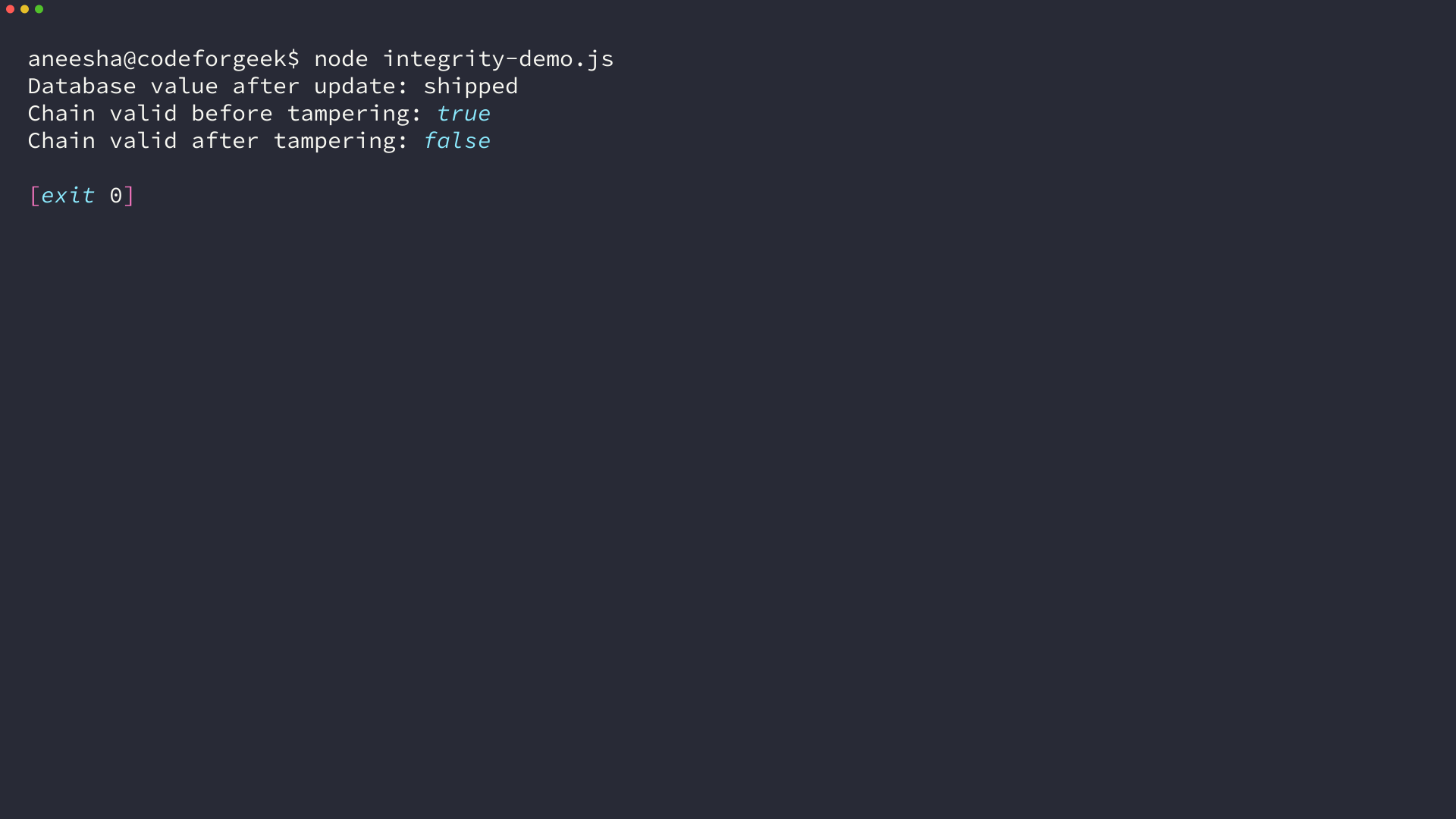
The Map accepts the new value because updates are part of its interface.
The chain reports false after the earlier entry changes because the stored hash no longer matches the block contents.
When to use a database
Start with a database when one organization owns the service and its authorization rules. This choice fits most websites, internal tools, software-as-a-service products, inventory systems, content platforms, and customer applications.
- One accountable operator can approve writes and resolve disputes.
- The application needs frequent corrections or deletions.
- Private records need fine-grained access control.
- Low latency, complex queries, reporting, or high write volume drives the design.
- Backups, audit logs, and signed events provide enough evidence for your threat model.
Do not reject a database merely because the service needs redundancy or several regions.
Distributed SQL, replication, change-data capture, and append-only audit tables can meet those requirements without decentralized governance.
When to use a blockchain
Evaluate a blockchain when several independent organizations share a workflow and none should own the canonical record alone. The design becomes stronger when participants already have conflicting incentives or costly reconciliation between separate ledgers.
- Independent parties must verify a shared sequence of transactions.
- No single participant should be able to rewrite accepted history.
- A token, asset, or smart contract must move under shared protocol rules.
- Public verification matters more than keeping every record private.
- The participants accept the network’s governance, fees, latency, and key-management duties.
Blockchain is not a security upgrade you can attach to any application.
If one company controls every validator, contract upgrade, gateway, and identity decision, a signed database ledger may provide the same useful accountability with less complexity.
When a hybrid architecture works better
A hybrid system keeps sensitive or query-heavy data in a database and places a hash, identifier, settlement event, or ownership change on a blockchain. The ledger provides a shared verification point while the database serves application screens, search, analytics, and privacy controls.
This split also creates a boundary you must design.
A hash can prove that an off-chain record changed, but it does not prove that the original record was truthful, available, legally collected, or interpreted correctly.
If you need a deeper foundation before choosing that split, review the comparison of blockchain and conventional ledgers. It clarifies why shared verification is different from ordinary record keeping without forcing a broad cluster link into the decision.
Use this decision checklist
Answer the control questions before comparing platforms, consensus algorithms, or cloud services. A yes to blockchain should come from the governance requirement, not from a desire to make a familiar database sound more advanced.
- Who may write? Name every organization or participant that can propose a transaction.
- Who decides validity? Identify the operator, quorum, validator set, or protocol rule.
- Who may correct mistakes? Define reversals, compensating transactions, deletion duties, and incident authority.
- Who needs to verify history? Separate internal auditors from independent external participants.
- What must stay private? Keep personal data, secrets, and large documents off a broadly visible ledger.
- What cost is acceptable? Include consensus latency, replicated storage, fees, key custody, monitoring, and contract review.
If one trusted operator answers every question, choose a database first.
If independent participants need a shared history and no operator can fairly own it, prototype the smallest blockchain workflow that tests that assumption.
Frequently asked questions
These answers address the boundary cases that make the comparison easy to misuse.
Is a blockchain a database?
A blockchain stores and retrieves records, so it can be described as a specialized distributed ledger or data store. Its defining feature is not storage alone. Cryptographic linking, consensus, replicated history, and shared governance change how writes become accepted.
Is blockchain more secure than a database?
Neither technology is automatically more secure. A blockchain can resist unilateral history changes, while a well-operated database can provide strong authentication, encryption, access control, backups, and audit logs. Your threat model decides which controls matter.
Can blockchain data be changed or deleted?
Confirmed history is designed to be tamper-evident and difficult to rewrite without the required consensus. Later transactions can correct application state, networks can fork, and governance may permit exceptional changes. Do not store personal data on-chain when deletion duties apply.
Can a database be distributed?
Yes. Replication, sharding, and distributed SQL can place database data across many machines or regions. Distribution improves scale and resilience, but a known operator can still control permissions and policy.
Do blockchain applications still need databases?
Many do. Databases support indexes, search, analytics, private profiles, cached views, and off-chain documents, while the blockchain holds settlement or shared verification events.
Choose from the trust boundary
A conventional database is the sensible starting point when your application has one accountable owner. Move toward blockchain only when independent parties need shared verification and the governance benefit justifies slower coordination, duplicated state, key custody, and protocol risk.
Build a small proof around one disputed transaction before committing the wider system.
Measure the complete write path, test a reversal, remove a participant, lose a key in a safe environment, and confirm that the shared ledger solves a coordination problem your database controls cannot solve.