New to Rust? Grab our free Rust for Beginners eBook Get it free →
Extract Address Information Using Geocodeapi

When an app accepts an address or place name, it needs a way to turn that text into location data. Geocodeapi looks up a place from address text or coordinates.
I’ll show how to send address or coordinate lookups from Node.js while keeping the API key out of the source file, then how to inspect the response before using it.
TL;DR: Use Geocodeapi From Node.js
Use a Node.js request to send address text to a geocoding endpoint, then check the HTTP response before using its data.
- Keep the API key in an environment variable instead of the source file.
- Use the historical Geocodeapi search path only after confirming it in the provider’s current reference.
- Do not treat a missing key or a server error as an address result.
What Is Geocodeapi Address Lookup?
Geocodeapi address lookup uses address text or coordinates to find a matching place and return location data.
| Task | Input | What to verify |
|---|---|---|
| Forward geocoding | Address or place text | Search endpoint and returned coordinate fields |
| Reverse geocoding | Latitude and longitude | Reverse endpoint and address-result fields |
| Autocomplete | Partial text | Suggestion endpoint, minimum input rules, and selected-result shape |
Place text can match several locations based on provider data, so inspect the returned detail before displaying it. A city-level match should not be presented as a street address.
After a request returns, select only the fields the screen needs instead of passing an entire provider object to the interface.
How to Extract Address Information with Geocodeapi
To extract address information with Geocodeapi, send an address query to its search endpoint and inspect the returned response.
- Use Node.js 26.7.0 or another runtime with the global fetch API.
- Save the program as geocodeapi_demo.mjs in your project directory.
Step 1: Keep the API key outside the source file
The sample reads GEOCODEAPI_API_KEY from the process environment and exits with code 2 before sending a request if it is missing. Set the variable in the same shell that starts Node.js, and replace this placeholder with your local key:
export GEOCODEAPI_API_KEY="YOUR_KEY_HERE"
node geocodeapi_demo.mjs
The historical example passes apikey in the query string, so avoid printing that URL or sending it to request-debug logs.
URL and URLSearchParams encode the address and key as separate request parameters instead of joining raw text into a URL. This keeps punctuation such as an ampersand inside the address value rather than treating it as a new parameter.
const apiKey = process.env.GEOCODEAPI_API_KEY;

if (!apiKey) {
  console.error("GEOCODEAPI_API_KEY is not set.");
  process.exitCode = 2;
} else {
  const url = new URL("https://app.geocodeapi.io/api/v1/search");
  url.searchParams.set("text", "Mumbai");
  url.searchParams.set("apikey", apiKey);

  try {
    const response = await fetch(url);
    const body = await response.text();
    const safeBody = body.split(apiKey).join("[redacted]");

    console.log(`HTTP ${response.status} ${response.statusText}`);
    console.log(safeBody);
    if (!response.ok) process.exitCode = 1;
  } catch (error) {
    console.error(`Request failed: ${error.name}`);
    process.exitCode = 1;
  }
}
The .mjs extension marks this file as an ES module, allowing top-level await in the standalone example. In a CommonJS project, put the request inside an async function or configure the project’s module format consistently.
To check the missing-key path without contacting the API, run the named file with GEOCODEAPI_API_KEY removed from that process.
env -u GEOCODEAPI_API_KEY node geocodeapi_demo.mjs
GEOCODEAPI_API_KEY is not set.
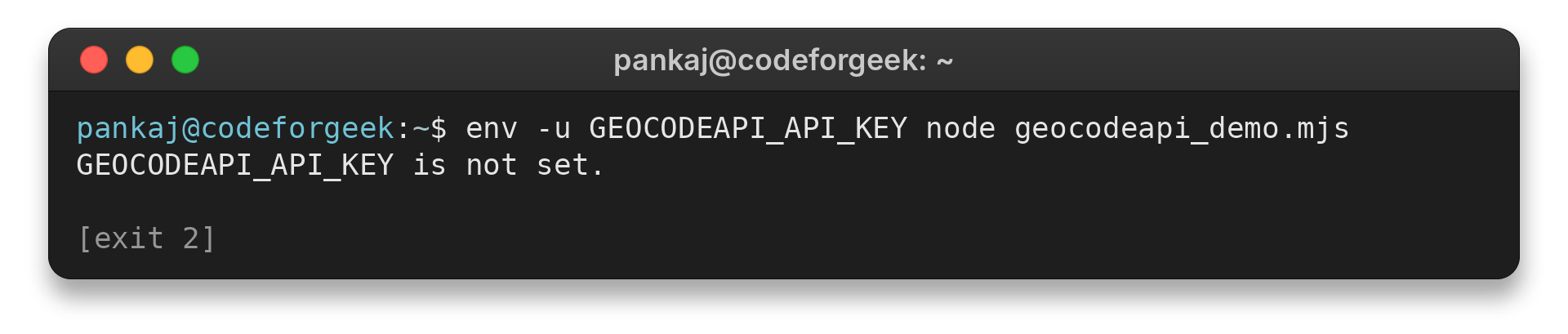
The screenshot shows only the local configuration check. No authenticated request or successful Geocodeapi response is included.
Step 2: Confirm the forward-search parameters
The next table lists the request fields shown in the previous article.
| Historical value | Purpose in the old example | Evidence limit |
|---|---|---|
| GET /api/v1/search | Search using text | Appears in the prior page |
| text | Address or place query | Used by the old request |
| apikey | Credential parameter | Shown in the old example |
The table records route and parameter names from the previous page, which should be compared with the current vendor reference.
Use a full address or a specific place name as the sample query. It retains Mumbai from the original page, and no specific result is promised.
Keep one query fixed while testing and change only one variable at a time. This helps connect a changed result to the input or code change.
Step 3: Use reverse geocoding for coordinates
Reverse geocoding takes a coordinate pair and looks for a matching address or place.
| Historical parameter | Value to supply | Role in the old request |
|---|---|---|
| point.lat | Latitude for the point | One coordinate component |
| point.lon | Longitude for the point | The other coordinate component |
| apikey | Private API credential | Authentication parameter |
Keep latitude and longitude in separate fields and check the source’s coordinate order before passing the pair to a geocoder. The older example used coordinates near the Eiffel Tower as its test point.
Because device coordinates can reveal a precise location, send them only when reverse lookup is required and discard them when the feature no longer needs them. If storage is necessary, set a retention period that matches the feature.
Step 4: Inspect the response before using a result
The catch block runs when fetch rejects before an HTTP response exists, and reports the exception name rather than a stack trace.
Because fetch resolves even for HTTP errors, the program exits with code 1 when response.ok is false. A 2xx body can still contain no match or an API-level error.
Calling response.text() consumes the response body. If structured fields are needed later, parse that text once with JSON.parse inside a try/catch after confirming the response format; do not call response.json() on the same response afterward.
| Response state | What the sample does | What to do next |
|---|---|---|
| 2xx status | Prints the response body. | Inspect the returned data before choosing fields. |
| Non-2xx status | Prints the body and exits with code 1. | Check the provider’s status and error guidance. |
| Network exception | Prints the exception name and exits with code 1. | Check the connection, then retry under the provider’s guidance. |
The unauthenticated request to the historical search URL returned HTTP 522 on October 26, 2026, and that gateway response says nothing about key validity or result fields.
What to Check When a Geocodeapi Request Fails
When a Geocodeapi request fails, check the API key, request URL and parameters, HTTP status, and response body to locate the fault.
| Case | What you see | Next check |
|---|---|---|
| Missing key | The sample reports a missing key and exits with code 2. | Set the variable in the environment that launches Node.js. The script skips the network request in this case. |
| HTTP 400 | The server rejects the request syntax. | Compare the path and parameter names with the current reference. |
| HTTP 404 | The route or requested resource was not found. | Check the host, path, and method against current provider documentation before changing address text. |
| HTTP 401 or 403 | The server rejects the request. | Check the key and current authentication rules. Do not assume that another provider’s key restrictions apply here. |
| HTTP 429 | The service signals a rate limit. | Check the provider’s quota and retry guidance before sending another request. |
| HTTP 5xx or timeout | A server or gateway did not complete the request. | Retry later and check the provider status page or support channel. A gateway failure says nothing about address matches. |
| Successful response with unexpected detail | The result identifies a broader place than the task needs. | Inspect the returned fields and avoid displaying a city match as a street address. |
| Successful HTTP response with no expected fields | The request returned content, but the parser does not find the field it needs. | Confirm the documented response schema and inspect the full response before selecting a property. |
| No matching address | The response completes but contains no useful result for the submitted text or point. | Check spelling, address detail, coordinate order, and any documented country or result filters. |
For credential or endpoint failures, compare the response with the provider’s troubleshooting guidance before changing the submitted address.
When contacting support, share the status and a sanitized response excerpt. Remove credentials and precise customer locations from logs or screenshots.
Conclusion: Verify the Endpoint Before Shipping
Use the Geocodeapi API v1 reference to confirm the request and response contract before shipping.
For an adjacent Node.js example of API-key handling and response filtering, see CodeForGeek’s Zenserp API guide. The Node.js Promises vs Async/Await guide explains the asynchronous syntax used by the request sample.
FAQ
These answers cover result variation, autocomplete, and key placement without assuming undocumented Geocodeapi behavior.
Does reverse geocoding always return a street address?
No. Reverse geocoding can return a broader place when a street-level match is unavailable. Check Geocodeapi’s current result types and precision fields before displaying a result as a street address. Coordinates can be valid even when the response identifies only a locality.
Can I use the search endpoint for address autocomplete?
Do not assume so. Autocomplete may use a separate endpoint for partial text. Confirm Geocodeapi’s current documentation before wiring suggestions into a form. Wait for the user to select a suggestion before treating it as the completed address.
Should I put the API key in browser JavaScript?
Keep a private key on a server or in a protected runtime environment. A key shipped in browser code can be read by visitors. Follow the provider’s current instructions for restrictions and client-side use.