New to Rust? Grab our free Rust for Beginners eBook Get it free →
Verida Alpha Protocol for Web3 Developers: Architecture and SDKs

Verida Alpha Protocol introduced a privacy-focused application stack built around user-controlled identity, encrypted data, and QR-based authorization. The useful question for a Web3 developer is no longer whether the Alpha release is live, but which parts became the Verida SDK stack and what you should verify before trusting them with application data.
What the Alpha Protocol introduced
The 2021 Alpha release grouped four components into one developer story. A user approved access in the mobile wallet, the application connected through a software development kit (SDK), and encrypted records moved to storage nodes without putting personal data on a public blockchain.
| Alpha component | Developer job | Boundary |
|---|---|---|
| Client SDK | Opens application contexts, databases, identity, messaging, and schema features | Your application still owns its authorization rules and error handling |
| Single Sign-On SDK | Starts a QR authorization request through the Verida Wallet | A login grants scoped application access, not unrestricted access to a user’s data |
| Verida Wallet | Holds the user’s identity and approves application requests | The wallet approval does not replace consent design inside your application |
| Storage Node | Persists encrypted databases for Verida accounts | The storage service receives ciphertext, while keys remain on the user side |
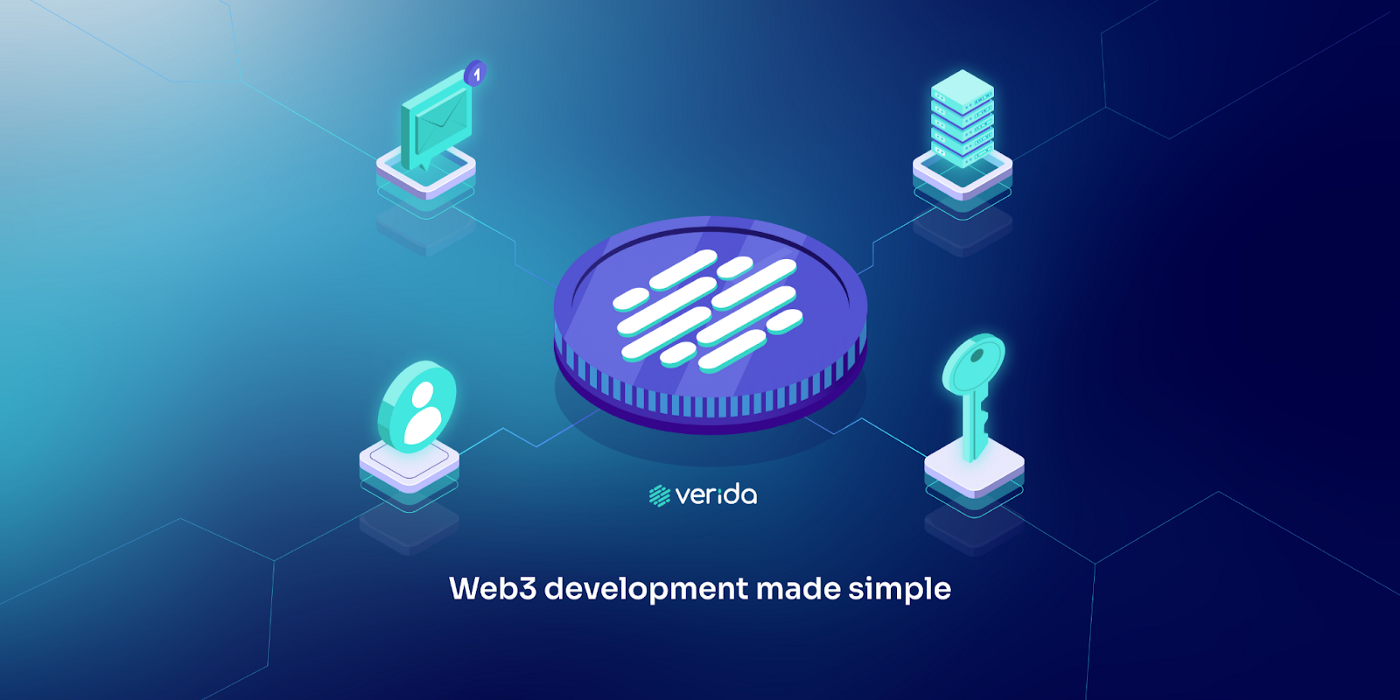
This launch artwork presented identity, keys, messaging, and storage as one stack. It is useful historical context, not an installation screen.
How private data moves through a Verida application
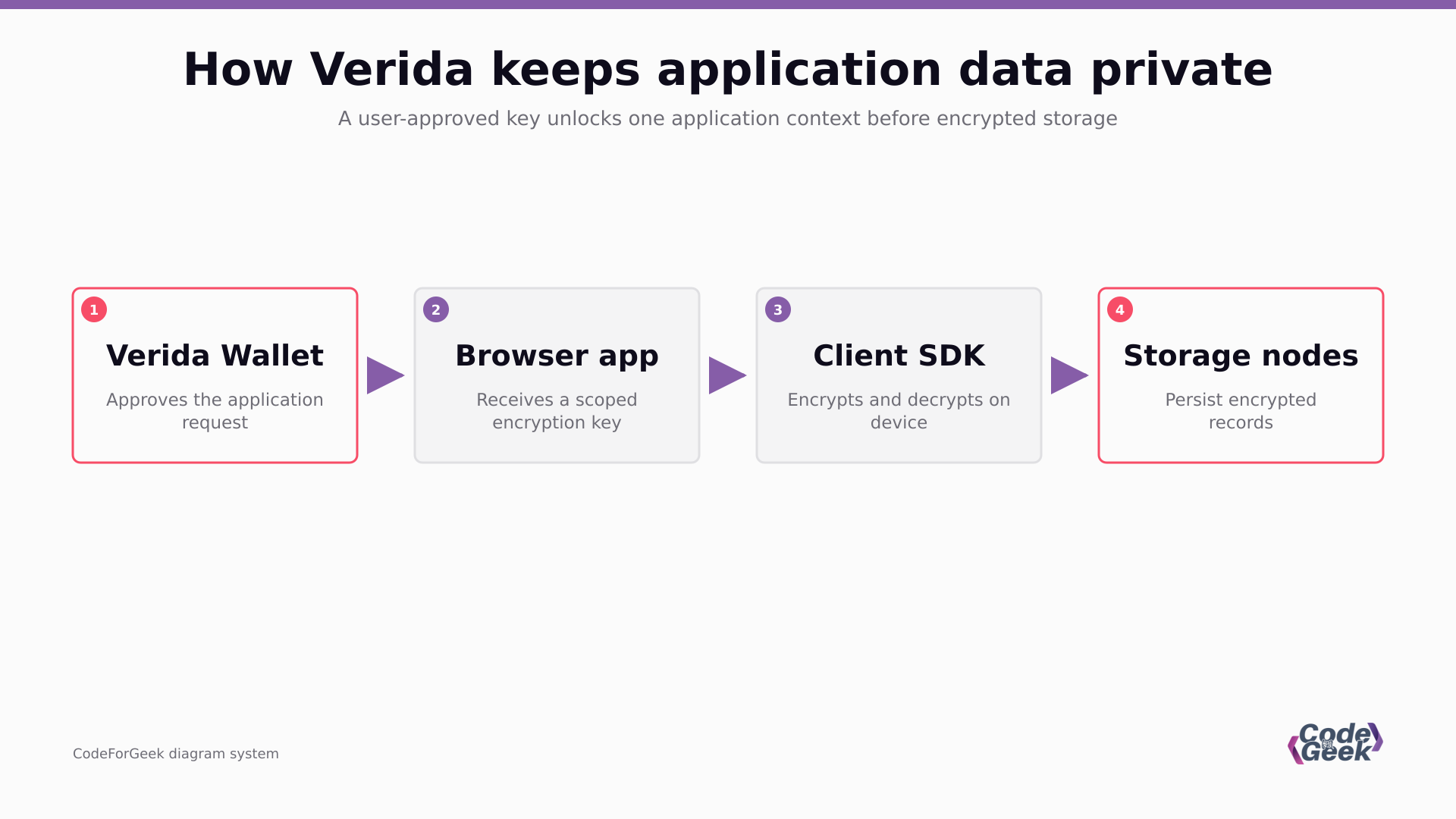
Verida’s design separates authorization, application logic, encryption, and persistence because a decentralized identity does not automatically make stored data private.
The Wallet authorizes one application context
The Verida Wallet controls the user’s decentralized identity and displays an authorization request that unlocks one isolated application context with its own data, keys, and storage configuration.
That scope prevents one connected application from receiving every record held by the same identity. Your interface should identify the requesting application, explain the requested data, and handle cancellation as a normal outcome.
The SDK handles data on the user side
The Client SDK exposes identity, database, messaging, and schema operations while encryption and decryption occur on the user’s device before records reach a storage node.
This architecture lets the storage operator persist and replicate records without receiving the private key required to read their contents.
Storage nodes persist encrypted records
A storage node provides authenticated database storage where access controls govern read, write, and delete operations while encrypted records remain separated by application context.
Do not describe this as storing personal information on-chain because the identity and authorization layer is distinct from the databases that hold application records.
What developers can evaluate today
The maintained verida-js repository identifies client-ts as the protocol client, account-web-vault as the browser authorization package, and account-node as the server-side account package controlled by a private key or seed phrase.
Confirm the published package versions
Check the npm registry before copying an integration example with this command for the two packages used by Verida’s browser getting-started path.
npm view @verida/client-ts version && npm view @verida/account-web-vault version
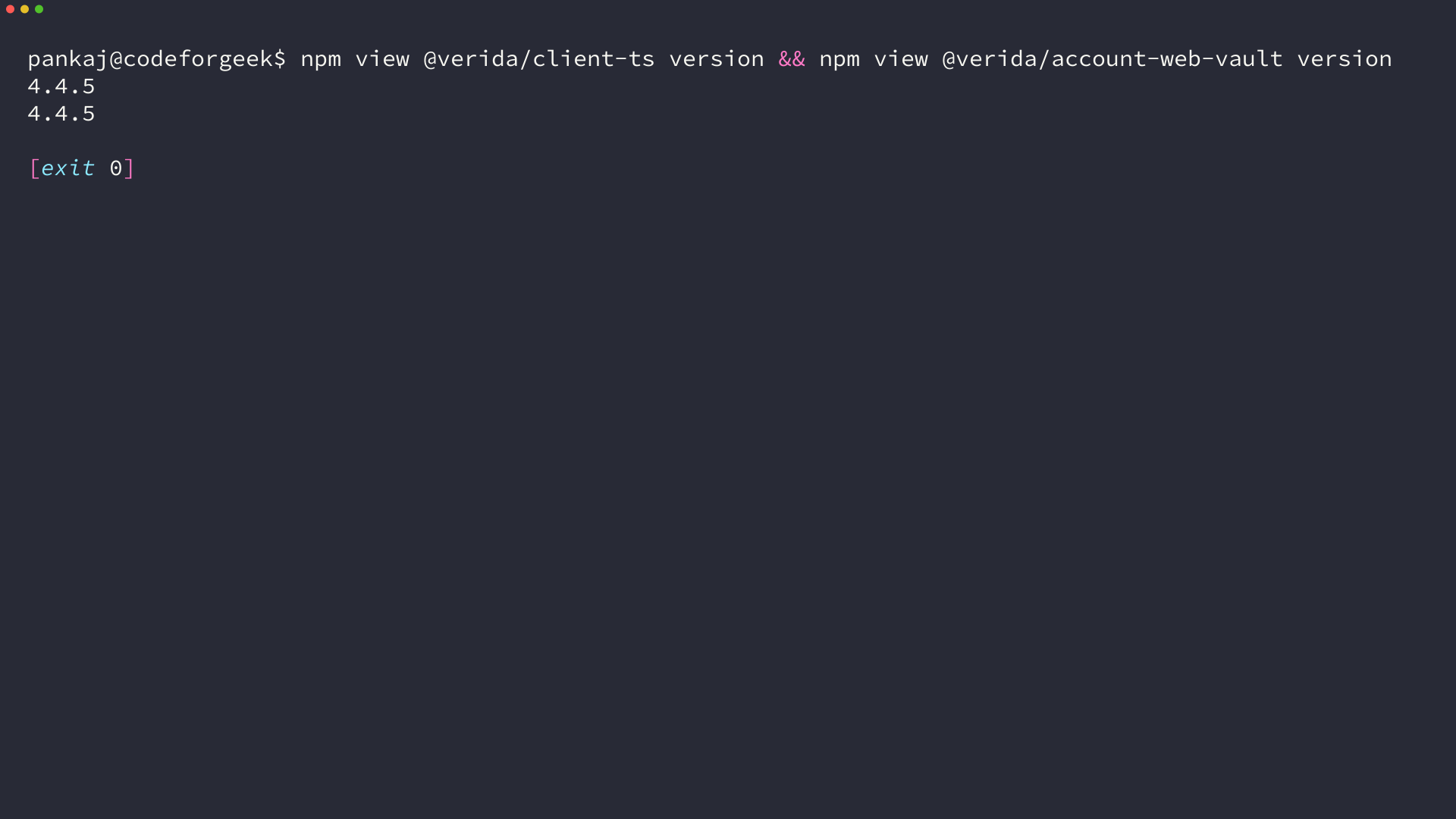
Both packages returned version 4.4.5 during my verification, which prevents the Alpha announcement’s package names from standing in for an installation receipt.
Treat a successful install as the first check
I installed the two documented packages in a clean Node.js 26 project, where installation completed but npm reported 42 dependency vulnerabilities and a direct Node-side import of account-web-vault failed when its distribution attempted to load a font file as JavaScript.
That result does not prove the browser package fails under every supported bundler, but it shows that npm installation alone cannot establish production compatibility for a browser-focused authentication package.
A safer evaluation sequence
Start with a disposable browser project on the runtime and bundler you intend to ship so each result answers one deployment question before private data enters the test.
- Read the Verida developer documentation and repository README together to connect the network flow with published packages and build assumptions.
- Install client-ts and account-web-vault without forcing an older release, then record the package tree and run npm audit against your risk policy.
- Build the browser bundle before writing application logic because asset loaders, CommonJS interoperability, and browser globals can fail after package installation succeeds.
- Test QR authorization with a disposable identity across acceptance, cancellation, session restoration, token expiry, and logout.
- Create one application context and one non-sensitive record, then confirm another context cannot read it and inspect what the storage node receives.
- Decide how your application handles lost devices, revoked access, unavailable storage nodes, and dependency updates before adding personal data.
Do not put a production seed phrase in a browser test. Delegate browser approval to the wallet and give server-side account tests a dedicated secret-handling design.
Where the Alpha label fits today
Alpha Protocol names the 2021 release that introduced the Client SDK, QR authorization, Vault, and Storage Node, not every package or service published under Verida today.
The developer-docs repository presents the Client SDK as an open-source integration for encrypted private storage, identity, messaging, and schemas while labeling some confidential-compute APIs as invite-only alpha.
Begin with the Verida start-building source and the verida-js repository, then verify package publication, browser compilation, wallet authorization, storage isolation, and dependency policy in the environment that will run your application.
Frequently asked questions
The launch terminology and the published package names answer different questions. These short distinctions keep an architecture review from becoming a history lesson.
Is Verida Alpha Protocol still the product name?
Alpha Protocol identifies the 2021 developer release. Check the status of the exact SDK or API you plan to use because Verida publishes components with different maturity labels.
Which packages support browser integration?
Verida’s getting-started source installs @verida/client-ts for protocol access and @verida/account-web-vault for QR authorization through the wallet.
Does Verida store private application data on a blockchain?
Verida uses identity and authorization components alongside storage nodes. Its storage documentation says application records are encrypted on the user side before the storage node receives them.