New to Rust? Grab our free Rust for Beginners eBook Get it free →
Strafe-jumping Acceleration for Game Development

After a game-code change, waiting for a development build can delay the next test. Incredibuild can distribute eligible Visual Studio build tasks, but that does not guarantee a faster result for every game project.
I’ll walk through setting up a test build and measuring whether Incredibuild helps your project.
TL;DR
Incredibuild can distribute eligible Visual Studio build tasks across a pool of agents, but that does not guarantee a faster result for every game project. Measure the same build before and after enabling it, and check the current supported-tools list and license package for your engine and toolchain.
- Start with a repeatable local baseline. Keep the commit, build configuration and cache state consistent when comparing runs.
- Think of the developer machine as the initiator, a coordinator as the resource manager, and other agents as helpers for eligible work.
- Use Build Monitor and elapsed build time to see whether work was actually distributed. If tasks are serial, cache-bound or too small, extra agents may not help.
What Is Build Acceleration for Game Development?
Build acceleration reduces the time between changing game code or assets and getting a usable development build. Incredibuild describes its Visual Studio integration as distributing eligible compilations and custom build steps across network resources, so this page is about development builds rather than player movement.
| Part | What it does | What to check |
|---|---|---|
| Initiator agent | Starts a build and requests resources for work it can distribute. | Does the selected Visual Studio or build-system integration support this project? |
| Coordinator | Tracks agents and allocates available helpers and licenses. | Can the initiating machine reach the intended coordinator and pool? |
| Helper agent | Runs eligible tasks assigned by the initiator, then returns generated outputs. | Are agents online, licensed and available when the build starts? |
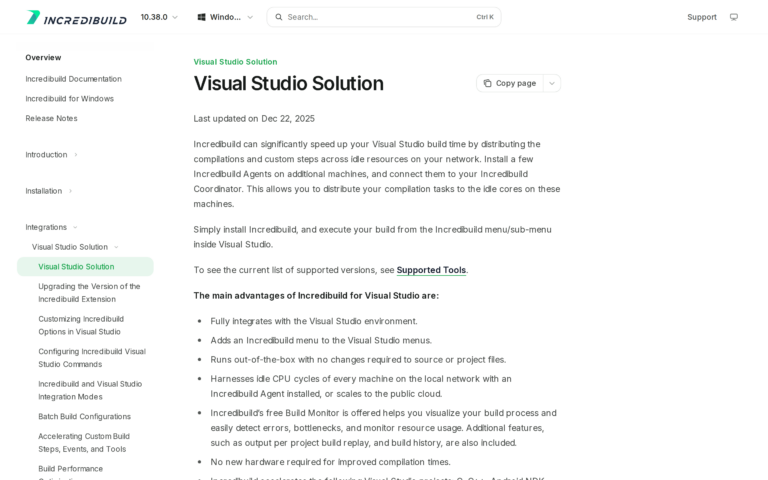
For Visual Studio compilations, Incredibuild says a helper needs its agent but not Visual Studio, the compiler, build tools or your source tree. The components and architecture guide, last updated in November 2024, explains initiators, helpers and coordinator allocation. Verify the current setup instructions before changing a production pool.
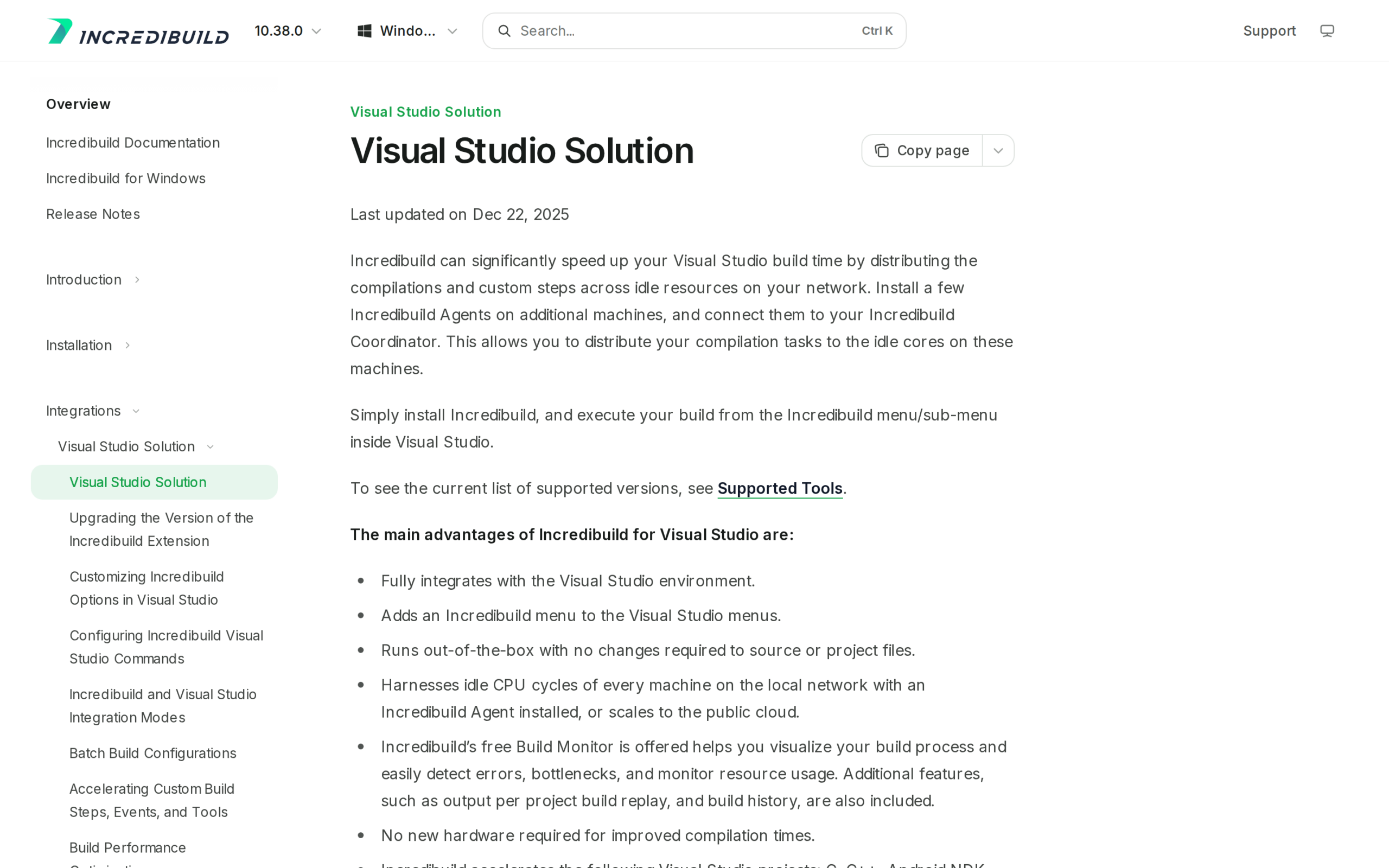
I kept the docs screenshot because its version and update date are visible. Game projects combine native compilation with engine-specific tasks.
The Supported Tools page, updated September 23, 2026, lists these relevant tool families:
| Tool family | Listed versions or examples | Package shown |
|---|---|---|
| Visual Studio and MSBuild | Visual Studio bundles 2013–2026 and MSBuild 2012–2026 | Basic Acceleration |
| Unreal Engine | 4.x and 5.x | Unreal Engine package |
| Game-console SDKs | SDKs listed under Gaming | Gaming |
Check the live table against the team’s toolchain and plan before setup.
How to Set Up and Measure Incredibuild Builds
Start with a focused test target because a smaller scope limits the setup variables. Use the build log to confirm which tasks were assigned to helpers.
Step 1: Establish a local baseline
Choose one representative solution and record its revision, configuration and elapsed time before changing the build path. A clean build starts without existing outputs, while an incremental build can reuse outputs left by earlier work.
| Run | Commit and configuration | Cache condition | Elapsed time | Distributed workers |
|---|---|---|---|---|
| Local baseline | Record the exact values | Clean or warm | Measure it | Local only |
| Distributed comparison | Use the same values | Match the baseline | Measure it | Record the observed allocation |
If the repository is large, use a dedicated test clone or the team’s normal build workspace. Keep generated files and source changes out of a shared checkout. The CodeForGeek desktop setup guide can help review the workstation and storage used for the baseline, but hardware changes should not be mixed into this comparison.
Step 2: Choose the integration mode
Use the Visual Studio integration when developers launch the solution build from Visual Studio. Use the documented command-line route when the team already builds through scripts or a CI tool.
Incredibuild currently shows this illustrative Windows command on its home page:
BuildConsole.exe MySln.sln /rebuild /cfg="Debug|Win64"I verified that this sample command appears on Incredibuild’s homepage. It is a vendor example rather than a measured result. Replace the solution and configuration with values supported by your project, then check the current command-line documentation before adding it to a build script.
Step 3: Add a helper agent
Follow the current Visual Studio setup guide to connect a helper to the intended coordinator. Confirm that the agent is visible and available before starting the comparison. The agent-only helper requirement described above applies to the documented Visual Studio compilation workflow, not automatically to every other project tool.
Before adding a personal workstation to a shared pool, review the team’s access policy. Confirm that the license covers the host and the network permits coordination traffic. Record the eligible machines and files, then confirm their agents are available.
Step 4: Compare matched builds
Repeat the same build through the distributed route with the same commit, configuration and cache condition. Inspect the build log or Build Monitor to confirm that eligible tasks reached helpers, then record elapsed time and worker allocation. Report a range when concurrent machine activity causes large swings.
| Observation | Likely interpretation | Next check |
|---|---|---|
| Tasks appear on helpers and elapsed time falls across comparable runs. | Distribution may be useful for this workload. | Repeat with another representative build before expanding the pool. |
| Tasks appear on helpers but total time is unchanged. | Parallel work may be a small share of elapsed time, or coordination and transfer costs may offset it. | Inspect the slow stages and task sizes. |
| No tasks appear on helpers. | The chosen integration, package, configuration or pool may not match the build. | Check supported tools, agent state and the build log before judging performance. |
When Does Distributed Build Acceleration Fail to Help?
Check the build timeline first because the slowest phase determines which setup question to investigate.
| What you see | Why it can happen | What to inspect |
|---|---|---|
| The build has long serial stages. | A task that must wait for earlier output cannot be split freely. | Use the build timeline to find where parallel work ends. |
| Long waits come from asset transfer or linking. | Compile distribution may not address the dominant stage. | Separate compile, asset and link durations in the build report. |
| Small incremental builds show no gain. | There may be too few eligible tasks to cover scheduling and data-transfer costs. | Compare both incremental and representative full builds. |
| Results vary between runs. | Cache state or competing work can vary. | Match the test conditions and record machine activity. |
The gaming product page also mentions shader and asset work. Check the supported-tools list and the project-specific integration before assuming those stages can use the same agent pool.
I left the gaming product-page screenshot out because a consent banner obscured part of the page. The page describes vendor-stated capabilities, which readers can evaluate with project-specific build logs. The official Doom 3 BFG source repository documents older Visual Studio and DirectX prerequisites, making it useful for legacy setup context rather than modern engine benchmarking.
Conclusion: Measure Before Adding Build Agents
Make the final decision against the project’s exact toolchain and package entitlement.
- Visual Studio Solution documentation for the current integration workflow.
- Supported Tools for version and package requirements.
- Pricing plans to confirm the team’s current entitlements.
- A CodeForGeek C++ game-strategy example for a separate look at how a game problem can be represented in code.
For broader context, Incredibuild’s game-development page describes its product coverage, while the architecture guide explains how coordinators and agents share work.
FAQ
These answers focus on the setup and measurement questions that affect a game-development build.
Does Incredibuild make every game build faster?
No. It distributes supported work, but serial stages, small incremental builds, transfer costs and unavailable helpers can limit the benefit. Compare repeatable builds and inspect whether tasks ran on helpers.
Does a Visual Studio helper need the compiler and source code?
Incredibuild’s components guide says a helper for distributed Visual Studio compilations needs the Incredibuild Agent, not Visual Studio, the compiler, build tools or the source tree. Check requirements for other integrations separately.
Which game engines and Visual Studio versions are supported?
The Supported Tools page updated September 23, 2026 lists Visual Studio bundles for 2013–2026 under Basic Acceleration and Unreal Engine 4.x/5.x under a separate Unreal Engine package. Confirm the latest table and your team’s package before setup.
How can I tell whether a build was distributed?
Check Build Monitor or the build log for helper activity, then compare elapsed time with a baseline that uses the same revision, configuration and cache condition. A shorter time alone does not show which tasks were distributed.