New to Rust? Grab our free Rust for Beginners eBook Get it free →
Best programming languages for smart contracts

The language for a smart contract comes after the chain choice. Ethereum-style networks lead you toward Solidity or Vyper, Solana programs are commonly written in Rust, Move chains use Move, and Starknet uses Cairo. I compiled the small Solidity contract below with solcjs, which confirms the sample matches a current compiler.
Choose the blockchain before the language
A smart contract runs inside a chain-specific execution environment. That environment determines the virtual machine, account model, SDKs, testing tools, and languages you can deploy. A blockchain’s block and consensus model explains why code on a shared ledger has constraints that ordinary server code does not.
Start with the network your product needs. A contract that must work with Ethereum wallets and EVM tooling belongs in the EVM family. A Solana program needs Solana’s account model and Rust tooling, even if you already know JavaScript.
The main smart contract programming languages
Each language below maps to a deployment environment. The right choice follows the chain and the team’s ability to test, review, and maintain the resulting contract.
Solidity for Ethereum and EVM chains
Solidity is the standard starting point for Ethereum and EVM-compatible chains. Its official documentation describes a statically typed language for implementing smart contracts, and the EVM ecosystem has extensive tooling for compilation, local testing, deployment, and contract interaction.
Choose Solidity when you need EVM deployment and want the broadest pool of examples, libraries, auditors, and developer tools. That reach does not reduce the need for careful access control, input validation, and tests.
Vyper for constrained EVM contracts
Vyper also targets the Ethereum Virtual Machine. Its Python-like syntax and deliberately smaller feature set appeal when you want code that is easier to inspect during review.
Choose Vyper when its constraints fit the contract you need to build and the team has a Vyper-aware test and review process. Solidity remains the practical fit when your required libraries or deployment tooling are Solidity-first.
Rust for Solana programs
Solana programs are commonly written in Rust. Anchor, a widely used framework in the Solana ecosystem, provides Rust macros and an account-validation model for writing programs.
Rust gives you compile-time ownership and type checks, while Solana’s account model still requires careful authorization and state validation. Choose it when Solana is the target chain and you can work comfortably with the chain’s program model.
Move for resource-oriented assets
Move is used by chains such as Aptos and Sui. Its resource model represents assets as values that cannot be copied or discarded by ordinary operations, which makes asset ownership part of the language model.
Choose Move when your target chain exposes Move modules and its resource semantics fit the assets you need to manage. You still need to study the chain’s object, capability, and transaction rules before deploying a module.
Cairo for Starknet
Cairo is Starknet’s contract language. It is designed around proof-oriented computation, so the execution model and tooling differ from both EVM contracts and Solana programs.
Choose Cairo when Starknet is the deployment target. Learning Solidity first can help with smart contract concepts, but it does not remove the need to learn Cairo’s types, storage model, and Starknet development tools.
Compare languages by deployment environment
The table keeps the decision tied to the place where the contract runs. It is more useful than ranking languages by familiarity alone.
| Language | Best fit | What to learn next |
|---|---|---|
| Solidity | Ethereum and EVM-compatible chains | EVM execution, Foundry or Hardhat, and contract security testing |
| Vyper | Auditable EVM contracts that fit Vyper’s design | Vyper compiler, EVM testing, and deployment tooling |
| Rust | Solana programs | Accounts, program-derived addresses, and Anchor |
| Move | Aptos and Sui modules | Resources, objects or capabilities, and chain-specific testing |
| Cairo | Starknet contracts | Starknet storage, account abstraction, and Cairo tooling |
Compile a minimal Solidity contract
A compiler check is a useful first step after selecting an EVM chain. The following contract keeps the behavior small enough to inspect. It stores a counter and exposes one function that increases it.
// SPDX-License-Identifier: MIT
pragma solidity ^0.8.0;

contract Counter {
    uint256 public count;

    function increment() external {
        count += 1;
    }
}
Save the file as src/Counter.sol, install the current Solidity compiler package, then run the command to emit the bytecode file.
npx solcjs --bin src/Counter.sol && wc -c src_Counter_sol_Counter.bin
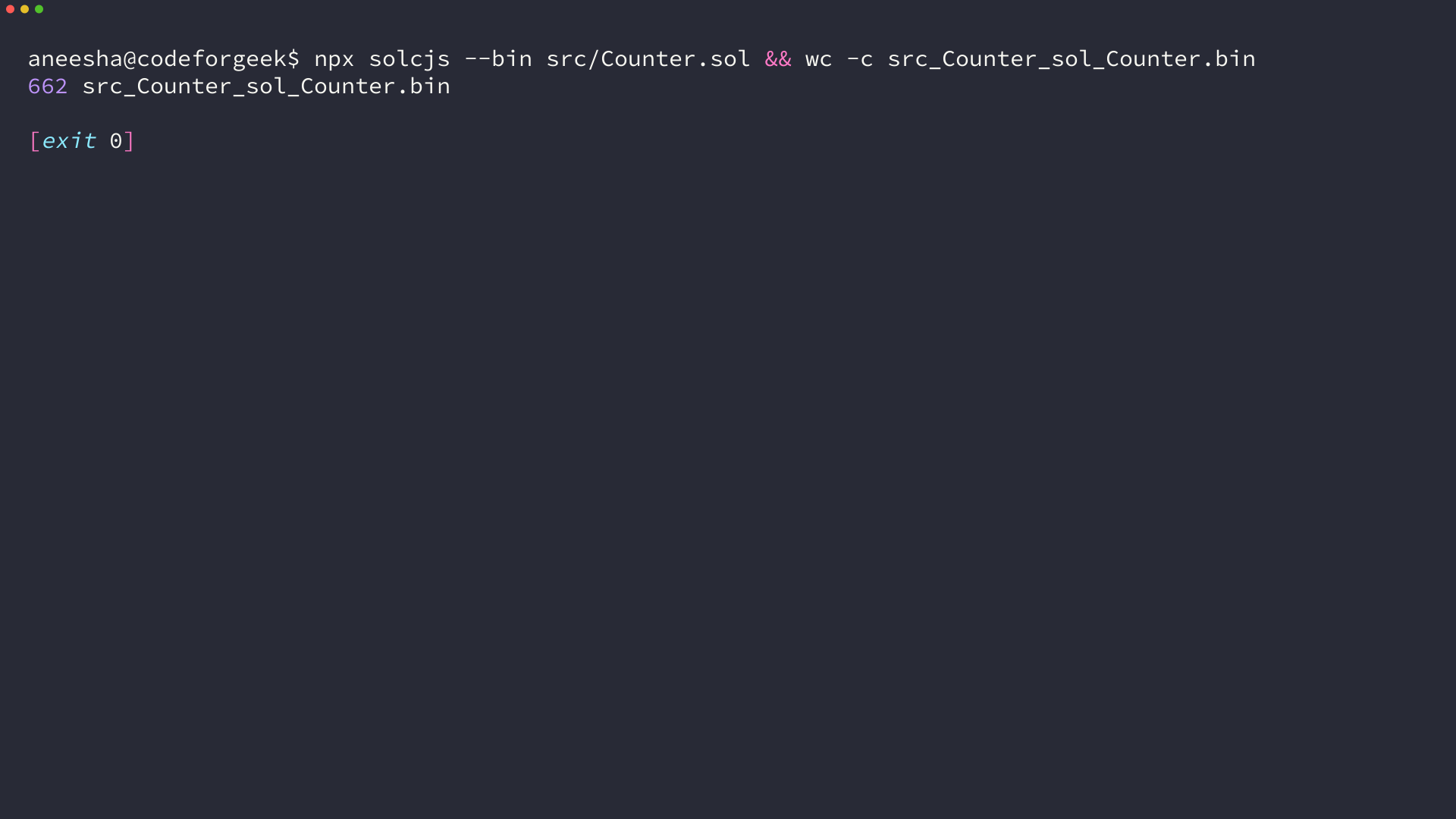
The compiler output confirms that the source is valid for the installed compiler, rather than proving the contract is safe or ready to deploy.
Language choice does not replace a security review
Smart contract code is difficult to change after deployment, so review authorization, external calls, economic assumptions, and tests before treating a successful compilation as a release signal.
Use the language that belongs to the chosen chain, then learn that ecosystem’s test framework and security guidance before building the application.
Choose the platform first
Pick Solidity or Vyper for an EVM deployment, Rust for a Solana program, Move for an Aptos or Sui module, or Cairo for Starknet, then compile the smallest official-style example before committing the application design to that stack.
Which language is best for Ethereum smart contracts?
Solidity is the usual choice for Ethereum and EVM-compatible chains because it has broad ecosystem support. Vyper is an EVM option when its constrained design fits the contract and the team’s tooling.
Can JavaScript write a smart contract?
JavaScript is commonly used to build interfaces and scripts that interact with contracts. The contract language depends on the target chain, such as Solidity for EVM chains or Rust for Solana programs.
Sources
Solidity documentation, Vyper documentation, Anchor documentation, Aptos Move Book, and The Cairo Book document the language and platform boundaries described here.