New to Rust? Grab our free Rust for Beginners eBook Get it free →
Chatbots: What They Are, How They Work, and Limits

When you send a question to software, it helps to know how the reply is produced and whether a person can take over. A chatbot lets you send software a text or voice message and get a reply.
I’ll explain how a chatbot handles a message and when to check its answer or ask for a person.
TL;DR: What a chatbot does
A chatbot receives a text or voice request and returns a reply. It can also complete a task or route a request to a person.
- Rule-based bots follow preset routes.
- AI bots handle varied wording but can be wrong.
- Keep a human fallback for unresolved requests.
What is a chatbot?
A chatbot is the text or voice interface through which a person exchanges messages with software. The term describes the interface, not one algorithm.
Conversational AI uses language technology to interpret intent or generate text. A large language model (LLM) generates replies, while retrieval searches a connected source.
| Design | Response method | Useful for |
|---|---|---|
| Rule-based | Fixed menus and replies | Repeated choices |
| Intent-based | Maps a request to a task and needed fields | Appointments or account tasks |
| Generative AI | Model writes text from input and context | Open questions |
| Hybrid | Combines rules with AI or a human handoff | Mixed tasks |
How a chatbot handles a message step by step
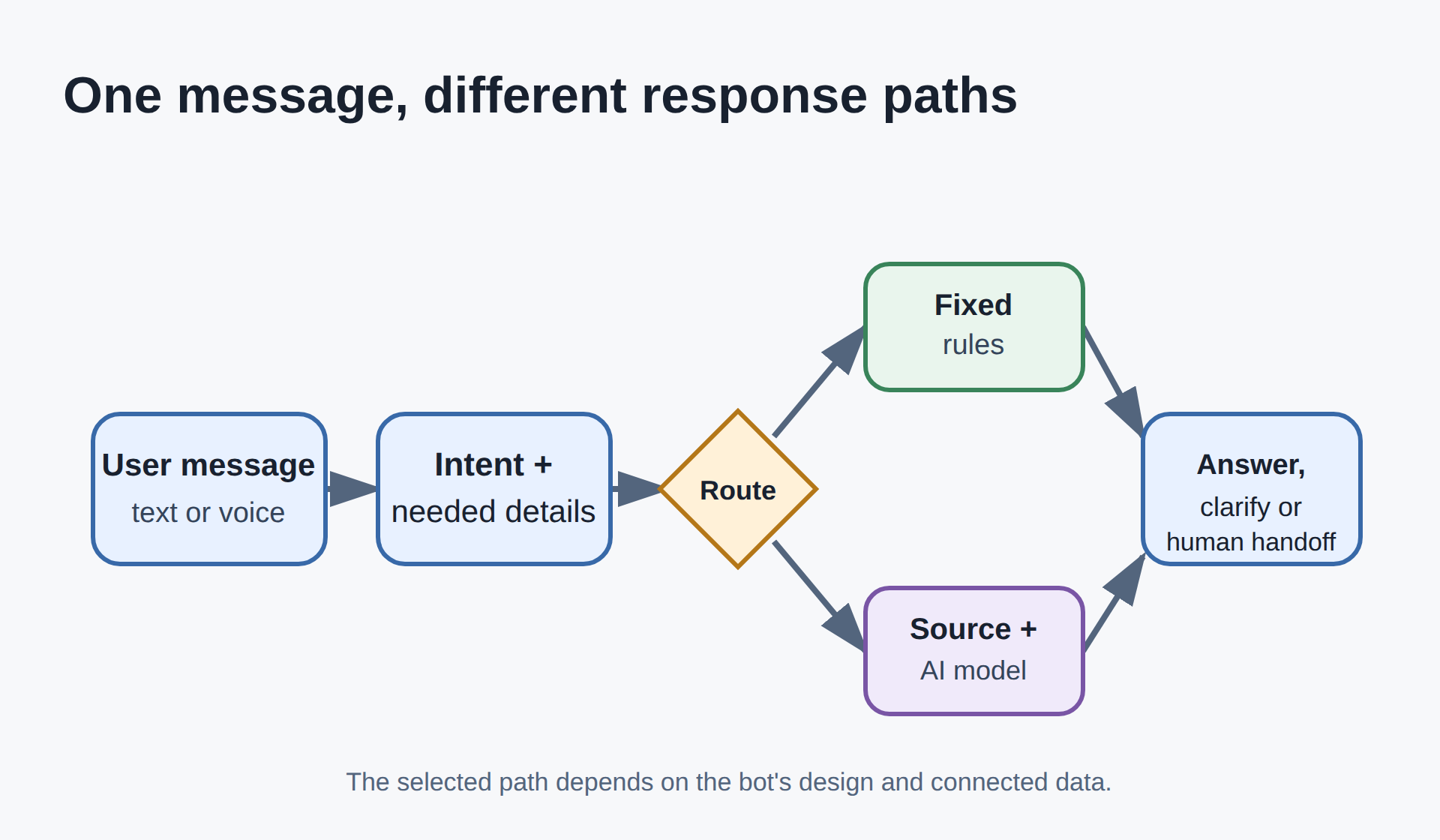
The request moves through a path set by the bot’s design and access.
Step 1: Receive the text or voice request
The interface sends text or a speech transcript to the chatbot. A voice system may convert speech to text first.
Step 2: Identify the task and missing details
An intent is the task a person wants to complete, such as booking an appointment. A slot or entity is a needed value, such as a date.
The bot can ask for a missing value. Rules match a menu choice, while AI can map varied wording to a task. Neither guarantees the request was understood.
Step 3: Use conversation context and a source
Context retains useful details from the exchange, such as a supplied date. A bot may search a knowledge base for an answer. Retrieval-augmented generation (RAG) gives retrieved material to a language model as it drafts a reply.
Step 4: Reply, clarify, or hand off
The bot returns a fixed reply or generated text. It can ask for a missing detail.
A task bot may call a connected service. A fallback can clarify or route an unresolved request to a person.
Limits, privacy, and when to ask for a person
A bot can misread unusual wording or lack the account data a request needs. It can also return an answer that sounds certain but is wrong.
A Reddit user described a default reply as “I’ve no idea what you want, but how can I help you?” Another said, “Chatbots just send you to a page you’ve already read and doesn’t answer your question.”
These comments are examples, not a measure of all users. When a reply misses the request, try a shorter question, then ask for a person if the bot loops.
For high-stakes answers, check the cited source. Do not share sensitive data without checking the service’s policy. OpenAI recommends human review for high-stakes outputs.
- Fixed bot: use its fallback route.
- AI bot: ask for the source behind a factual claim.
- Account issue: stop sharing details and request human review.
Conclusion: match the chatbot to the task
A chatbot is the conversation surface, not a guarantee about its engine. Match the response method to the task and keep a way to check answers or reach a person.
| If the task is… | Check for… |
|---|---|
| A repeated request with known choices | A clear rule or menu path |
| A question about a changing fact | A named source and a human fallback |
For a task-oriented example, read Amazon Lex V2 core concepts. For retrieval-augmented generation, see Google Cloud’s chatbot overview.
Chatbot FAQs
These answers separate the chatbot interface from the system that produces a reply.
Are all chatbots powered by AI?
No. Some use fixed menus or rules. AI chatbots use language models or other language systems.
How does a chatbot work?
It receives a message and identifies the task. It then uses a rule or connected information to reply. Some systems retain context or hand off to a person.
When should a chatbot hand off to a person?
A handoff helps when the bot cannot identify the request or lacks needed access. Ask for a person when the issue needs judgment or the bot repeats an unhelpful answer.