New to Rust? Grab our free Rust for Beginners eBook Get it free →
Blockchain in Supply Chain: How Traceability Records Work

Blockchain in supply chain management gives partners a shared history for shipment events such as receipt, inspection, and handoff when several organizations need to verify the same record, though it cannot prove that the original event data was correct.
What blockchain adds to supply-chain traceability
Supply-chain records often sit in enterprise resource planning systems, warehouse tools, transport platforms, and supplier portals, yet an importer, carrier, warehouse, and retailer may still lack a shared shipment history.
A blockchain ledger gives approved participants a shared sequence of records that identifies a shipment, states what happened, names the event source, includes a timestamp, and points to evidence such as a bill of lading or inspection document.
Deloitte, IBM, Oracle, Harvard Business Review, and SEKO Logistics frame blockchain supply chains around traceability, transparency, and coordination among organizations instead of a replacement for every supply-chain system.
How a shared traceability record works
The ledger is useful only after each participant agrees on what an event means, who may add it, and which shared schema a shipment record must use.
Record an event, not a claim
Store a concrete event such as received at port, temperature check completed, or customs document attached. Include the shipment identifier, time, location, organization, and an evidence reference that another participant can inspect.
Keep large files and sensitive commercial data outside the ledger when access, retention, or cost makes that appropriate. The record can retain a reference and a cryptographic digest for the external document.
Link records with hashes
A hash converts a fixed input into a digest, and including the preceding event’s digest in each new event makes an unexpected edit detectable during verification.
That property protects record consistency. It does not establish that a warehouse employee entered the correct location or that a sensor reading was trustworthy at collection time.
Decide who can write and read
Most business workflows need a permissioned network, where approved organizations have defined identities and roles. Hyperledger Fabric documents this model as a shared ledger with policies that govern how participants transact and update the ledger.
Write permissions, endorsement rules, dispute handling, and access to commercial data are business decisions. Choose them before building an integration.
Run a small traceability example
This Node.js example creates a received event and an inspected event for one shipment. It hashes a fixed set of fields, links the second event to the first, then verifies both the hashes and the link.
const crypto = require('node:crypto');

function canonicalEvent(event) {
  return JSON.stringify({
    previousHash: event.previousHash,
    eventType: event.eventType,
    shipmentId: event.shipmentId,
    location: event.location,
    recordedAt: event.recordedAt,
    evidence: event.evidence,
  });
}

function hashEvent(event) {
  return crypto.createHash('sha256').update(canonicalEvent(event)).digest('hex');
}

const received = {
  previousHash: 'GENESIS',
  eventType: 'received',
  shipmentId: 'SHIP-204',
  location: 'Port of Rotterdam',
  recordedAt: '2026-08-15T10:00:00Z',
  evidence: 'bill-of-lading:BL-983',
};
received.hash = hashEvent(received);

const inspected = {
  previousHash: received.hash,
  eventType: 'inspected',
  shipmentId: 'SHIP-204',
  location: 'Rotterdam warehouse',
  recordedAt: '2026-08-15T12:00:00Z',
  evidence: 'inspection:IN-551',
};
inspected.hash = hashEvent(inspected);

const chain = [received, inspected];
const valid = chain.every((event, index) =>
  hashEvent(event) === event.hash &&
  (index === 0 || event.previousHash === chain[index - 1].hash)
);

for (const event of chain) {
  console.log(`${event.eventType}: ${event.hash.slice(0, 16)}…`);
}
console.log(`Chain verifies: ${valid}`);
Save the file as traceability-chain.js, then run the following command from that directory. The output should show two event digests and Chain verifies: true.
node traceability-chain.js
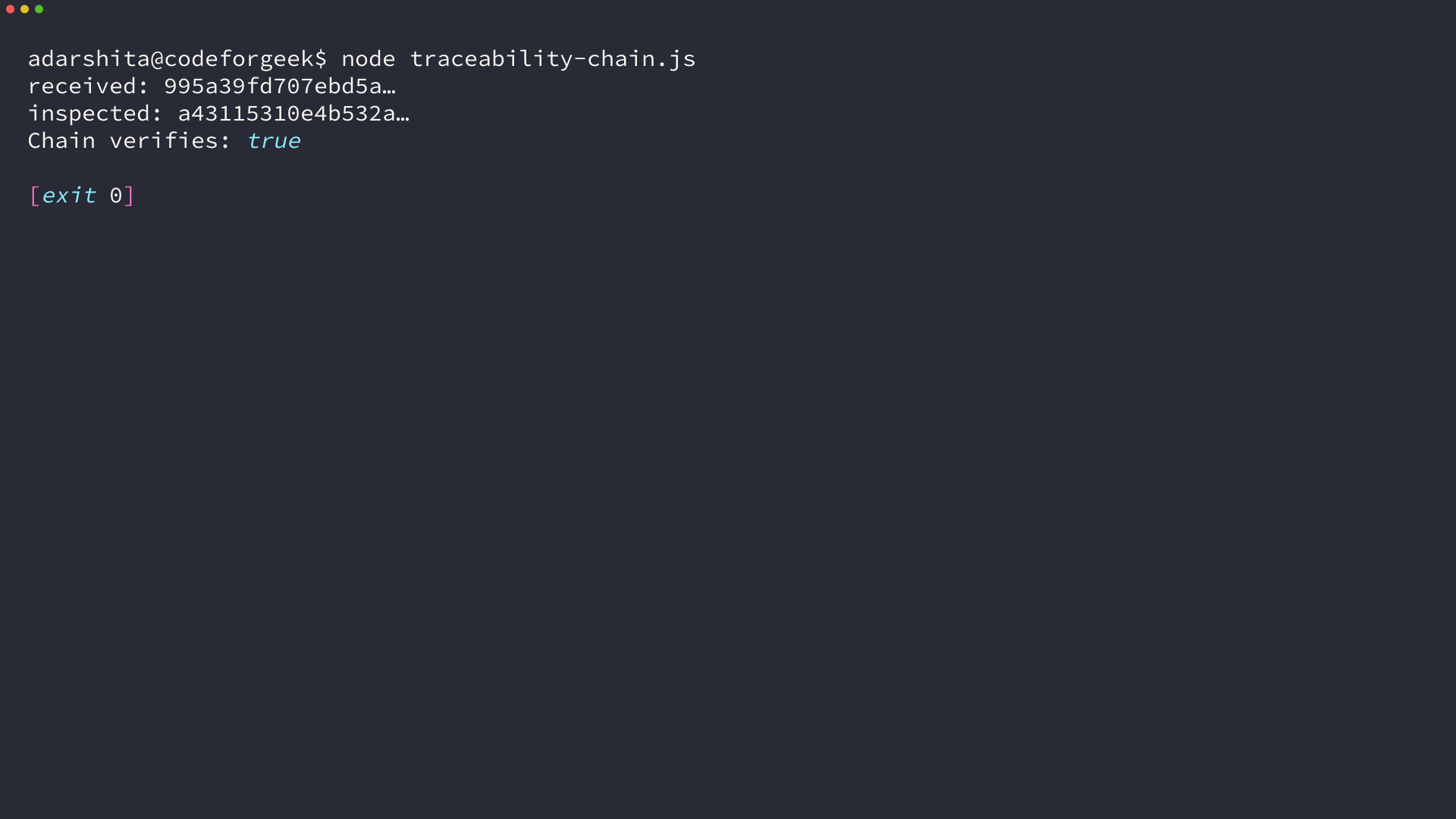
The example checks the ledger structure only. A production workflow also needs authenticated identities, data validation at the integration boundary, error handling, and a policy for corrections.
Where blockchain helps in a supply chain
Use a shared ledger when the same shipment history must cross organizational boundaries and each participant needs an auditable view. Product provenance, food recall support, regulated documentation, and multi-party handoffs are common candidates.
- Trace a product from a supplier event to a retailer handoff.
- Compare a shared document reference without exposing the full document to every participant.
- Give an auditor a history of approved events and their supporting evidence.
IBM and Oracle describe supply-chain blockchain around shared records and partner visibility, and Harvard Business Review notes that transparency depends on the information participants agree to share and verify.
Limits you must plan for
If an organization enters a false origin, a ledger can preserve that entry and show who submitted it, yet an audit, certification process, sensor control, or inspection must establish the fact itself.
Commercial terms, customer details, and supplier pricing may need separate storage with role-based access, with the ledger retaining a reference or digest that participants can check later.
Participants need a correction process that appends an event superseding an incorrect business record and records the reason for the change.
Choose the architecture before you build
Start with one handoff that creates costly disputes or slow verification, then map the event, evidence, writer, verifier, and access rule before selecting a blockchain platform.
A central database may fit when one organization owns the workflow and other parties only need reports.
A permissioned ledger fits a workflow where independent participants need governed writes and a shared history.
FAQ
These questions separate a shared record from the operational controls that establish trustworthy supply-chain evidence.
Is blockchain useful for every supply chain?
Use it when independent participants need to write or verify a shared history, and use a database when one company owns the data and approval process.
Does blockchain prove that a product is authentic?
It can preserve and link provenance records, and authenticity still depends on trustworthy source evidence, participant identity, and an inspection process.
What data should stay outside the ledger?
Keep large documents, sensitive customer information, and confidential commercial terms in systems with appropriate access controls, storing a reference and digest on the ledger when participants must verify an external document.
Read NISTIR 8202, Blockchain Technology Overview and the Hyperledger Fabric ledger documentation, then use the traceability script to define one event before expanding the workflow.