New to Rust? Grab our free Rust for Beginners eBook Get it free →
Blockchain in the Automotive Industry: Use Cases and Limits

Blockchain in the automotive industry is useful when several organizations need to verify the same vehicle or component event without giving one participant unilateral control of the record, I ran the hash example below with Node.js 24.18.0 to show the kind of tamper-evidence a shared record can carry.
Where blockchain fits in automotive systems
A blockchain is an append-only ledger replicated among approved participants, Each new entry is linked to prior data through cryptographic hashes, so an altered record becomes detectable when participants verify the chain.
That property does not make a sensor reading, workshop claim, or supplier certificate correct, It makes the submitted record harder to alter without leaving evidence, which matters when the parties need an auditable history.
Use a permissioned network for business records
Automotive participants usually need known identities, access rules, and confidentiality controls, A permissioned network can limit who writes, reads, validates, or audits a record while still sharing a common history.
Useful automotive blockchain applications
The strongest applications begin with a cross-company record that is expensive to reconcile or easy to dispute, A blockchain is not a replacement for the operational database that runs a factory, dealer system, or vehicle.
Component provenance and recalls
A supplier can attach a batch identifier, certificate, and handoff event to a component record, If a defect investigation identifies a batch, the shared history can help trace which vehicles received it and which organization supplied each handoff.
Vehicle compliance records
Compliance evidence often crosses engineering, suppliers, manufacturing, and regulators, IBM documents Renault Group’s XCEED platform as an industry-wide blockchain-based platform for certifying vehicle-component compliance, which is a concrete example of a shared audit trail rather than a consumer cryptocurrency use case.
Maintenance and resale history
A vehicle identity can link authorized service events, ownership transfers, and mileage attestations, The Mobility Open Blockchain Initiative describes maintenance traceability as a vehicle-identity use case, but the system still needs rules for who can submit an event and how a buyer resolves a bad submission.
Payments and mobility services
Charging, tolling, parking, insurance, and fleet services can involve several providers, A shared ledger can record settlement events, but payment authorization, fraud controls, privacy obligations, and consumer support remain separate system responsibilities.
A small tamper-evidence example
This Node.js example hashes a service event, Store the event and its digest separately, then recompute the digest when an authorized participant needs to verify that the submitted fields match the recorded event.
const { createHash } = require('crypto');

const record = {
  vin: '1HGBH41JXMN109186',
  event: 'service',
  odometerKm: 48210,
  at: '2026-08-09T10:00:00Z'
};

const digest = createHash('sha256')
  .update(JSON.stringify(record))
  .digest('hex');

console.log({ ...record, digest });
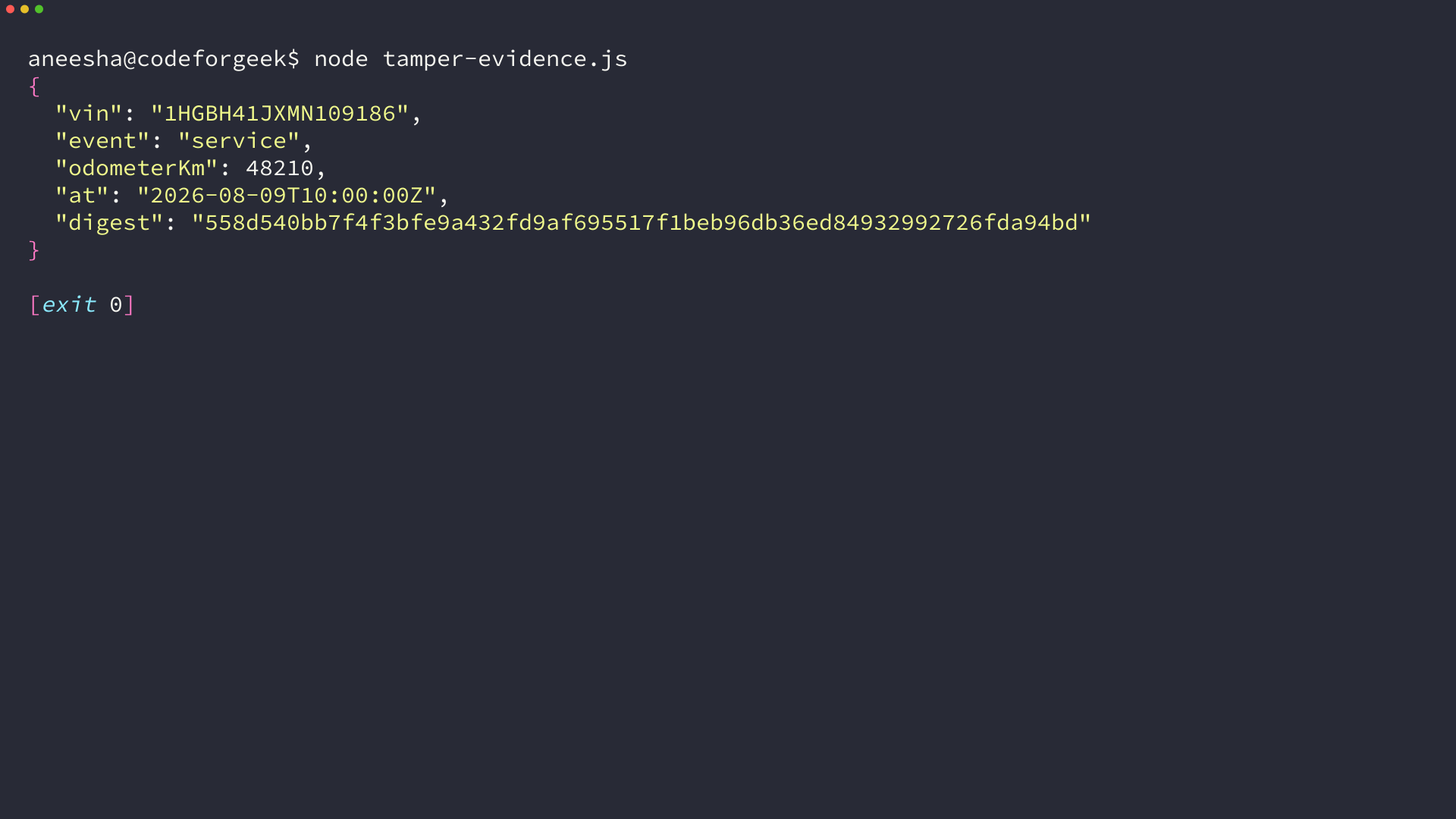
The command printed a SHA-256 digest beginning with 558d540bb7f4, Changing the odometer value changes the digest, so a verifier can detect that the supplied data differs from the record that was hashed.
What blockchain does not solve
Blockchain cannot prove that data was truthful before it entered the ledger, Use device attestation, signed identities, validation workflows, and audit rights to reduce bad inputs, then decide how the business corrects an accepted record.
Do not place personal data or sensitive vehicle telemetry on a broadly shared ledger, Keep sensitive data off-chain, retain only a reference or digest when that supports verification, and define retention and access policies before deployment.
Choose blockchain only when the trust boundary needs it
Start with the disputed record, the organizations that need to verify it, and the consequences of a changed record, If one organization already owns the workflow and its database meets the audit requirement, a conventional system is usually simpler.
When multiple independent participants need a shared, auditable history, define the vehicle or component identity, write permissions, validation rules, privacy boundary, and correction process before choosing a ledger platform.
Sources
IBM case study: Renault and vehicle component compliance
Mobility Open Blockchain Initiative: Vehicle Identity use cases