New to Rust? Grab our free Rust for Beginners eBook Get it free →
Online XML Minify: How to Use It Safely


XML Minify
Readable XML can be made more compact before you use it in a build or application. An online XML minifier removes selected layout characters from the document text to create a compact copy.
I'll show you how to use the page and check whether its output changes text your application relies on.
TL;DR
Paste a readable XML document into the page's input, choose Minify XML, then inspect and copy the result. Keep the original because this tool uses text substitutions, not an XML parser, and removing whitespace can affect mixed-content documents.
- Minification removes selected formatting characters from the XML text. It is different from gzip compression.
- Check the result with an XML parser before using it in a build, feed, or application.
- Use a local tool for credentials or confidential XML.
What is XML minification?
XML minification makes a document's written form more compact by removing selected layout characters.
XML remains common for structured data exchanged between systems, including in sitemaps and configuration files. Tags express a hierarchy, while text nodes carry values. An XML-aware editor can provide syntax highlighting as you create a document.
Minification rewrites the document text. gzip or Brotli encodes a file or response for transfer, often through a server or build pipeline. These techniques can be combined.
A formatter lays out nested tags for reading. Parsing checks XML syntax, while schema validation checks a document against the rules for its data.
| Task | What it changes or checks | When to choose it |
|---|---|---|
| Minify | Removes some layout characters from the written document. | When a compact text form is useful. |
| Compress | Encodes the file or response for transfer. | When reducing bytes sent over a connection. |
| Format | Adds indentation and line breaks for people. | When reading or reviewing nested elements. |
| Parse or validate | Checks XML syntax or conformance to a schema. | When checking whether software can accept the document. |
How to minify XML online
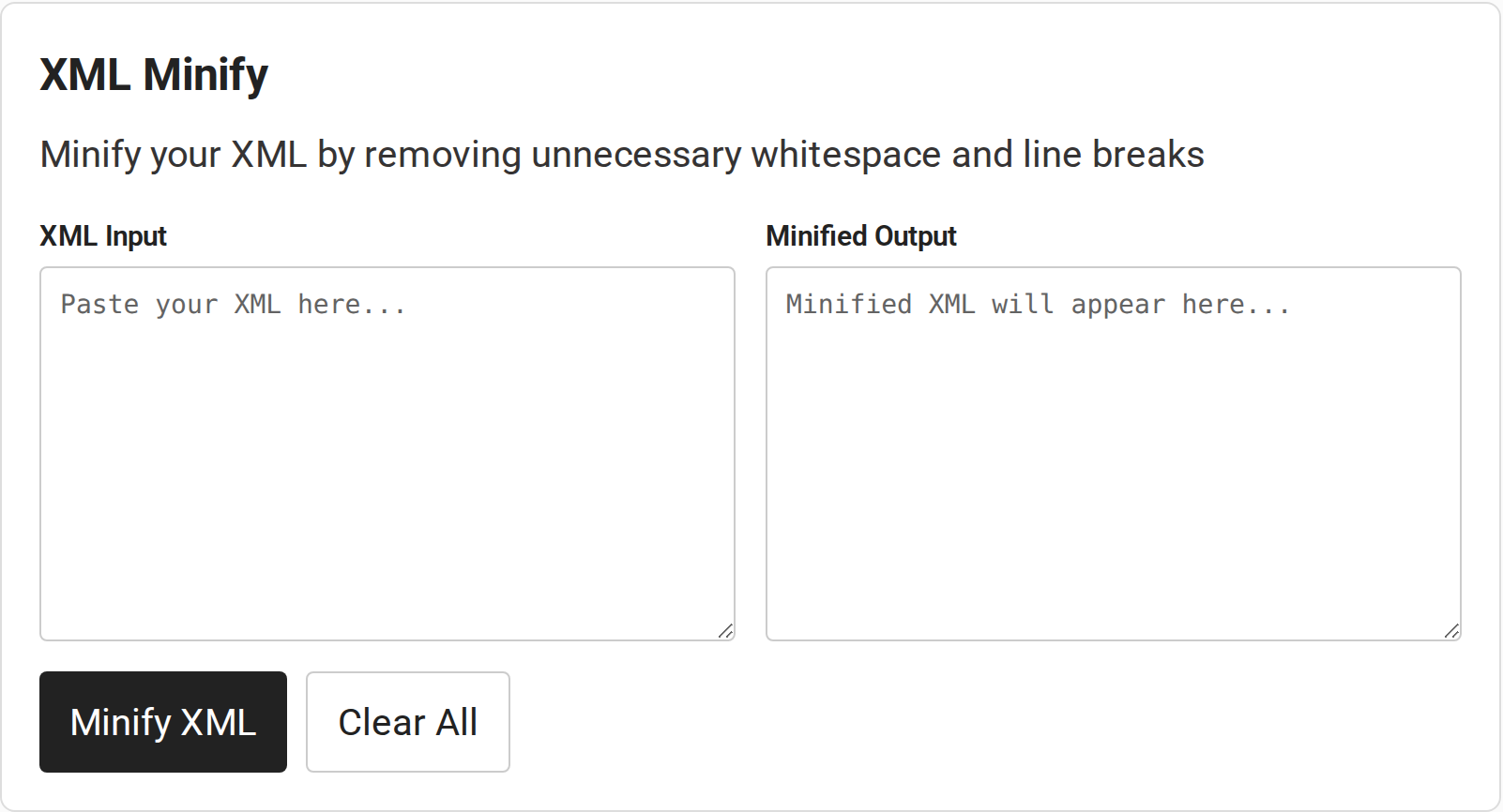
I checked the live page controls: XML Input, Minified Output, Minify XML and Clear All.
Step 1: Keep a copy and inspect the input
Save the original document separately before changing it. Identify which application will read the output and note any required text values or rendering behavior to check later.
Do not paste credentials or confidential configuration into a web tool. The page's code runs the minifying function in the browser.
Choose a small, non-sensitive sample first if you have not used the page before. That lets you see how its output behaves with your kind of XML before processing a full document.
Step 2: Paste XML and run the minifier
Paste the document into XML Input and select Minify XML. The transformed text appears in Minified Output. Clear All resets both text areas.
The page applies replacements around tag boundaries. It removes carriage returns and line feeds throughout the input, then trims the result. Check whether those changes alter text your application uses.
Step 3: Review and copy the result
Compare the output's important text with the source, especially around inline child elements. Then parse it with your project's XML parser or consuming application.
Before replacing an application asset, test the result in staging.
Compare the original and minified file sizes in a file manager to see whether the result saved bytes.
XML minification edge cases
The table covers cases where this tool's fixed behavior needs more control.
| Situation | Why it matters | Safer next step |
|---|---|---|
| Mixed content or meaningful spaces | Whitespace between text and nested elements can be part of the value. An xml:space="preserve" attribute signals that an application should retain whitespace. | Test against the consuming application and compare the parsed text. |
| Malformed input | The tool changes text without checking XML structure first. | Fix the parser error in the original before minifying. |
| Confidential content | A browser tool is not the right place for data restricted to a private environment. | Use a local formatter or build step approved for that data. |
| Need to remove comments or enforce a schema | Those are separate transformations or validation tasks. | Choose a tool with explicit, documented options and verify its output. |
| SVG or another rendered XML format | Rendered appearance depends on the markup and viewer, not only on compactness. | Open the output in its target viewer and compare key labels or graphics. |
A local command-line or build tool suits large files and batch work. This page suits a quick document you can inspect before use.
Comments are part of the markup. If removing them is a requirement, select a tool whose documentation explicitly describes comment removal, then check the output for that change.
Conclusion
Use this tool for a quick compact copy, then check the output against its intended use. For format conversion, try CodeForGeek's XML to JSON converter. The online developer tools page lists other utilities.
FAQ
These answers focus on what the page does and what to check before using the compact result.
Does minifying XML validate it?
No. The CodeForGeek minifier changes the input text with regular-expression replacements and does not validate XML well-formedness. Parse the result separately.
Can removing whitespace change XML text?
It can. Whitespace between text and child elements may be meaningful in mixed content, so compare the output and test it with the consuming application.
Is minification the same as gzip compression?
No. Minification rewrites the XML text. gzip compresses the data for transfer or storage without serving as an XML-aware validation step.
Should I paste private XML into an online minifier?
Do not paste credentials or confidential data into an online page. Use an approved local workflow when the data must remain in a controlled environment.