New to Rust? Grab our free Rust for Beginners eBook Get it free →
Blockchain-Based Loyalty Programs: How They Work

A blockchain-based loyalty program records reward events in a shared ledger and applies earning or redemption rules through an application or smart contract. It can help when several partners need the same balance history, but it does not remove the need for consent, fraud controls, or customer support.
What a blockchain-based loyalty program changes
A conventional loyalty system usually keeps member accounts, points, transaction history, and redemption rules in one operator’s database. A blockchain design gives approved participants a shared transaction history, so each participant can verify the same issued, redeemed, or reversed reward event.
The design is most useful when a program spans merchants, a marketplace, or a network of partners that need agreed rules and an auditable balance. It adds operational work when one company already owns the data and can reconcile rewards inside its existing system.
How the reward flow works
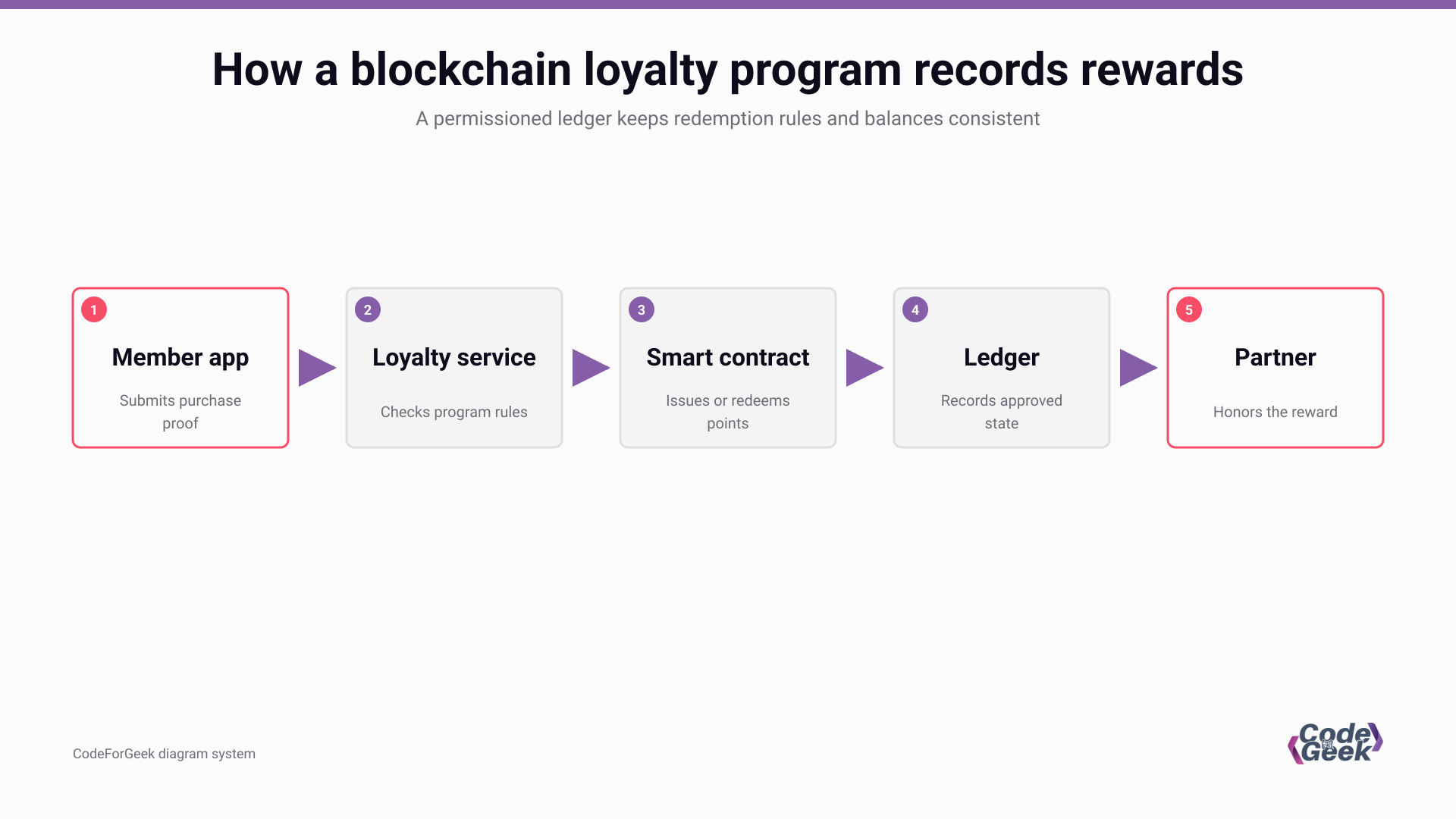
The ledger should record a business event after the loyalty service has checked the purchase, member, and program rules. Hyperledger Fabric describes a ledger that combines state data with an immutable transaction log, while an external application invokes the smart contract that changes that ledger state.
Keep customer data and point state separate
A reward event needs an identifier, a program rule, and enough information to resolve the member’s balance. Names, email addresses, receipts, and consent records often belong in a protected application database rather than in ledger data that several organizations can access.
The application can store a reference or a cryptographic digest on the ledger and keep the underlying personal data under the retention and deletion controls your program requires. That separation makes the shared record useful without turning it into a customer profile store.
Define issuance and redemption rules
The rule layer should decide whether an event earns points, what balance changes, who can redeem, and how a reversal is represented. IBM’s customer-loyalty example uses a Hyperledger Fabric smart contract to manage loyalty assets, which is a practical shape for rules that more than one approved organization must enforce.
Do not erase a mistaken reward record. Add a compensating transaction that identifies the original event, then let the balance calculation apply both entries. Your support team can explain the correction because the event history remains available for review.
What blockchain can improve
Shared ownership is the main reason to consider this architecture because a partner can confirm a redemption against the same state that issued the points, reducing reconciliation work when each participant would otherwise maintain a separate balance.
Smart-contract rules can make issuance and redemption behavior consistent across approved applications, while an audit trail makes disputes easier to investigate when the system records the actor, event reference, authorization result, and reversal path that support staff need.
Boundaries before you build
A ledger is a data-sharing and coordination choice rather than a loyalty strategy, so the program still needs useful rewards, clear expiration rules, partner settlement terms, and a support path for missing points or disputed purchases.
Privacy and deletion requirements
Immutable transaction history conflicts with any plan to write personal data directly to the ledger and delete it later. Keep personally identifiable data off-ledger, limit access to the members that need it, and decide how a member’s account is closed without invalidating the financial or audit record.
Partners, fees, and operations
Every partner needs an agreement on who funds the reward, who accepts it, how disputes are resolved, and who can update the rule set. A public chain can add transaction fees and wallet friction, while a permissioned network adds membership, governance, and operational responsibilities.
A centralized database remains a sound choice when one operator controls the program and partners do not need independent verification. The blockchain case becomes stronger when shared governance changes the operating model.
A practical design checklist
Start with one issuance event and one redemption event. Write the rule for each event, name the organization allowed to submit it, choose the data that stays off-ledger, and specify the compensating event that corrects an error.
- Define the reward asset, balance calculation, expiration rule, and reversal rule.
- Separate customer identity and receipts from the shared transaction state.
- Document partner permissions, settlement ownership, support escalation, and rule-change approval.
Use that small model to test whether a shared ledger solves a coordination problem your existing loyalty platform cannot. If the answer is no, keep the program in the system that already handles its data and support workload.
Frequently asked questions
These answers separate the ledger decision from the loyalty program decisions that still belong to the operator and its partners.
What is a blockchain-based loyalty program?
It records earning, redemption, and reversal events in a shared ledger. A loyalty application or smart contract applies the rules that change a member’s points balance.
Does a blockchain loyalty program need to store customer data on-chain?
No. Keep personal data and receipts in a protected application database when retention, deletion, or access rules require it. The shared ledger can store the event state or a reference needed to verify that event.
Before selecting a platform, trace one reward from purchase proof to redemption and ask which participant must verify each state change. That answer defines the system boundary more clearly than a token label does.